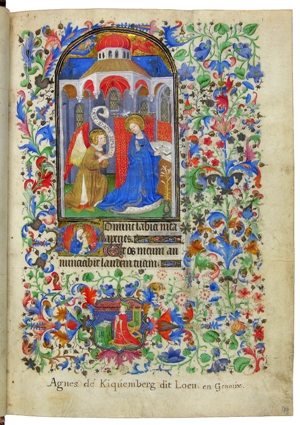
 |
Agnès de Kiqeumberg's Matins, c1425
|
O Lord, my lips You shall open, and my mouth shall tell of Your praise: Your praise, because I have been created: Your praise, because sinning I have not been forsaken: Your praise, because I have been admonished to confess: Your praise, because in order that I might be secured I have been cleansed...
Not even we have been left without a Sacrifice to offer to God.
For hear what he says, having a concern for his sin, and wishing the evil thing which he has done to be forgiven him: If You had willed, he says, sacrifice, I would have given it surely. With holocausts You will not be delighted. Nothing shall we therefore offer? So shall we come to God? And whence shall we propitiate Him? Offer; certainly in yourself you have what you may offer. Do not from without fetch frankincense, but say, In me are, O God, Your vows, which I will render of praise to You.
St Augustine on Psalm 50
The first words a monk says each day...
In a monastery, the 'great silence' traditionally begins after Compline.
It ends, at least as St Benedict prescribed it, with the first words of Matins, which is this verse from Psalm 50:
It ends, at least as St Benedict prescribed it, with the first words of Matins, which is this verse from Psalm 50:
16 Dómine, lábia mea apéries: * et os meum annuntiábit laudem tuam.
|
O Lord, you will open my lips: and my mouth shall declare your praise.
|
St Benedict instructs that it be said three times, as the monk or nun makes the sign of the cross over their lips, thus invoking the symbolism of the Trinity, that asks God to cleanse us from our sins, and make us worthy to praise him.
The sacrifice of praise and the sacrifice of justice
This verse of Psalm 50 seems to me to encapsulate the key purpose of the Divine Office, and indeed our existence - the offering of praise to God through our worship and deeds.
It points to a twofold, and interrelated, mission in my view: firstly to praise and worship God; and secondly to work to advance his kingdom in the world.
The task of praise is perhaps best explained by Pope Benedict XVI:
...in a monastery of Benedictine spirit, the praise of God, which the monks sing as a solemn choral prayer, always has priority...In the life of monks, however, prayer takes on a particular importance: it is the heart of their calling. Their vocation is to be men of prayer. In the patristic period the monastic life was likened to the life of the angels. It was considered the essential mark of the angels that they are worshippers. Their very life is worship. This should hold true also for monks.
Monks pray first and foremost not for any specific intention, but simply because God is worthy of being praised. “Confitemini Domino, quoniam bonus! – Praise the Lord, for he is good, for his mercy is eternal!”: so we are urged by a number of Psalms (e.g. Ps 106:1). Such prayer for its own sake, intended as pure divine service, is rightly called officium. It is “service” par excellence, the “sacred service” of monks. It is offered to the triune God who, above all else, is worthy “to receive glory, honour and power” (Rev 4:11), because he wondrously created the world and even more wondrously renewed it. (Visit to Heiligenkreuz Abbey)But that work of renewing the world is something we are co-workers in. The work of advancing Christ's kingdom is symbolically the rebuilding of the walls of Jerusalem, and constantly turning us to that time when God will once again accept 'the sacrifice of justice', something mentioned also in Psalm 4 at Compline.
What is the sacrifice of justice? It is surely Christ's sacrifice on the cross, to which we are invited to join ourselves, to take up our own cross, as we offer our small sacrifices such as the Divine Office. And why do we offer it? Both for our own sins and those of the world; above all to rebuild the desolated walls of holy Mother Church. St Bede, for example, commented that:
For the fiftieth psalm - in which the prophet prays specifically for the construction of this city, saying Deal favourably, Oh Lord, in your good will with Zion, that the walls of Jerusalem may be built up - is one of repentance and forgiveness.
On the fiftieth day of the Lord's resurrection, the Holy Spirit; through which not only the desire to repent is poured into us but also the gift of pardon is conferred on those who repent, came to the primitive Church.
Now there are two precepts concerning charity, namely love of God and of neighbour, in which, once pardon for sins has been granted to us by the Holy Spirit, we are commanded to endeavour to attain eternal life.
It is therefore most appropriate that, when rebuilding the wall of the holy city that has been destroyed by the enemies, its citizens restore it in fifty-two days, because this, undoubtedly, is the perfection of the righteous in this life - namely that they should not only, by repenting through the grace of divine inspiration, set aright whatever sins they have committed, but afterwards adorn themselves with good works in love of God and neighbour. (On Ezra and Nehemiah, trans DeGregorio, pg 189)

