 |
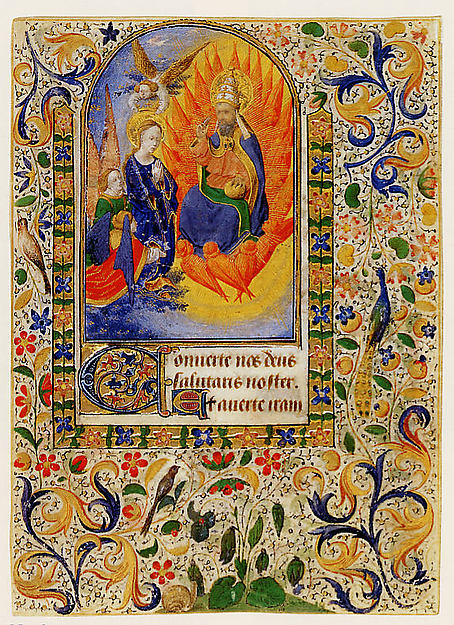
| Coronation of the Virgin, The Met ca. 1455–60 |
Continuing this step-by-step progress through Compline (Pt 3), today a little about versicles. This post also covers their use in the other hours.
OVERVIEW
Versicles are short verses with a
response.
At Compline a sign of the cross
is made at the ‘Adjutorium nostrum’ verse, and over the heart with the thumb at
the ‘Converte nos Deus’.
Alleluias are added to the
versicles (where marked) in Eastertide.
More elaborate chant tones are
used for Lauds and Vespers, and for feasts at those hours.
What is a versicle?
The versicle is a short statement and response.
In the Diurnal they are usually just marked V: and R:
All of the hours contain versicles, and in the main they are very straightforward to say.
Still, there are a few rubrics that go with them in particular hours, such as Compline, and variants in the chants used them on feasts that are worth noting.
Where the versicles are placed
At Prime to None and Compline, there are versicles after the short reading and/or chapter verse, acting as the equivalent of a responsory to it. Versicles also have other positions and functions in the hours though.
Compline
The first versicle of Compline is said immediately after the short reading:
V. Adjutórium nostrum in nómine Dómini. +
R. Qui fecit cælum et
terram.
|
V. Our help is in the name of the Lord, +
R. Who made heaven and earth.
|
A second closes off the first section of the hour, 'responding' perhaps to our act of contrition:
V. Convérte nos Deus,+ salutáris noster.
R. Et avérte iram tuam a nobis.
|
V. Turn us then, O God,+ our saviour:
R. And let thy anger cease from us.
|
And there is another one after the chapter verse that comes in the middle section of Compline:
V. Custódi nos, Dómine, ut
pupíllam óculi.
R. Sub umbra alárum tuárum
prótege nos.
|
V. Keep us, Lord, as the apple of thine eye.
R. Protect us under the shadow of thy wings.
|
Prime to None
At both Prime and Compline (aside from those linked to the Marian antiphon), the versicles are the same each day.
At both Prime and Compline (aside from those linked to the Marian antiphon), the versicles are the same each day.
At Terce, Sext and None, however, they vary with seasons and feasts, in order to match the chapter verses they follow.
Matins, Lauds and Vespers
At Matins the versicles come immediately after the psalms are said in each Nocturn, while at Lauds and Vespers they come after the hymn and before the New Testament Canticles, and can vary with the day of the week as well as the season or feast.
Versicles are also used at various other points through the Office.
Rubrics for the versicles
When the Office is said in common or in choir, the person leading the Office chants the verse (labelled V.), everyone then joins the response (R.).
In private recitation, just say both the verse and response.
Normally there are no particular gestures or postures associated with versicles.
The key exception is at Compline, where a sign of the cross is made at the 'Adjutorium nostrum', and with the thumb over the heart at the 'Converte nos Deus'.
Eastertide
The other point worth being aware of is that during Eastertide, alleluias are added to the versicles in the main part of the hour.
If you look at page 263 in the Diurnal (AM 172), for example, you will see it says (T.P. Alleluia or, in the English version, P. T...). This means add an Alleluia to the verse (and response) during Paschaltide (Tempus Paschali, ie Easter).
If you look at page 263 in the Diurnal (AM 172), for example, you will see it says (T.P. Alleluia or, in the English version, P. T...). This means add an Alleluia to the verse (and response) during Paschaltide (Tempus Paschali, ie Easter).
Chant tones for versicles
The Antiphonale Monasticum provides four alternate tones for the versicles (AM 1232-3):
- a 'simplex tone' (Tonus simplex) for use at Prime to None and Compline, as well as when making a commemoration at Lauds;
- a common tone (tonus communis) for Lauds and Vespers on normal days;
- a solemn tone (tonus solemnis), for use on major feasts and Lauds and Vespers; and
- a tone for use in the Office of the Dead and during the Triduum (AM 1233).
SUMMARY: Rubrics for the first section of Compline
The versicle 'Converte nos' marks the end of the first section of Compline, and the table below summarises the rubrics for Compline up to this point.
Opening section of Compline
Office component
|
Page number
|
Key words
|
Key points to note
|
Rubrics
|
Reading -
Short lesson with blessing
|
MD 256-7
AM 167
[video 1.07]
|
Jube Domne..
Noctem quietam…
|
Alternative readings can be used
|
Stand; in monastery, reader kneels for
the blessing
|
Versicle
|
MD 257
[video 1.56]
|
Adjutorium nostrum…
|
Make sign of cross
|
|
Examination of Conscience or Pater Noster
Confession, absolution
|
MD 257
MD 258-9 (Unless in a monastery or with a priest leading)
[video 2.17]
|
Confiteor Deo
omnipotenti…
Misereatur
nostri…
Indulgentiam…
|
The Diurnal provides two versions of this section – use the
second in private recitation.
Note addition of St Benedict to the Confiteor.
|
Bow (profound)
Strike breast x3 at mea culpa.
At absolution (Indulgentium), make sign of the cross
|
Versicle
|
MD 259
[video 3.49]
|
Converte nos Deus…
|
Sign of cross with thumb over heart
|
Yu can find the next part in this series, on the opening prayers of the Office (and opening of the middle section of Compline), here.

