Friday, January 26, 2018

Learn the Office 2.7 - The psalms Pt 3 - singing the psalms and antiphons

O Antiphons

Let those who have been ordered, intone the psalms or the antiphons in their turn after the Abbot. No one, however, should presume to sing or read unless he is able so to perform this office that the hearers may be edified; and let it be done with humility, gravity, and reverence by him whom the Abbot hath ordered.

Rule of St Benedict, ch 47

SINGING THE PSALMS


This post looks at how the to sing the psalms, and in particular, how to decipher the cues given in the Antiphonale Monasticum.

OVERVIEW

The antiphon determines which tone is used to chant the psalm.

There are eight main chant tones, plus a few others that are regularly used.

The Antiphonale Monasticum provides the number of the chant tone as well as the ending (differentiae), and includes a summary for the ending.


The antiphons


Each of the antiphons have their own chant setting, which you can find in the Antiphonale Monasticum,  either in the psalter section of the book, or the sections for the seasons, saints or commons of feasts.

The antiphon normally used for the first psalm of Sunday Vespers, for example, can be seen on page 125 of the Antiphonale, depicted in the image below.


Note that the Antiphonale only provides a short cue for the antiphons before the psalms for Sunday Vespers - but under the 1962 rubrics, the antiphon is sung on full both before and after the psalm.

The psalms themselves are sung to one of a series of fixed tones, numbered 1 to 8, with a couple of extras thrown in.

The 'mode' of the antiphon determines which chant tone should be used for the following psalm.

The chant tones


Normally the key to which psalm tone to use  is the letter and number combination usually written underneath the 'Ant' in the book (as on page 125 for the second psalm of Sunday Vespers, pictured above, which uses Tone 4 g).

But in the case of the first psalm of Sunday Vespers, for example, the book tells you that the psalm tone is 7 c2.

The first number (VII) for Dixit Dominus tells you to use tone 7. 

Once you know the correct psalm tone to use, you can consult pages 1210-1219 of the Antiphonale Monasticum to find the details of that particular chant set out in generic form.

The second letter/number combination tells you which 'differentiae' or ending, to use.  The image below shows the corresponding entry in the Antiphonale.


The four notes used in the word 'Septimus' (seven) are only used for the intonation of the first verse of the psalm (though they are used for every verse of a canticle) - all subsequent verses start on the note used for 'modus...' (re).

The note change marked 'flectitur' is only used when you see the dagger figure in the text of a psalm.

The note changes for 'sic mediatur', however, are always used in the syllables leading up to the * in the middle of each psalm verse.

The pattern of note changes for the second half of the verse varies depending on the 'differentiae', each of which is indicated by a letter (or letter number combination), such as a, c, c2 or d in the case of tone 7.

Most chant books also include some cues on the page with the antiphon for the ending of the verse, so that if you know the start of tone 7 off by heart (and if you sing them regularly over time you will learn them), you don't have to go check the end of the book.  Instead you just look at the arrangement notes that go with 'Euouae', which stands for  'Et in saecula saeculorum Amen' (ie the end of the doxology).

Audio resources and learning the psalm tones


You can find audiofiles of all of the standard chant tones (as well as many other useful audio resources) on the Chantblog. or sung individually on youtube.

Or you can try the video below.

If you are starting from scratch though, I recommend starting with the simplest tones such as Psalm 8.  Sing the psalms using that tone in the Antiphonale, and once you are comfortable with it, add in the next one (2 then 5, then 6, 4 and 7).


Note that there are some minor differences between the psalm tones as set out in the Antiphonale Monasticum and those used in the Roman form of the Office (mainly affecting tones 3 and 6 and the labelling of some of the differentiae).

 Matching the verses to the psalm tones


In theory you could work out which places to change note on for yourself.

In practice, especially at first, it is simplest to use a book with the psalms 'pointed' for you.

There are several books that have been produced at various times for Vespers and Compline, and some of these can be downloaded from CC Watershed (Tomus 9 Psalmiis in notis).  In addition, the Liber Usualis contains a fair number of psalms pointed to tones used in the Benedictine Office.

The simplest solution these days, though, is to use a psalm tone generator to generate your own set of pointed psalms as needed for the particular season, hour or feast.

The image below gives you a feel for the kind of product you can generate.

Another psalm tone generator, offering a range of different formats, can be found on The Academy of Gregorian Chant website (which contains a lot of other very useful resources as well).


How the antiphons and psalms are sung - rubrics

Finally, a note on the rubrics for singing the psalms.

When the Office is sung in choir or in common, the cantor intones the first part of the antiphon, then everyone joins in the rest of it.

The cantor then sings the first half of the first verse of the psalm or canticle, and his or her side of the choir join in with the second half of the verse.

Verses are then alternated between the two sides of the choir.

Everyone stands for the doxology.

When the antiphon is repeated again after the doxology, it is sung by everyone.

And for the next part in this series, continue on to learn about the hymns of the Office.

Thursday, January 25, 2018

Learn the Office 2.6 - The psalms Pt 2 - Psalms and canticles with antiphons.


File:O sapientia.jpg

Antiphons are said at each of the hours, following their institution by Holy Ambrose; this as done because…Blessed Ignatius, the third bishop of Antioch after Blessed Peter, was on a certain mountain and heard choirs of angels singing antiphons.

William Durand, Rationale V


In the last post we looked at psalms said without antiphons; in this one psalms with antiphons; in the next post I will look at singing the psalms and antiphons.


OVERVIEW

Antiphons are short chants used with psalms and canticles.

Under the 1962 rubrics they are always sung in full both before and after a psalm, canticle, or group of psalms.

The ‘default’ antiphons can be found in the psalter section of the Diurnal and Antiphonale, but these can be displaced by those for special seasons or feasts. 

What is an antiphon?


Most of the psalms and canticles in the Office are said with an antiphon, a short set of words that is said or sung before and after a psalm or group of psalms.

Antiphons often serve to focus on a key theme or meaning of either the psalm about to be said, or tell us something important about the season, feast or saint being celebrated.

Antiphons are provided in the psalter section of the Diurnal for each day of the week for use in the period 'throughout the year' (the 'default option').  

The psalter section also provides some - but not all - of the seasonal antiphons.  Antiphons to mark the seasons, feasts and special days though the year can be found in the proper of seasons and proper of saints sections (and sometimes the Common of Saints)..

How antiphons are used


At some hours - basically Prime to None - and during some seasons, such as Eastertide, only one antiphon is used.  In this case it is said before the start of the psalms, and then again after the psalms, that is:

Antiphon
Psalm+doxology
Psalm+doxology
Psalm+doxology
Antiphon

At Vespers for most of the year, however, there is normally one antiphon for each psalm.  In this case the antiphon for the psalm is repeated in full before and after each psalm:


Antiphon 1 +Psalm+Doxology+Antiphon 1
Antiphon 2 +Psalm+Doxology+Antiphon 2
Antiphon 3 +Psalm+Doxology+Antiphon 3
Antiphon 4 +Psalm+Doxology+Antiphon 4

Note: In older versions of the Office, the antiphon was not always said in full before the psalm, so the Antiphonale Monasticum, for example, doesn't always write it out.  In the 1962 rubrics however the antiphon is always said in full before the psalm(s), so you may need to look for it at the end of the psalm.

Lauds uses a mix of both antiphons for a group of psalms, antiphons for individual psalms (and the Old Testament canticle, which is treated exactly like a psalm). 

On normal Sundays, for example, the first three psalms are said under one antiphon, the canticle has its own antiphon, and the three Laudate psalms (Ps 148-150) are said under one antiphon (and with only one doxology, at the end).  On weekdays for most of the year and feasts, however, the first three psalms each have their own antiphon, making five in total.


In addition, at Lauds and Vespers, the New Testament canticle also has its own antiphon.


Where to find the antiphons


The antiphons used on most days of the week throughout the year can be found in the psalter section of the Diurnal and Antiphonale.

If you look at Tuesday Prime, for example, the antiphon normally said throughout the year is 'Deus iudex iustus'.

Accordingly, the middle section of Tuesday Prime (ie after the hymn) goes:

Antiphon: Deus iudex iustus, fortis et longanimis: numquid irascetur per singulos dies?
Psalm: Domine Deus meus...Gloria patri
Psalm: Domine, Dominus noster...Gloria Patri...
Psalm: Confitebor tibi, Domine...Gloria Patri
Antiphon: Deus iudex iustus, fortis et longanimis: numquid irascetur per singulos dies?

Antiphons can change according to seasons, feasts and special days, though, and the easiest way to find the correct set for the season or day is to use an Ordo.

On feasts, there can be as many as three sets of antiphons for the day hours.  The most normal pattern, though is to provide one set of antiphons for Lauds, which are also used at the other hours.  In this case the antiphons are used as follows:

Antiphon 1 of Lauds= Prime, Antiphon 1 of Vespers
Antiphon 2 of Lauds= Terce, Antiphon 2 of Vespers
Antiphon 3 of Lauds= Sext, Antiphon 3 of Vespers
Antiphon 4 of Lauds
Antiphon 5 of Lauds= None, Antiphon 4 of Vespers

And you can find the next part of this series, on singing the psalms, here.

Wednesday, January 24, 2018

Learn the Office 2.5 - How the psalms are said in the Office Pt 1 - Including psalms without antiphons

Georgian Psalter 13-15 c.jpg
King David composing the psalms


Let Compline be limited to the saying of three psalms, said straightforward and without an antiphon.  Rule of St Benedict, ch 17

At Compline let the same psalms be repeated every day: that is, the fourth, the ninetieth, and the hundred and thirty-third.  Rule of St Benedict, ch 18


The Psalms in the Benedictine Office


This post covers some general rubrics around the psalms in the Office, as well as taking a look at psalms said without antiphons at Compline, Lauds and Matins.

The psalms are the core of the Benedictine Office, so it is worth taking a little time to look at how they are properly said. 

OVERVIEW

The layout of the psalms in the psalter differs from that in most Bibles in several ways, including the division of the verses.

In the Office, the doxology (Gloria Patri…) is added to all psalms and canticles unless otherwise noted.

The psalms of Compline, as for Psalm 66 at Lauds, are said without antiphon.

A tone for the psalms without antiphon can be found in the Antiphonale Monasticum on page 1219, however alternate tones are often used at some times of the year.


Reading the psalms in the psalter section of your book(s)


If you look at the psalter section of the Diurnal (or Antiphonale) you will see that the psalms are laid out slightly differently to the way they appear in most Bibles.


Layout of the psalms for liturgical use


The psalter section of the Diurnal is organised so that the psalms appear more or less in their numerical order (a few psalms needed for particular hours excepted).  In the case of Compline though, the psalms span the psalter, so are placed last.

The psalm titles are omitted, as these are not sung.  

In addition, no verse numbers are normally provided.  

It is also worth noting that the division of the verses sometimes differs from the standard divisions in modern Bibles (which date from the seventeenth century).


The asterix marks in the psalter


If you look at the psalms as laid out in the psalter section of the Diurnal or other books you will also see an asterix * in the middle of each verse.

The norm for the Benedictine Office is for it to be sung in choir.  When the Office is sung in choir or in common, the normal practice is to alternate verses between the two sides of the choir or church. 

Rather than pausing between verses, though, it is usual to pause in the middle of the verse, but not have much of a gap between verses.  The asterix marks the place for the pause.  The asterix also helps you know when to change notes if using a chant tone.  

The doxology at the end of the psalms


If you look underneath Psalm 1 at the beginning of the psalter section of the Diurnal, you will see it writes out the Gloria Patri in full at the end of the psalm, and says this is always said at the end of each psalm, part of a psalm (for example the individual stanzas of Psalm 118 said on Sunday and Monday, and psalms that are divided, the second half of which are usually marked with the word 'divisio' ), or canticle unless otherwise indicated.

The key exceptions to the use of the doxology are:
  • after Psalms 148 and 149 at Lauds (the three Laudate psalms are said under one Gloria);
  • after Psalm 115 at Monday Vespers (Psalm 115 is joined to Psalm 116); 
  • the Benedicite Canticle on Sundays; and
  • at certain times of the year, most notably during the Triduum. 
In choir, everyone stands and bows for the words 'Gloria Patri et Filio et Spiritui Sancto'.


The psalms without an antiphon - Lauds and Compline.


There are three different ways of saying the psalms in the Office: 
  • without an antiphon ('in directum'); 
  • responsorially (Psalm 94 at Matins); and 
  • antiphonally (most of the hours). 

I will look at the psalms said antiphonally in the next post, but for now the psalms said without antiphon.

There are three sets of psalms said without antiphon in the Office: Psalm 3 at Matins; Psalm 66 at Lauds; and the psalms of Compline.

Originally psalms said 'in directum' were probably said in full by everyone present.  In most monasteries, though, the verses are alternated between the two sides of the choir and/or church as for the rest of the psalmody.

When sung, the key difference is in the first verse of the psalm, as there is no initial 'intonation' - the singing starts on the note it continues on.

The Antiphonale Monasticum provides only one chant tone for psalms sung without antiphon, on page 1219.  You can hear it used for Psalm 66 at Lauds by following the link here (Lauds, around 3.45).

Many monasteries do use alternate chant tones at Compline for some feasts and times of the year however, and the one on the video of Compline I've previously posted can be found in the Liber Usualis (tone for the Nunc Dimittis on Easter Day in the Roman Office), or in the 2005 Antiphonale Monasticum on page 517 (where the rubrics state that it is used for Christmas and Easter).

Pronouncing the Latin


If you are using the Diurnal, you have the English in front of you to help understand the Latin.  It is the Latin, however, that is approved for liturgical use in the 1962 Office.

If you aren't familiar with Latin pronunciation, the best approach is probably to start by listening to recordings such as the Compline video I've previously posted, and the podcasts of Le Barroux for example.

There are a number of great resources available online to help you thou, including:

And you can find the next part in this series, on psalms with antiphons, here.

Tuesday, January 23, 2018

Learn the Office 2.4 - The 'opening' prayers of the day hours (Compline step-by-step 4)


Image result for deus in adjutorium image

And so for keeping up continual recollection of God, this pious formula is to be ever set before you: O God, make speed to save me: O Lord, make haste to help me, for this verse has not unreasonably been picked out from the whole of Scripture for this purpose. For it embraces all the feelings which can be implanted in human nature, and can be fitly and satisfactorily adapted to every condition, and all assaults...This verse is an impregnable wall for all who are labouring under the attacks of demons, as well as impenetrable coat of mail and a strong shield. St John Cassian, Conferences 10:10 
The more diligent in prayer are wont to subjoin in their prayers the Hallelujah...[which] is excellent which, for the extolling and honouring of God, aims unitedly to bring Him enriched prayer as a choice victim. Tertullian, On prayer, chapter 27

OVERVIEW

A standard set of prayers of prayers are used to open all of the hours from Lauds to Vespers.  At Compline they open the middle section of the hour.

They can be found written out in full on MD1 and consist of the ‘Deus in adjutorium…’, Gloria Patri…’ and Alleluia.

From Septuagesima Sunday to Holy Saturday, the Alleluia at the end of these prayers is omitted, and ‘Laus tibi, Domine’ is said instead.

The Diurnal, Antiphonale and other books do not always spell these out or write these out in full – but they always need to be said, and so are worth memorizing.

Different chant tones are used depending on the hour and level of the day.


The second section of Compline is the section that is described in the Rule, and begins with the opening prayers that are common to all of the day hours.

These prayers start by reminding us of our dependence on God; then affirm our faith in the Triune God who created us; and end with an invocation of praise to him.

(1) Interpreting the Diurnal 


The opening prayers for the day hours are on the first page of the psalter section of the Diurnal - you may wish to keep a ribbon here until you know them off by heart.

In most cases the Diurnal does not write the prayer out in full again.  When it comes to each hour of the Office it either gives you a prompt, but doesn't write out the text needed in full (for example for Monday and Sunday Prime, MD 1, 146); or just expects you to know that these prayers are to be said (for example, Tuesday to Saturday Prime).

The only change in these prayers during the year comes from 'Septuagesima Sunday' (the start of a pre-Lent season in the traditional calendar, up to the end of Lent, when the Alleluia is not said.  Instead the ending becomes: Laus tibi, Dómine, Rex ætérnæ glóriæ (Praise be to thee, O Lord, King of eternal glory).

(2) The rubrics ('do the red')


The opening of the Office is properly said standing.

On the first word (Deus/O God) you should make the sign of the cross.

You should bow for the first half of the doxology (Gloria Patri et Filio et Spiritui Sancto Sancto/Glory be to the Father, and to the Son and to the Holy Ghost).

Stand
V. Deus + (make the sign of the cross) in adjutórium meum inténde.
R. Dómine, ad adjuvándum me festína.
V. (bow) Glória Patri, et Fílio, * et Spirítui Sancto.(stand straight)
R. Sicut erat in princípio, et nunc, et semper, * et in sǽcula sæculórum. Amen.
Alleluia or Laus tibi, Dómine, Rex ætérnæ glóriæ.


(3) The chants


The tone most commonly used for the opening prayers at all hours other than solemn Vespers is set out below, and can also be found in the Antiphonale Monasticum on page 1203.

On the video of Compine we have been using it can be heard around 4.00.


The video below provides a version with the Lent ending.


The chant tone used can, however, change to reflect the greater importance of the hour, or recognise that a feast is being celebrated.  The recording below uses the solemn tone.


And for a particularly grand polyphonic setting of the text:


**NB Videos many not be available in some regions.

And you can find the next part of this series, on saying the psalms in the Office, especially at Compline, here.

Saturday, January 20, 2018

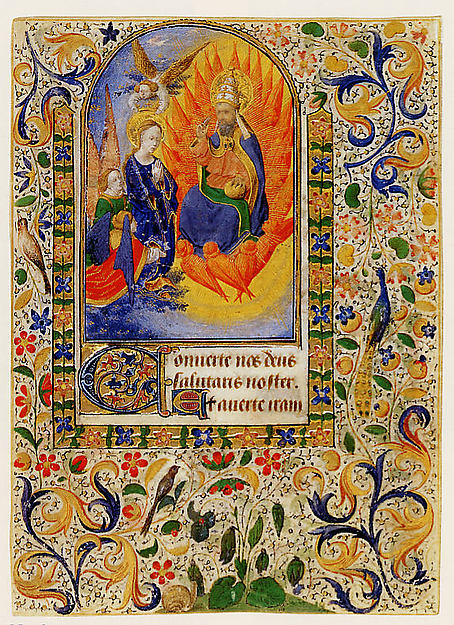
Learn the Office 2.3: Versicles - Compline step-by-step 3


Coronation of the Virgin, Paris, France  (?), Tempera and gold leaf on parchment, France, probably Paris
Coronation of the Virgin, The Met
ca. 1455–60

Continuing this step-by-step progress through Compline (Pt 3), today a little about versicles.  This post also covers their use in the other hours.


OVERVIEW

Versicles are short verses with a response.

At Compline a sign of the cross is made at the ‘Adjutorium nostrum’ verse, and over the heart with the thumb at the ‘Converte nos Deus’.

Alleluias are added to the versicles (where marked) in Eastertide.

More elaborate chant tones are used for Lauds and Vespers, and for feasts at those hours.

What is a versicle?


The versicle is a short statement and response.

In the Diurnal they are usually just marked V: and R:

All of the hours contain versicles, and in the main they are very straightforward to say.

Still, there are a few rubrics that go with them in particular hours, such as Compline, and variants in the chants used them on feasts that are worth noting.

Where the versicles are placed


At Prime to None and Compline, there are versicles after the short reading and/or chapter verse, acting as the equivalent of a responsory to it. Versicles also have other positions and functions in the hours though.

Compline

The first versicle of Compline is said immediately after the short reading:

V. Adjutórium nostrum in nómine Dómini. +
R. Qui fecit cælum et terram.
V. Our help is in the name of the Lord, +
R. Who made heaven and earth.

A second closes off the first section of the hour, 'responding' perhaps to our act of contrition:

V. Convérte nos Deus,+ salutáris noster.
R. Et avérte iram tuam a nobis.
V. Turn us then, O God,+ our saviour: 
R. And let thy anger cease from us.

And there is another one after the chapter verse that comes in the middle section of Compline:

V. Custódi nos, Dómine, ut pupíllam óculi.
R. Sub umbra alárum tuárum prótege nos.
V. Keep us, Lord, as the apple of thine eye.
R. Protect us under the shadow of thy wings.

Prime to None

At both Prime and Compline (aside from those linked to the Marian antiphon), the versicles are the same each day.

At Terce, Sext and None, however, they vary with seasons and feasts, in order to match the chapter verses they follow.

Matins, Lauds and Vespers

At Matins the versicles come immediately after the psalms are said in each Nocturn, while at Lauds and Vespers they come after the hymn and before the New Testament Canticles, and can vary with the day of the week as well as the season or feast.

Versicles are also used at various other points through the Office.

Rubrics for the versicles


When the Office is said in common or in choir, the person leading the Office chants the verse (labelled V.), everyone then joins the response (R.).

In private recitation, just say both the verse and response.

Normally there are no particular gestures or postures associated with versicles.  

The key exception is at Compline, where a sign of the cross is made at the 'Adjutorium nostrum', and with the thumb over the heart at the 'Converte nos Deus'.

Eastertide

The other point worth being aware of is that during Eastertide, alleluias are added to the versicles in the main part of the hour.

If you look at page 263 in the Diurnal (AM 172), for example, you will see  it says (T.P. Alleluia or, in the English version, P. T...).  This means add an Alleluia to the verse (and response) during Paschaltide (Tempus Paschali, ie Easter).

Chant tones for versicles


The Antiphonale Monasticum provides four alternate tones for the versicles (AM 1232-3):

  • a 'simplex tone' (Tonus simplex) for use at Prime to None and Compline, as well as when making a commemoration at Lauds;
  • a common tone (tonus communis) for Lauds and Vespers on normal days;
  • a solemn tone (tonus solemnis), for use on major feasts and Lauds and Vespers; and 
  • a tone for use in the Office of the Dead and during the Triduum (AM 1233).

SUMMARY: Rubrics for the first section of Compline


The versicle 'Converte nos' marks the end of the first section of Compline, and the table below summarises the rubrics for Compline up to this point.

Opening section of Compline

Office component
Page number
Key words
Key points to note
Rubrics
Reading - Short lesson with blessing


MD 256-7
AM 167

[video 1.07]
Jube Domne..
Noctem quietam…
Alternative readings can be used
Stand; in monastery, reader kneels for the blessing
Versicle  
MD 257

[video 1.56]

Adjutorium nostrum…
Make sign of cross
Examination of Conscience or Pater Noster

Confession, absolution
MD 257


MD 258-9 (Unless in a monastery or with a priest leading)


[video 2.17]


Confiteor Deo omnipotenti…

Misereatur nostri…

Indulgentiam…


The Diurnal provides two versions of this section – use the second in private recitation.

Note addition of St Benedict to the Confiteor.

Bow (profound)


Strike breast x3 at mea culpa.

At absolution (Indulgentium), make sign of the cross


Versicle
MD 259


[video 3.49]
Converte nos Deus…
Sign of cross with thumb over heart


Yu can find the next part in this series, on the opening prayers of the Office (and opening of the middle section of Compline), here.

Friday, January 19, 2018

Learn the Office 2.2 - Examen and Confession (Compline step-by-step 2)

Image result for confiteor

When the day’s work is ended, thanksgiving should be offered for what has been granted us or for what we have done rightly therein and confession made of our omissions whether voluntary or involuntary, or of a secret fault, if we chance to have committed any in words or deeds, or in the heart itself; for by prayer we propitiate God for all our misdemeanors.  

The examination of our past actions is a great help toward not falling into like faults again; wherefore the Psalmist says: ‘the things you say in your hearts, be sorry for them upon your beds.’ (Ps 4:5)  Again, at nightfall, we must ask that our rest be sinless and untroubled by dreams. At this hour, also, the ninetieth Psalm should be recited.

Long Rule of St Basil the Great (330-379)


Compline step-by-step part 2 - Examen and confession


This post continues this step-by-step guide to Compline and the components of the Benedictine Office, looking at the Examination of conscience and confession section of Compline.


OVERVIEW

The form of the Confiteor and absolutions used depends on whether or not the Office is being said with or by a priest.

The Confiteor used in the Benedictine Office includes a reference to St Benedict.

The examen


The rubrics in the 1962 Office provide two options - either make a brief examination of conscience, or say an Our Father silently.

The Confiteor and absolutions


The Diurnal then provides two versions of the Confiteor (I confess..).

In a choir of monks

The first version (MD 257, and with an instruction in red that 'The hedbomadary recites the Confiteor') is only used in a choir of monks (or where the Office is lead by a priest). 

The format is the same as in the prayers at the foot of the altar at an EF Mass, with the Confiteor recited first by the 'hebdomadary' (person leading the Office on the day), then by everyone else.

In private recitation or a choir of nuns

Where the Office is said by one person alone, a small group, or by a choir of nuns, the second formula (on page 258) is used.

The text of the Confiteor

It is also worth noting that wording of the Confiteor is slightly different than that used in either the Ordinary or Extraordinary Form Mass as it adds in an invocation to St Benedict.

For those not familiar with the Latin, the video below is not the monastic version, but it says it very slowly so is useful for learning.

Body postures an gestures


In private recitation it is not compulsory to follow the rubrics on standing, sitting, bowing etc - just do what you can.

Still, praying with our bodies helps our mind to focus on what we are doing, so making a profound bow while saying the Confiteor, just as the priest and servers do at Mass, is a good practice to get into the habit of.

You should also make a sign of the cross at the absolution (Indulgentiam...).


And for a version sung on one note:


*NB The videos may not be available in some regions.

Compline - opening section recap


 Opening section of Compline
Office component
Page number
Key words
Video time

MD 256-7
AM
Jube Domne..
Noctem quietam…

1.07
Versicle  
MD 257
Adjutorium nostrum…

1.56
Examination of Conscience

Confession, absolution
MD 257


MD 258-9 (Unless in a monastery or with a priest leading)


Confiteor Deo omnipotenti…

Misereatur nostri…

Indulgentiam…


2.17


3.18

3.32


Versicle
MD 259
Converte nos Deus…

3.49


Thursday, January 18, 2018

Learn the Office 2.1 - The short lesson at Compline (Compline step-by-step 1)


 Compline

…a most beautiful custom has developed in the Church, namely that through each hour of daily psalmody a passage from the Old or New Testament is recited by heart for all to hear, and thus strengthened by the words of the apostles or the prophets, they bend their knees to perseverance in prayer, but also at night, when people cease from the labours of doing good works, they turn willing ears to listen to divine readings.  

St Bede, On Ezra and Nehemiah (Neh 9:3), trans Scott deGregorio, pp 200-201


OVERVIEW

Compline begins with a short lesson.

The texts are laid out in full on MD 256 and AM 167; the chants can be found on AM 1235.

The front section of Compline includes the reading; examination of conscience, confession and absolution; and ends with a short versicle. It is not described in the Rule, but has ancient origins.


The rubrics for the reading at Compline


If you watched the video of Compline in the previous post,  or have looked at this hour in your book, you will know it starts with a short lesson, usually from 1 Peter 2:8-9.

You can find the text for the reading in the Monastic Diurnal at page 256-7, or in the Antiphonale Monasticum on page 167.

The basic format of the reading is more or less the same as for the readings at Matins.

It starts with a request for a blessing for the reader.  This is followed by the blessing.  Then comes the reading, to which is added a short response formula (Tu autem Domine...).  Everyone then responds, 'Deo Gratias'.

In a monastery the reader requests the blessing from the person presiding, who then gives it; but in private recitation the words are all still said.


Jube, domne, benedícere.

Benedictio. Noctem quietam et finem perfectum concedat nobis Dominus omnipotens. Amen.

Lectio ...
V. Grant, Lord, a blessing.

Benediction. May almighty God grant us a peaceful night and a perfect end. Amen.


Reading ...


After the blessing for the reading, everyone (except the reader) sits down.

The standard ending for readings, which is usually not written out in breviaries, is:

V. Tu autem, Dómine, miserére nobis.
R. Deo grátias.
V. But thou, O Lord, have mercy upon us.
R. Thanks be to God.


The chants for the reading


The easiest way to learn the chant tones for this section of Compline is probably to learn it by ear, either by using the video (below), or listening to Compline sung by the monks of Le Barroux.

The chant tones for it are laid out in full in the Antiphonale Monasticum on page 1235 (Tonus Lectionis brevis).


Place in the structure of Compline


As we go through the hours, I would encourage you to read the descriptions of them contained in the Rule of St Benedict (written some time in the period 510-547), and match them up with the Office as you find it in your Diurnal.

the 1962 Office is, of course, the product of around fifteen hundred years of 'organic' (and perhaps sometimes some 'inorganic!) development' of the liturgy, so there are differences.  In most cases though, they are fairly minor.

Of all the hours, though, Compline is actually the one that seems at first glance to have developed the most, with St Benedict's prescriptions now sandwiched between a 'new' front section containing a short reading and confession, and a Marian antiphon and prayer at the end.

In reality though, as the 'added' front section of Compline probably just formalizes and codifies what was always done informally -  a seventh century description of monastic practices in Rome (circa 670) mentions starting the hour with a reading for example.

The table below summarises the content of the first section of Compline, before the elements that St Benedict mentions in chapters 17&18 of the Rule.  It also gives time references to the video, to help you follow it.

 Opening section of Compline
Office component
Page number
Key words
Video time

Reading - Short lesson with blessing
MD 256-7
AM
Jube Domne..
Noctem quietam…

1.07
Versicle  
MD 257
Adjutorium nostrum…

1.56
Examination of Conscience

Confession, absolution
MD 257


MD 258-9 (Unless in a monastery or with a priest leading)


Confiteor Deo omnipotenti…

Misereatur nostri…

Indulgentiam…


2.17


3.18

3.32


Versicle
MD 259
Converte nos Deus…

3.49