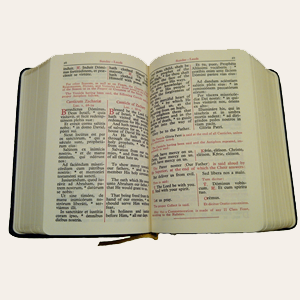
This post provides an overview of how the
Diurnal is organised, and where to place your ribbons.
Note: Page numbering
Before you look into the contents of the book, it is
important to understand that the Diurnal is not page numbered consecutively
from page 1 to page x at the end of the book.
Instead, it contains a number of separate
sections, each starting again at 1, but with brackets, asterisks etc indicating
which section of the book you are in. If you are using an Ordo take careful note of which section of the Diurnal is being referred to.
In addition, while there is an index, on page
(233) ff, this is more designed to help you find particular psalms, hymns, and so
forth than to help you navigate the book.
Front material
This section includes the Title page, Preface, Introduction,
calendars, conclusions to the collects.
The page number use Roman numerals, appearing to start at MD xi and go to MD xxx.
Most of this material is for reference only, and
you won't need it very often, but some of it is important.
Some of the key pages particularly worth noting
include:
- the Table of Movable feasts - you can get this from an
Ordo, but it is a useful cross-check;
- the calendar, which lists out the feasts for each
month; and
- the conclusions to the collects - the capitalised words
clue you in as to which ones should be added to the collect of the day or
week.
Proper of the Season
This part of the Diurnal provides the texts that
vary according to the seasons over the year.
Its pages are marked with a page number and an
asterisk: pages numbered (pages, or MD) 1* to 487*.
At least one of your ribbons should normally be
placed in this section of the book.
In some seasons, you will use
this section a lot, and may need to use two or three ribbons to mark the
appropriate places.
During Advent, for example, there are texts that are used throughout the season,
such as 'the Ordinary of the ferial office in Advent' (MD 9*), as well as texts
for the relevant week of the season, and sometimes also day.
By contrast, in time after Pentecost the main
thing that you need from this section is the collect for the week (used at all of the hours each day
except Prime and Compline, except when the weekly collect is displaced by a
feast).
This section also includes the antiphons for the New Testament canticles (Benedictus and Magnificat) for use at Saturday and Sunday Vespers and Sunday Lauds.
The Psalter
The psalter is the most important section of the
book, as most of the texts you need to say the Office each day contained in it.
As well as the psalms, it contains the
standard 'fixed' prayers used at each of the hours.
The pages are marked with plain page numbers: numbered 1 to 269.

Note that this section is
(roughly) organised around the order of the psalms rather than the order in
which the various 'hours' of the Office are said. It starts, for example,
with Prime, because Prime starts at Psalm 1, but places Sunday Prime after
Lauds, because it uses Psalm 118.
This is another place where you should put a ribbon.
How you place them will depend on which and how
many hours you plan to say. If you only
say one or two hours each day, you could leave your ribbons on them.
Alternatively, before you start saying a
particular hour, you could move your ribbons to the various places you need for
it.
Proper of the Saints
This section provides the prayers and special
texts used on the feasts of saints, and is arranged by date.
The page numbers are in square brackets:
numbered [1] to [385].
It is normally helpful to put a ribbon on the nearest date to the current
one. The key exception to this is
between December 23 and January 6, when the texts for the relevant feasts of
saints (and other feasts) are included in the Proper of the Season section
instead.
The Common of Saints, assorted prayers and indices
The 'commons' are used for more important feasts
that don't have their own special texts. They are grouped by types of
saints (apostles, confessors, etc).
Page
numbers in this section are marked with round brackets (parentheses): numbered
(1) to (243).
The key pages you should have a look at are
those for:
- the Office of the Blessed Virgin Mary on Saturday, MD
(129), which includes prayers and antiphons used most Saturdays of the
year;
- the Office of the Dead, MD (135) - use it to say an
Office for the repose of souls; and
- the Itinerary, MD (225) - a great set of prayers for
anyone going on a major journey.
Supplement of Saints feasts
The final section of the book contains texts for
feasts that are celebrated in certain places only. Page numbers in it are indicated by a page
number with two asterisks: numbered 1** to 59**.
You can find the next part of this series, on singing the Office and using the Antiphonale Monasticum, here.
SUMMARY
The Diurnal has six main sections - the most important is towards the middle, and is labelled 'The Psalter arranged for the week'.
If you are using a different edition of the Diurnal, the page numbers might be different, or it may be missing some of the material I mention.
This post provides an overview of what is in the Diurnal. It also provides suggestions on where to place your ribbons.
You can find the next part of this series, on singing the Office and using the Antiphonale Monasticum, here.


Very helpful overview. Thank you.
ReplyDeleteHaving trouble searching for a podcast to pair with doing the office. What would be a few that are recommended?
ReplyDeleteDepends on your time zone: several do live podcasts, some also archive them in various forms.
ReplyDeleteGo to websites of le Barroux, Gower nuns, Notre Dame Priory.
Or if looking for archived ones: https://barrouxchant.com/
You should get this app: Neumz. It is like being a part of a cloister...
ReplyDelete