Showing posts with label hymn. Show all posts

Tuesday, February 6, 2018

Learn the Office 2.8 - The singing the hymn at Compline and the other hours

The Consecration of St Ambrose

At this time it was instituted that, after the manner of the Eastern Church, hymns and psalms should be sung, lest the people should pine away in the tediousness of sorrow; which custom, retained from then till now, is imitated by many, yea, by almost all of Your congregations throughout the rest of the world.

St Augustine on St Ambrose’s introduction of hymns, Confessions Bk 9:7


The hymns of the Benedictine Office are very straightforward rubrics-wise, so most of the notes below relate to using the Antiphonale Monasticum and other resources to sing them.  There are a few things that are worth knowing about them though, so do at least skim this post!

About hymns in the Office


The use of hymns was introduced to the Western Church by St Ambrose of Milan.  A number of St Benedict's monastic contemporaries also used hymns, but the Roman Office didn't add hymns until about four centuries after St Benedict.

St Benedict specifies that the hymns for the 'minor hours' (Compline, Prime, Terce, Sext and None) should be proper to them (ie not change each day).  Accordingly, while the tunes can change with the day of the week (Sundays generally have a different tune for example) season or feast, the texts don't.

In St Benedict's time, the hymns at Lauds and Vespers were probably the same each day, changing only for feasts and perhaps the summer and winter seasons.   The set of Vespers hymns usually used each day from Sunday to Friday, however, were early attributed to St Gregory the Great, and were certainly used widely from the eighth century onwards.

Over time, the repertoire has expanded even greatly, with the composition of hymns for use at Vespers and Lauds on most feasts and seasons.

With a few notable exceptions (such as the Te Deum and Te decet at Matins), the hymns we sing now (with a few exceptions) are not necessarily the one's that were used in St Benedict's time.  In fact the hymns used have changed several times over the centuries, and different ones have been used at different times and places.  St Benedict may well have known an earlier version of the Compline hymn though, given its antiquity.

The Benedictine Office has, however, retained the traditional texts of the hymns throughout its history.  This means that they often differ from the versions used in the Roman Office, which were amended by Pope Urban VIII in the seventeenth century to make them conform with his ideals of classical Latin.  More recent editions of the Roman Breviary have reverted to the original forms of the hymns.

The position of the hymn in the hours and their rubrics


Each hour of the Benedictine Office has at least one hymn, while Matins has three.

St Benedict specifies three different positions for the hymn in the day hours:
  • at Prime to None it comes right at the beginning, following the standard opening prayers, and before the psalms;
  • at Compline it follows immediately after the psalms; and
  • at Lauds and Vespers the hymn comes after the chapter and responsory, and before the New Testament canticle and its antiphon.
In choir or singing the Office with a group, you should stand for the hymn.  You also bow during the last verse (in honour of the reference to the Trinity in the 'doxology).

An amen is always added to the end of the hymn, and you can find the chant tones for this written out on AM 1231.

WHEN
Gestures/postures
Who says it in a monastery/notes
For the hymn
All stand

verses

Verses alternate between sides of the choir
Last verse (doxology)
Bow

Amen

Added to end of all hymns (and sometimes also an alleluia)

Singing the hymns of Prime to None and Compline 


Where hymns are proper to the hour (ie the same each day), they usually have different chant tones for days throughout the week, Sundays, for different levels of feasts, and for special seasons of the year.

If you look at the first page of the Ordinary in the Antiphonale Monasticum (see image below), for example, you will see it provides the chant tone for the hymn Iam Lucis Orto Sidere for 'feriis et officiis Simplicibus per annum', that is, for use on ordinary days (ferias) throughout the year.

On page 81, an additional tone is provided for use on Sundays.

Note though that AM 2 also provides alternative versions for use on Class III feasts (equivalent to Tonus in festis minoribus per annum); Class II feasts (Tonus in Festis Majoribus); and Class I feasts (Tonus in Solemnitatibus).

A similar variety of tones is provided for the other hours with one fixed hymn, that is:
  • Terce (Nunc Sancte Nobis), on AM 84-5 and 93-94;
  • Sext (Rector Potens), AM 87-8 and 98-9;
  • None (Rerum Deus), AM  90-1 and 98-9; and
  • Compline (Te Lucis ante terminum), AM 170-1-2.
Note that in the case of Compline, because it is said after I Vespers of the Sunday, it counts as part of the Sunday Office, so uses a Sunday psalm tone on both nights.

In addition to these tones, some seasons have set hymn tones, which can be found in the Ordinary of time section.  During Advent, for example, the tone for Compline can be found on AM 183, and for Prime to None on AM 185.
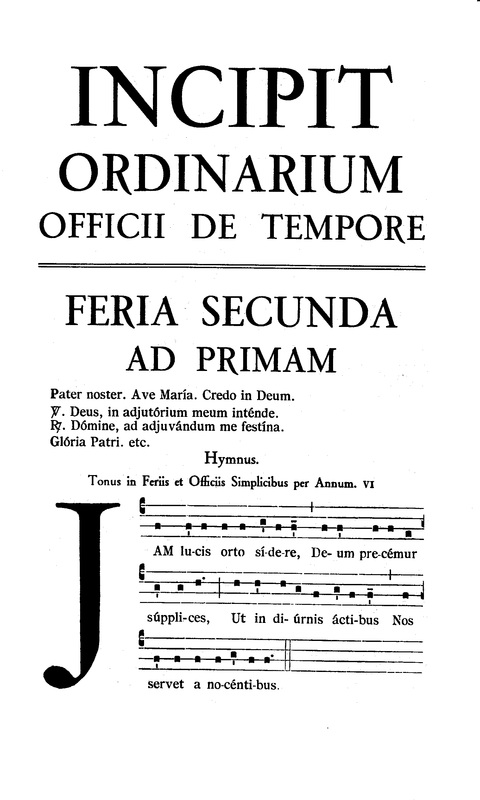
Image result for incipit ordinarium officii de tempore image

You can recordings of many of these hymns in their various tones on youtube.  A particularly useful resource though is the online Liber Hymnarius.  Although it is arranged for the 1970 Liturgy of the Hours, most of the traditional chant tones (Prime aside) can be found on it with a bit of searching.

Singing the hymns of Lauds and Vespers


Lauds and Vespers "during the year'' usually have a hymn specific to the day of the week.  These hymns though, have specific chant tones for summer and winter, both of which can be found in the Antiphonale Monasticum or the Liber Hymnarius.

During the key seasons there are usually special hymns for the hour, noted in the ordinary of time section'of the Antiphonale.

Feasts also generally have their own hymns.  There are also a default set of hymns in the Commons of Saints.  For many feasts the same hymn is for Vespers and Matins, with an another used at Lauds.  There are some feasts with three or even four hymns though.


Further reading/resources


Chant books

The Liber Hymnarius published by Solesmes can be purchased via most monasteries.  If you are singing from the Antiphonale Monasticum, it often only gives one verse set to the chant - the hymnarius often (though not always) sets it out in full.

Understanding the hymns and their context

There are two books that provide translations and notes on the texts of the hymns:

Matthew Britt OSB, Hymns of the Office and Missal, 1922.  Reprints also available.

Joseph Connelly, Hymns of the Roman Liturgy, Newman Press, 1957, reprinted by FSSP.

SUMMARY


Each of the hours of the Office has at least one hymn. 

The hymn for Prime to None and Compline is generally fixed for (proper to) the hour.  The hymns of Lauds and Vespers vary with the day of the week, season, day or feast.

An amen is added to the end of hymns

And for the next part on this series, on the chapter (capitulum), continue on here.

Sunday, April 23, 2017

White Sunday: Ordo notes (and singingTe decet laus in Eastertide)


White Sunday (and Pentecost Sunday likewise) is somewhat unusual as the Octave day of a feast, in that it is not a simple repetition of the texts of the feast.  Instead, the Office is largely that of the Ordinary of Eastertide, but reusing many (but not all ) of the responsories from Easter Sunday.


Divinum Officium


Matins as set out at Divinum Officium (pre-Tridentine monastic) generally conforms to the 1963 monastic office save for the readings and responsories, which can be found arranged correctly at my Lectio Divina blog.  The final Our Father should also be omitted.


Finding the chants


There is only one antiphon for each Nocturn, and these are used on Sundays throughout the season.  The texts are in the Clear Creek Matins booklet (Matins according to...); the chants can be found either in the Psalter for Matins of Peter Standhofe (PDF only), or the Nocturnale Romanum.

In terms of the other chants:
  • the invitatory antiphon is Surrexit Dominus vere, alleluia, which can be found in the Liber Responsorialis (LR), pg 82; Liber Hymnarius, pg 79; or Invitatory booklet;
  • the hymn is Rex Sempiterne Domino, LR 82, Nocturnale Romanum or Liber Hymnarius;
  • the responsories can mostly be found in the Liber Responsorialis under Dominica Resurrectionis (pg 82 ff), but note that there are some differences in order from Easter Sunday, and the second responsory for White Sunday, Angelus Domini locutus est, is not in LR, but can be found at Gregorfacsimil or in the Nocturnale Romanum, pg 442.
Note that the Easter tone for the Te Decet Laus is used, and this can be found both in the LR (Pg 42, alter tonus) and Liber Hymnarius.  The version in the Hymnarius (tone no 1 in the page above), used in the recording below, has some differences to the LR version, but they are very minor.


Monday, March 27, 2017

Opening section of Matins/6 &Closing section/1 - The hymns of Matins


Let the [Ambrosian] hymn follow next (Rule of St Benedict 9)

…When the fourth responsory is finished, let the abbot begin the hymn Te Deum laudamus…then let the abbot follow with the hymn Te decet lausRule of St Benedict Chapter 11


The final part of the opening section of Matins is the hymn.  Matins on Sundays and feasts also has two other hymns though, so I thought I would cover those off here as well.

The structure of Matins
SECTION

OPENING (INVITATORY)
Same elements everyday – opening prayer, Ps 3, Ps 94 (with verse), hymn
NOCTURN I
Six psalms with antiphon(s)
Versicle, Our Father, absolution
Blessing, reading and responsory (1,3 or 4 sets)
NOCTURN II
Six psalms with antiphon(s)
 Sundays and major feasts only:
Versicle, Our Father, absolution
Blessing, reading and responsory *4
NOCTURN III
Sundays and major feasts only:
Three OT canticles under one antiphon
Versicle, Our Father, absolution
Blessing, reading and responsory *4
CONCLUDING SECTION

Weekdays and minor feasts: Chapter and versicle
 SundaysTe Deum, Gospel, Te Decet Laus
CLOSING PRAYERS
Collect only or concluding prayers


The use of hymns in the Benedictine Office


Some commentators point to St Benedict's adoption of the Roman Office canticles as evidence of his more general debt to Roman practice in his Office.  But one of the several respects in which he was decidedly not following Roman tradition would appear to be in his use of hymns.  The Roman Church in the sixth century seems generally have been reluctant to use non-Scriptural texts in the liturgy, and even in the ninth century, the date of the earliest comprehensive description of it, the Roman Office was still devoid of hymns.

St Benedict, on the other hand, had no such hesitation in relation to non-Scriptural texts, happily adopting the tradition of Office hymns popularised in the West by St Ambrose.  A hymn is sung to close off the opening section of the hour each day.  In addition, the Te Deum and Te decet laus towards the end of the hour on Sundays and major feasts.

Where to find the hymn


The hymn in the opening section of Matins is usually of the day of the week, unless replaced by one for the season or feast.  The hymn for each day of the week for most of the year is set out in breviaries, the Clear Creek Matins booklet and the Psautier Monastique under Matins for the particular day of the week.

Those for seasons and feasts will need to be found in other sections of the books or elsewhere, but on feasts the hymn is generally (though not always) the same as for Vespers.

The chant for the Te Deum and Te decet laus can be found in the Liber Responsorialis or the Solesmes Liber Hymnarius.  Note that there are numerous versions of the Te Deum, and an Eastertide version of the Te decet laus.


How to say the hymns


The rubrics for the daily hymns in the opening section are the same as for the other hours - the hymn is properly sung standing, and one normally bows for the doxology in the last verse.  In addition an Amen is always added to the end of the hymn.

The Te Deum and Te decet laus are also said standing, and in the Te Deum everyone kneels at the verse Te ergo quaesumus.


Resources for the hymns - chants


The daily hymns for Matins can be found in a convenient format in the Holger Peter Standhofe draft of the OSB Psalterium.  The chant tones for the hymns (also used in the Nocturnale Romanum) are not the same as the Solesmes Hymnarius, but generally come from the monastic office Codex Hartker manuscript.  Most of the hymns for feasts can be found in the Liber Responsorialis or the Antiphonale Monasticum (also available online for free download).

The Nocturnale Romanum is probably the other source to consider - it is expensive and hard to find, but does include most of the seasonal hymns missing from Liber Responsorialis.  It wouldn't be worth buying just for that (the Solesmes Hymnarius also has a version of most of them as well) but if you are also interested in the responsories, it might be worth considering.

Another option to consider, is the Solesmes 1983 Liber Hymnarius.  It has to be used with caution as it doesn't always line up with 1963 and earlier breviaries.  All the same, a useful book to have as it has most of the hymns you will need, and is extremely useful in (often but not always!) writing out hymns in full, rather than just giving you the first verse.

Resources - listening


Youtube searches will yield recordings of many of the Matins hymns.  The Liber Hymnarius website is also always worth checking.  Another great resource worth checking out is the Chant blog.