 |
| The Consecration of St Ambrose |
At this time it was instituted that, after the manner of the Eastern Church, hymns and psalms should be sung, lest the people should pine away in the tediousness of sorrow; which custom, retained from then till now, is imitated by many, yea, by almost all of Your congregations throughout the rest of the world.
St Augustine on St Ambrose’s introduction of hymns, Confessions Bk 9:7
The hymns of the Benedictine Office are very straightforward rubrics-wise, so most of the notes below relate to using the Antiphonale Monasticum and other resources to sing them. There are a few things that are worth knowing about them though, so do at least skim this post!
About hymns in the Office
The use of hymns was introduced to the Western Church by St Ambrose of Milan. A number of St Benedict's monastic contemporaries also used hymns, but the Roman Office didn't add hymns until about four centuries after St Benedict.
St Benedict specifies that the hymns for the 'minor hours' (Compline, Prime, Terce, Sext and None) should be proper to them (ie not change each day). Accordingly, while the tunes can change with the day of the week (Sundays generally have a different tune for example) season or feast, the texts don't.
In St Benedict's time, the hymns at Lauds and Vespers were probably the same each day, changing only for feasts and perhaps the summer and winter seasons. The set of Vespers hymns usually used each day from Sunday to Friday, however, were early attributed to St Gregory the Great, and were certainly used widely from the eighth century onwards.
Over time, the repertoire has expanded even greatly, with the composition of hymns for use at Vespers and Lauds on most feasts and seasons.
With a few notable exceptions (such as the Te Deum and Te decet at Matins), the hymns we sing now (with a few exceptions) are not necessarily the one's that were used in St Benedict's time. In fact the hymns used have changed several times over the centuries, and different ones have been used at different times and places. St Benedict may well have known an earlier version of the Compline hymn though, given its antiquity.
The Benedictine Office has, however, retained the traditional texts of the hymns throughout its history. This means that they often differ from the versions used in the Roman Office, which were amended by Pope Urban VIII in the seventeenth century to make them conform with his ideals of classical Latin. More recent editions of the Roman Breviary have reverted to the original forms of the hymns.
The position of the hymn in the hours and their rubrics
Each hour of the Benedictine Office has at least one hymn, while Matins has three.
St Benedict specifies three different positions for the hymn in the day hours:
- at Prime to None it comes right at the beginning, following the standard opening prayers, and before the psalms;
- at Compline it follows immediately after the psalms; and
- at Lauds and Vespers the hymn comes after the chapter and responsory, and before the New Testament canticle and its antiphon.
An amen is always added to the end of the hymn, and you can find the chant tones for this written out on AM 1231.
WHEN
|
Gestures/postures
|
Who says it in a monastery/notes
|
For the hymn
|
All stand
| |
verses
|
Verses alternate between sides of the choir
| |
Last verse (doxology)
|
Bow
| |
Amen
|
Added to end of all hymns (and sometimes also an alleluia)
|
Singing the hymns of Prime to None and Compline
Where hymns are proper to the hour (ie the same each day), they usually have different chant tones for days throughout the week, Sundays, for different levels of feasts, and for special seasons of the year.
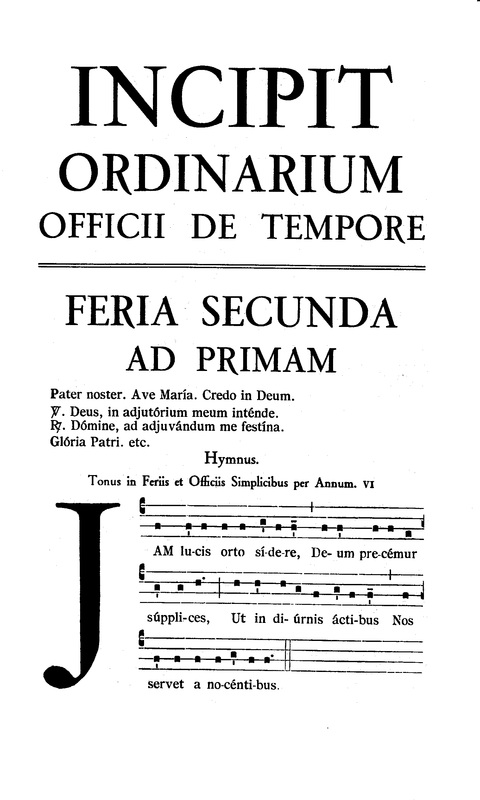
If you look at the first page of the Ordinary in the Antiphonale Monasticum (see image below), for example, you will see it provides the chant tone for the hymn Iam Lucis Orto Sidere for 'feriis et officiis Simplicibus per annum', that is, for use on ordinary days (ferias) throughout the year.
On page 81, an additional tone is provided for use on Sundays.
Note though that AM 2 also provides alternative versions for use on Class III feasts (equivalent to Tonus in festis minoribus per annum); Class II feasts (Tonus in Festis Majoribus); and Class I feasts (Tonus in Solemnitatibus).
A similar variety of tones is provided for the other hours with one fixed hymn, that is:
- Terce (Nunc Sancte Nobis), on AM 84-5 and 93-94;
- Sext (Rector Potens), AM 87-8 and 98-9;
- None (Rerum Deus), AM 90-1 and 98-9; and
- Compline (Te Lucis ante terminum), AM 170-1-2.
In addition to these tones, some seasons have set hymn tones, which can be found in the Ordinary of time section. During Advent, for example, the tone for Compline can be found on AM 183, and for Prime to None on AM 185.
You can recordings of many of these hymns in their various tones on youtube. A particularly useful resource though is the online Liber Hymnarius. Although it is arranged for the 1970 Liturgy of the Hours, most of the traditional chant tones (Prime aside) can be found on it with a bit of searching.
Singing the hymns of Lauds and Vespers
Lauds and Vespers "during the year'' usually have a hymn specific to the day of the week. These hymns though, have specific chant tones for summer and winter, both of which can be found in the Antiphonale Monasticum or the Liber Hymnarius.
During the key seasons there are usually special hymns for the hour, noted in the ordinary of time section'of the Antiphonale.
Further reading/resources
Chant books
The Liber Hymnarius published by Solesmes can be purchased via most monasteries. If you are singing from the Antiphonale Monasticum, it often only gives one verse set to the chant - the hymnarius often (though not always) sets it out in full.
Understanding the hymns and their context
There are two books that provide translations and notes on the texts of the hymns:
Matthew Britt OSB, Hymns of the Office and Missal, 1922. Reprints also available.
Joseph Connelly, Hymns of the Roman Liturgy, Newman Press, 1957, reprinted by FSSP.
SUMMARY
Each of the hours of the
Office has at least one hymn.
The hymn for Prime to None
and Compline is generally fixed for (proper to) the hour. The hymns of Lauds and Vespers vary with the
day of the week, season, day or feast.
An amen is added to the
end of hymns
And for the next part on this series, on the chapter (capitulum), continue on here.

No comments:
Post a Comment