Showing posts with label Diurnal basics. Show all posts

Wednesday, January 17, 2018

Learn the Office 1.6: Preparatory prayers


We believe that God is present everywhere and that the eyes of the Lord behold the good and the bad in every place.  

Let us firmly believe this, especially when we take part in the Work of God. Let us, therefore, always be mindful of what the Prophet saith, "Serve ye the Lord with fear" And again, "Sing ye wisely". And, "I will sing praise to Thee in the sight of the angels". 

Therefore, let us consider how it becometh us to behave in the sight of God and His angels, and let us so stand to sing, that our mind may be in harmony with our voice.

Rule of St Benedict, ch 19

Getting started


Before actually saying the hours, it is important to prepare yourself mentally, in line with St Benedict's instructions in his Rule.

Approaching the hours


Traditionally, those saying the Office said preparatory prayers beforehand so as to put themselves in the right frame of mind, remind themselves of what they were doing, and ask for God's help in doing it.

If you look at the first page of the psalter section in the Antiphonale Monasticum, for example, for Monday Prime (Feria Secunda ad Primam) you will see the words 'Pater noster, Ave Maria.  Credo in Deum'.
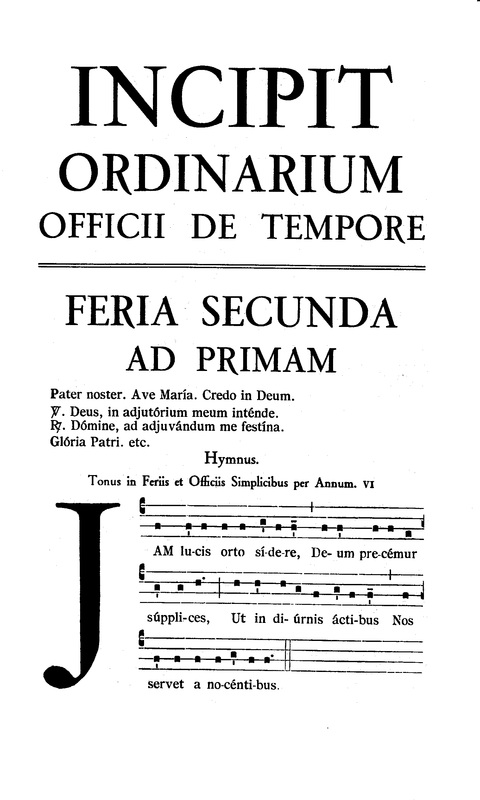
Image result for incipit ordinarium officii de tempore image
They are code for 'say an Our Father, Hail Mary and the Creed'.

These prayers are no longer compulsory to say before the Office.

All the same, you might want to consider saying the Aperi Domine, the standard prayer that was previously said before the start of the Office each day:

APERI, Dómine, os meum ad benedicéndum nomen sanctum tuum: munda quoque cor meum ab ómnibus vanis, pervérsis et aliénis cogitatiónibus; intelléctum illúmina, afféctum inflámma, ut digne, atténte ac devóte hoc Offícium recitáre váleam, et exaudíri mérear ante conspéctum divínæ Majestátis tuæ. Per Christum Dóminum nostrum. Amen.
Open Thou, O Lord, my mouth to bless Thy holy name; cleanse my heart from vain, evil and wandering thoughts; enlighten my understanding, inflame my will, that so I may worthily, attentively and devoutly recite this Office and deserve to be heard in the presence of Thy Divine Majesty. Through Christ our Lord. Amen. O Lord, in union with that divine intention wherewith Thou whilst here on earth didst Thyself praise God, I offer these Hours to Thee.
Dómine, in unióne illíus divínæ intentiónis, qua ipse in terris laudes Deo persolvísti, has tibi Horas (vel hanc tibi Horam) persólvo.
O Lord, in union with that divine intention wherewith Thou Thyself, while on earth, didst offer praises unto God, I offer these hours (or this hour) unto Thee.


Compline


And to get a sense of what the Office is really about, I recommend watching the video of Compline below, from the monastery of Farnborough, that really conveys, I think, the sense of reverence with which we should approach the liturgy.

If you want to follow it in your book, you can find the texts in the Diurnal on page 256, or in the Antiphonale on 167.

Don't worry if you get lost though, we will go through the hour step by step in future posts.


SUMMARY


Before you start saying the Office each day, make sure you are ready.

Saying the ‘Aperi Domini’ is a good way of preparing to say the Office.


You can find the next part in this series here.

Tuesday, January 16, 2018

Learn the Office 1.5 - What changes and what doesn't in the Office

The last of the preliminaries I want to cover before we get down to the hours themselves and their components, is about the distinction the fixed parts of the Office, and those that change with week, season and/or feast.

In this post I want to provide a bit of an overview of each of these cycles which you can refer back to as we go through the Office in more detail.


OVERVIEW

The Benedictine Office contains several different cycles which affects what you should say in it, encompassing:
  • the eight 'hours' said through each day and night;
  • the cycle of psalms and other prayers that change with the day of the week
  • the annual liturgical cycle, which is based around the week of the liturgical year, including movable feasts whose date depends on the date of Easter each year; and 
  • feasts attached to fixed dates in each month of the calendar year.


The hours 

Image result for divine office image

The eight hours

As noted previously, the Benedictine Office is made up of eight separate sets of prayers called 'hours', although in reality they are mostly much shorter than that to say.

They are called the hours because they mark the turn of them.

In St Benedict's time, the day was divided into twelve even hours of daylight  - so an 'hour' was shorter in winter and longer in summer.

The hours mostly just the Roman name of the hour.  So Prime means first, for the first hour of the day; Terce, means the third hour; Sext the sixth; and None the ninth.

The table below summarises when each hour is ideally said.  Note that while it is good to aim to say those hours that you say at around the correct time, it isn't absolutely essential.  Just make sure you say whichever hours you say in the correct order.

Hour of the Office
Indicative time of day said
Matins (not in Diurnal)
In darkness, very early morning
Lauds
First light/dawn
Prime
Before starting work
Terce
Mid-morning
Sext
Lunchtime/noon
None
Mid-afternoon
Vespers
Sunset/early evening
Compline
Before bed

Note that while professed religious (monks and nuns) are generally obliged to say all of the hours each day, laypeople are simply encouraged to say whatever hours of the Office they can.  Before Vatican II many monasteries encouraged their Oblates to say Prime and Compline; these days many suggest Lauds and Vespers.

The fixed elements of the hours

Each of the hours has some fixed elements.

The extreme case of this is Compline, where all of the texts used are the same each day; only the Marion antiphon and prayer at the end varying with the seasons.

Some fixed elements are common to most or all of the hours - the opening and closing prayers for example.

Many of these fixed elements, though, are particular to the individual hours, and help give each of them a distinctive flavour.

At Prime, Terce, Sext, None and Compline, for example, the hymns are the same each day at that particular hour, and include references to the time of day when the hour is said.

Lauds and Vespers both include New Testament Canticles, the Benedictus and Magnificat respectively.

Matins and Lauds both contain psalms appropriate to the hour that are said every day of the week.


Day of the week


Image result for days of creation medieval


Aside from Compline, all of these hours include some elements that change over the course of the week.

Terce, Sext and None have a threefold form, with different stanzas of Psalm 118 being used at each hour on Sunday and Monday, and then repeats the first nine of the Gradual psalms on Tuesday to Saturday each week.

The remaining hours - Matins, Lauds, Prime and Vespers - each have unique sets of psalms, as well as some other elements, such as hymns for each day of the week for most of the year.

The liturgical week and seasons


The Office is closely linked to the Mass, and this is particularly reflected in the Office as it is said on Sunday.

St Benedict makes it clear in his Rule that the liturgical week starts with Sunday.  And Sundays in the liturgy have specific texts attached to them, appropriate to the changing liturgical seasons.

In the Office as it has evolved over time, the links between the Mass and the Office are made clear by use of the same collect most of the time, and by antiphons at Lauds and Vespers of Sunday that normally refer to the Gospel of the day (in the Extraordinary Form calendar).

Some of the other standard parts of the Office, such as the hymns at Lauds and Vespers, also change to reflect the liturgical season or day.

Feasts fixed by calendar date


Related image


The final cycle that affects the Office is that of feasts fixed to particular calendar dates - feasts or other special days that always occur on a particular date, such as Christmas Day, and feasts of individual saints.

The Monastic Diurnal provides a listing of those in the 1962 General Calendar by month in the front section.  Each monastery, diocese, country or region has its own special feasts that you will need to add to this yourself though.


Using an Ordo


In theory you can use the table of movable feasts that appears in the front of the Monastic Diurnal to work out which season and week of the liturgical year you are in, and so what collect and other texts you need to use.

And you can use the calendar to track what feasts of saints are reflected in the Office.

In practice though, the interactions between movable days and calendar date feasts can get quite complex.

The best approach is therefore to use an 'Ordo' for the Office, that helps keep you keep track of what you should be doing.

Ordos normally tell you about the things that differ, on a particular day, to the standard 'ferial', or everyday Office.

Some monasteries put out their own Ordos for the use of their Oblates.

Alternatively you can use the 'default Ordo', which follows the General Calendar for the Benedictine Order provided on the Saints Will Arise, and just add in any feasts that apply to your particular monastery or location.


FURTHER READING


For more details on the rules around when the hours are properly said, go here.


And you can find the next part of this series, on prayers before saying the Office here.

Thursday, January 11, 2018

Learn the Office 1.4 - Singing the Office (and finding your way around the Antiphonale Monasticum)


Today I want to continue this series by providing an overview of the other key book relating to the day hours of the Benedictine Office, the Antiphonale Monasticum, which provides the chants.

If you an absolute beginner with the Office, and don't know anything abut Gregorian chant, this one to leave until later, until you are more familiar with the basic texts.

Sing the Office - start now, and build gradually

But it is important to know that the Office is meant to be sung rather than said if at all possible - St Benedict quotes the psalm that says 'Sing wisely', not one that says 'Say it wisely'!

One way you can do this right from the beginning is to sing it ‘recto tono’, or one note.  Most monasteries use this approach for at least some of the hours each day, and doing the Office this way is a good way to start.

Singing it isn't always possible of course, and saying it is better than not saying it all, but it is good to try and sing at least some of the Office, and over time, try and gradually add more and more of the appropriate Gregorian chants.

Learning to read and sing Gregorian chant

Some of these can be learnt by ear from recordings and podcasts.

For many of the hours, however, there are too many chants to learn easily, and recordings are not available.

The solution is to use or all of those set out in books like the Antiphonale Monasticum.

For this reason, I will provide page references to the Antiphonale Monasticum (AM) in these notes that you can either use as we go along, or come back to at your leisure.

If you are not familiar with how to read the ‘square notation’ used in chant books, there are a number of excellent sites which provide lessons on this, such as those on the FSSP's Our Lady of Guadelupe Seminary website.

The key book for the chants is the Antiphonale Monasticum 1934 (reprint with supplements 2010).  It is available for purchase (but make sure you are buying the 1934 version – the 2005 onwards books are not aligned with the Monastic Diurnal), or can be downloaded from CC Watershed.

About the Antiphonale Monasticum (1934)

The Antiphonale is in Latin only, and is organized slightly differently to the Diurnal, so this post provides some notes to help navigate it. 

In addition, the Antiphonale contains some material that has been trimmed out of the 1962 version of the Benedictine Office, or is used slightly differently, so you will need to use it in conjunction with your Diurnal.

The Antiphonale has eleven sections.  I have marked the most important ones with one or more asterixes.

I. ***Incipit Ordinarium Officii de Tempore (AM 1-180) = Psalter section

In the Diurnal, the psalter section is in the middle of the book.  In the Antiphonale it is the very first section – the Latin means the start of the Ordinary of the Office of Time.

As in the Diurnal, it starts with Monday Prime (Feria Secunda ad Primam), and starts by providing four alternative chant tones for the hymn Iam lucis orto sidere, to be used on different levels of days.

II. **Proprium de Tempore (AM 181-618) = proper of time

Provides the chants for the seasons and moveable feasts.

3. **Commune sanctorum (AM 619-720) = Common of saints

Provides the chants for feasts of saints without ‘proper’ texts.

Note especially the Office of Our Lady on Saturday, from page 712-719).

4. Psalmi festivi (AM 721- 752) = psalms for feasts

Sets out the ‘festal psalms’, versicles for various types of feasts, and antiphons and verses for use to commemorate categories of saints.  All of this material can be found elsewhere, it is brought together here for convenience.

5. **Proprium Sanctorum (page 753- 1149) = Propers for feasts of saints

As in the Diurnal, this is arranged by date.

6. Officium Defunctorum (AM 1150-1169)  = Office of the Dead 

7. Responsoria brevia…responsoria prolixa (AM 1170-1204)

Provides the brief responsories used at Vespers for various categories of feasts, and optional more elaborate responsories for use at I Vespers of selected feasts.

8. **Toni communes = chant tones used in the ordinary (commons) of the Office (AM 1208-1249).

This is an important section as it provides the chants for the repeated/fixed parts of the Office.  It contains a number of sub-sections, and generally several alternatives to reflect the level of the day:

I In principio Horarum = opening prayers of the hours**
II De Cantu Psalmorum = tones used for chanting the psalms and canticles**
III Alleluia = tones for the alleluia when added to antiphons and responsories during Eastertide
IV Gloria Patri =tones for the doxology for the prolix responsories
V De Cantu Hymnorum = Notes on the singing of hymns, including tones for the Amen at the end of them
VI Toni Versiculorum – Tones for the versicles
VII Tonus Capituli =tones for the chapter verses
VIII Tonus Lectionis brevis = tone for brief reading at Compline
IX Tonus Orationis = tones for the collects (prayers).  This section also includes the chants for the concluding section of the hours (Kyrie, Pater Noster)
X In fine Horarum = Endings of the hours
XI Benedicamus Domino = Tones for the Benedicamus used at Lauds and Vespers.**

9. Appendix = assorted chants and prayers for various occasions.

10. Index (AM 1264 – 1292)

11. Supplements for various congregations  - (AM 1* - 58*)

Image result for antiphonale monastique

And you can find the next part in this series here.

Wednesday, January 10, 2018

Learn the Office Pt 1.3 - Finding your way around the Monastic Diurnal


Image result for monastic diurnal


This post  provides an overview of how the Diurnal is organised, and where to place your ribbons.

Note: Page numbering


Before you look into the contents of the book, it is important to understand that the Diurnal is not page numbered consecutively from page 1 to page x at the end of the book.

Instead, it contains a number of separate sections, each starting again at 1, but with brackets, asterisks etc indicating which section of the book you are in.  If you are using an Ordo take careful note of which section of the Diurnal is being referred to.

In addition, while there is an index, on page (233) ff, this is more designed to help you find particular psalms, hymns, and so forth than to help you navigate the book.

Front material


This section includes the Title page, Preface, Introduction, calendars, conclusions to the collects.  

The page number use Roman numerals, appearing to start at MD xi and go to MD xxx.

Most of this material is for reference only, and you won't need it very often, but some of it is important.

Some of the key pages particularly worth noting include:
  • the Table of Movable feasts - you can get this from an Ordo, but it is a useful cross-check;
  • the calendar, which lists out the feasts for each month; and
  • the conclusions to the collects - the capitalised words clue you in as to which ones should be added to the collect of the day or week.

Proper of the Season


This part of the Diurnal provides the texts that vary according to the seasons over the year.

Its pages are marked with a page number and an asterisk: pages numbered (pages, or MD) 1* to 487*.

At least one of your ribbons should normally be placed in this section of the book.

In some seasons, you will use this section a lot, and may need to use two or three ribbons to mark the appropriate places.

During Advent, for example, there are texts that are used throughout the season, such as 'the Ordinary of the ferial office in Advent' (MD 9*), as well as texts for the relevant week of the season, and sometimes also day.

By contrast, in time after Pentecost the main thing that you need from this section is the collect for the week (used at all of the hours each day except Prime and Compline, except when the weekly collect is displaced by a feast). 

This section also includes the antiphons for the New Testament canticles (Benedictus and Magnificat) for use at Saturday and Sunday Vespers and Sunday Lauds.

The Psalter 


The psalter is the most important section of the book, as most of the texts you need to say the Office each day contained in it.  

As well as the psalms, it contains the standard 'fixed' prayers used at each of the hours.  

The pages are marked with plain page numbers: numbered 1 to 269.


Note that this section is (roughly) organised around the order of the psalms rather than the order in which the various 'hours' of the Office are said.  It starts, for example, with Prime, because Prime starts at Psalm 1, but places Sunday Prime after Lauds, because it uses Psalm 118.

This is another place where you should put a ribbon. 

How you place them will depend on which and how many hours you plan to say.  If you only say one or two hours each day, you could leave your ribbons on them.

Alternatively, before you start saying a particular hour, you could move your ribbons to the various places you need for it.

Proper of the Saints


This section provides the prayers and special texts used on the feasts of saints, and is arranged by date.  

The page numbers are in square brackets: numbered [1] to [385].

It is normally helpful to put a ribbon on the nearest date to the current one.  The key exception to this is between December 23 and January 6, when the texts for the relevant feasts of saints (and other feasts) are included in the Proper of the Season section instead.

The Common of Saints, assorted prayers and indices


The 'commons' are used for more important feasts that don't have their own special texts.  They are grouped by types of saints (apostles, confessors, etc).  

Page numbers in this section are marked with round brackets (parentheses): numbered (1) to (243).

The key pages you should have a look at are those for:
  • the Office of the Blessed Virgin Mary on Saturday, MD (129), which includes prayers and antiphons used most Saturdays of the year;
  • the Office of the Dead, MD (135) - use it to say an Office for the repose of souls; and
  • the Itinerary, MD (225) - a great set of prayers for anyone going on a major journey.

Supplement of Saints feasts 


The final section of the book contains texts for feasts that are celebrated in certain places only.  Page numbers in it are indicated by a page number with two asterisks: numbered 1** to 59**.

SUMMARY


The Diurnal has six main sections - the most important is towards the middle, and is labelled 'The Psalter arranged for the week'.

If you are using a different edition of the Diurnal, the page numbers might be different, or it may be missing some of the material I mention.

This post provides an overview of what is in the Diurnal.  It also provides suggestions on where to place your ribbons.


You can find the next part of this series, on singing the Office and using the Antiphonale Monasticum, here.

Monday, January 8, 2018

Learn the Office Pt 1.2 - Books for the Benedictine Office


THE first degree of humility is obedience without delay. This becometh those who hold nothing dearer to them than Christ; who, because of the holy service which they have professed, the fear of hell, and the glory of life everlasting, as soon as anything has been ordered by the superior, receive it as a divine command and cannot suffer any delay in executing it. Of these doth the Lord say: At the hearing of the ear he hath obeyed me. And again he saith to teachers: He that heareth you heareth me.

Rule of St Benedict, chapter 5


In order to say the traditional Benedictine Office, you need the right book or books.

A plethora of Offices

Since Vatican II, individual monasteries have been permitted, within certain guidelines, to develop their own forms of the Office.  That means that there are a lot of different forms of the Office that you might encounter if you visit a Benedictine Monastery.

Many modern Benedictine monasteries use different distributions of the psalms to those set out in the Rule.  They may not say all of the eight ‘hours’ St Benedict specifies should be said.  Some have adopted the 1970 Roman Liturgy of the Hours instead of the Benedictine form of it.

While all of these approaches are permitted under current Church law, this book is concerned with the form of the Benedictine Office that has been used by Benedictines since St Benedict’s own time, as described in chapters 8 to 19 of his Rule, as reflected in the 1962 Breviarum Monasticum (monastic breviary).

The 1962 Benedictine Office

One of the core features of the traditional form of the Benedictine Office is St Benedict’s arrangement of the psalms over a week, and this is preserved in its essentials in the 1962 monastic breviary.  St Benedict’s psalm distribution differs both from that of the older forms of the Roman Office (pre or post 1911), as well as the modern (1970) Liturgy of the Hours.

Pope Benedict XVI’s decrees Summorum Pontificum and Universe Ecclesiae confirmed that the form of the Benedictine Office set out in the 1962 monastic breviary and older chant books used with it (such as the Antiphonale Monasticum of 1934) can continue to be used. 

For those who are fluent in Latin, the notes here can also be used in conjunction with:

It is also possible to adapt the notes to older editions of the Monastic Diurnal (published by Collegeville in 1962 and earlier) though the page numbers will not align, as well as earlier editions of the breviary. 

The best option for laypeople, though, is to use the Monastic Diurnal published by St Michael’s Abbey in Farnborough in 2005, which reflects the 1962 monastic breviary (it is a reprint of the 1962 Collegeville text), to learn the Office, since it includes the English for study purposes.  

The Diurnal provides a Latin-English version of the day hours of the Benedictine Office (ie all of the hours except Matins), enabling oblates and others to follow the Office when they visit a monastery, or listen to podcasts of the Office, as well as to learn to say some of the hours for themselves. 

The Diurnal, like the 1962 Breviary and Antiphonale Monasticum uses the traditional Vulgate translation of the psalter, and older versions of the hymns.   

Aps and other shortcuts

If you are unfamiliar with the Office though, there are a couple of resources that can be used to help you learn it.

One excellent starting point is the Office leaflets put out by Clear Creek Abbey.  These provide the texts for the core of the Office, the texts for normal 'ferial' days of the week for each of the hours in English and Latin.    They don't contain all the texts you will need for the feasts and some seasons, but they are an excellent way to get started.

Another option is to take a look at the Divinum Officium Website and select the 'monastic 1963' option.  The texts provided there now generally match up with the 1962 Office. 

Matins books

For those wishing to say (or sing) Matins, the situation is more complex.  An overview of the resources available can be found here.

Other books

It is also worth knowing that some monasteries who continue to use St Benedict’s ordering of the psalms use the neo-Vulgate version of the psalter promulgated in 1979 and revised volumes of the Antiphonale Monasticum published from 2005 onwards.  These books are, however, only available in Latin and use a different calendar and rubrics.

There are also a number of English only Monastic Diurnals published by assorted Anglican and Orthodox groups.  These typically use different calendars and older rubrics (as well as unapproved translations), so use at your own risk!

In addition, these notes will not align with:
·         books for the Roman Office (1962 or older, or 1970); or
·         Benedictine Daily Prayer (a devotional rather than liturgical office published by Collegeville).

SUMMARY

The notes provided here are designed to be used with the English-Latin Monastic Diurnal published by St Michael’s Abbey, Farnborough, 2005 editions onwards.

They can also be used in conjunction with the chants provided in the Antiphonale Monasticum of 1934.

You can find the next part in this series, on finding your way around the Diurnal here..