Monday, January 8, 2018

Learn the Office Pt 1.2 - Books for the Benedictine Office


THE first degree of humility is obedience without delay. This becometh those who hold nothing dearer to them than Christ; who, because of the holy service which they have professed, the fear of hell, and the glory of life everlasting, as soon as anything has been ordered by the superior, receive it as a divine command and cannot suffer any delay in executing it. Of these doth the Lord say: At the hearing of the ear he hath obeyed me. And again he saith to teachers: He that heareth you heareth me.

Rule of St Benedict, chapter 5


In order to say the traditional Benedictine Office, you need the right book or books.

A plethora of Offices

Since Vatican II, individual monasteries have been permitted, within certain guidelines, to develop their own forms of the Office.  That means that there are a lot of different forms of the Office that you might encounter if you visit a Benedictine Monastery.

Many modern Benedictine monasteries use different distributions of the psalms to those set out in the Rule.  They may not say all of the eight ‘hours’ St Benedict specifies should be said.  Some have adopted the 1970 Roman Liturgy of the Hours instead of the Benedictine form of it.

While all of these approaches are permitted under current Church law, this book is concerned with the form of the Benedictine Office that has been used by Benedictines since St Benedict’s own time, as described in chapters 8 to 19 of his Rule, as reflected in the 1962 Breviarum Monasticum (monastic breviary).

The 1962 Benedictine Office

One of the core features of the traditional form of the Benedictine Office is St Benedict’s arrangement of the psalms over a week, and this is preserved in its essentials in the 1962 monastic breviary.  St Benedict’s psalm distribution differs both from that of the older forms of the Roman Office (pre or post 1911), as well as the modern (1970) Liturgy of the Hours.

Pope Benedict XVI’s decrees Summorum Pontificum and Universe Ecclesiae confirmed that the form of the Benedictine Office set out in the 1962 monastic breviary and older chant books used with it (such as the Antiphonale Monasticum of 1934) can continue to be used. 

For those who are fluent in Latin, the notes here can also be used in conjunction with:

It is also possible to adapt the notes to older editions of the Monastic Diurnal (published by Collegeville in 1962 and earlier) though the page numbers will not align, as well as earlier editions of the breviary. 

The best option for laypeople, though, is to use the Monastic Diurnal published by St Michael’s Abbey in Farnborough in 2005, which reflects the 1962 monastic breviary (it is a reprint of the 1962 Collegeville text), to learn the Office, since it includes the English for study purposes.  

The Diurnal provides a Latin-English version of the day hours of the Benedictine Office (ie all of the hours except Matins), enabling oblates and others to follow the Office when they visit a monastery, or listen to podcasts of the Office, as well as to learn to say some of the hours for themselves. 

The Diurnal, like the 1962 Breviary and Antiphonale Monasticum uses the traditional Vulgate translation of the psalter, and older versions of the hymns.   

Aps and other shortcuts

If you are unfamiliar with the Office though, there are a couple of resources that can be used to help you learn it.

One excellent starting point is the Office leaflets put out by Clear Creek Abbey.  These provide the texts for the core of the Office, the texts for normal 'ferial' days of the week for each of the hours in English and Latin.    They don't contain all the texts you will need for the feasts and some seasons, but they are an excellent way to get started.

Another option is to take a look at the Divinum Officium Website and select the 'monastic 1963' option.  The texts provided there now generally match up with the 1962 Office. 

Matins books

For those wishing to say (or sing) Matins, the situation is more complex.  An overview of the resources available can be found here.

Other books

It is also worth knowing that some monasteries who continue to use St Benedict’s ordering of the psalms use the neo-Vulgate version of the psalter promulgated in 1979 and revised volumes of the Antiphonale Monasticum published from 2005 onwards.  These books are, however, only available in Latin and use a different calendar and rubrics.

There are also a number of English only Monastic Diurnals published by assorted Anglican and Orthodox groups.  These typically use different calendars and older rubrics (as well as unapproved translations), so use at your own risk!

In addition, these notes will not align with:
·         books for the Roman Office (1962 or older, or 1970); or
·         Benedictine Daily Prayer (a devotional rather than liturgical office published by Collegeville).

SUMMARY

The notes provided here are designed to be used with the English-Latin Monastic Diurnal published by St Michael’s Abbey, Farnborough, 2005 editions onwards.

They can also be used in conjunction with the chants provided in the Antiphonale Monasticum of 1934.

You can find the next part in this series, on finding your way around the Diurnal here..

Sunday, January 7, 2018

Learn the Office Pt 1.1 - Benedictine Office Basics


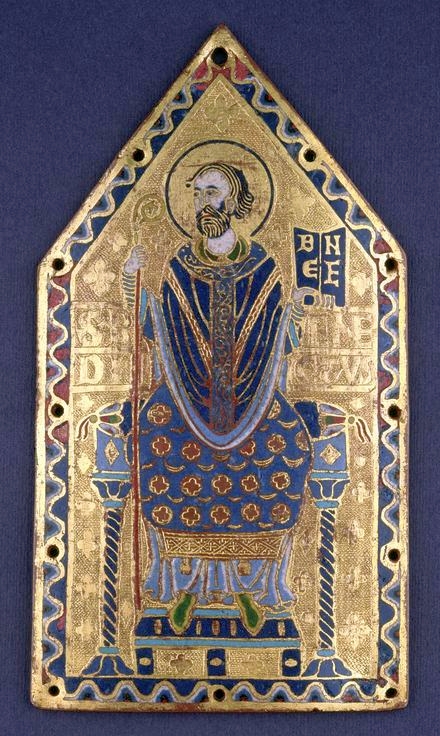
Limoges Plaque with St. Benedict.jpg


Let nothing be put before the Work of God.
Rule of St Benedict, ch 43


I'm starting a new series here, for those wanting to learn how to day the Benedictine Office using the Monastic Diurnal.  The first few posts are by way of preparation - some background reading for those considering buying a Diurnal, or some pre-reading before you actually try to use it.


1.  The Benedictine Office was formulated by St Benedict in the first half of the sixth century

The traditional form of the Benedictine Office as set out in the Monastic Diurnal follows the guidelines set out by St Benedict in his Rule in chapters 8 to 19.  The rubrics for the Office have evolved over a time a little, including to take account of the development of feasts, but the basic structure of the 'hours', including the psalms assigned to them, remains unchanged.

Many modern Benedictine monasteries use different distributions of the psalms and hours, following either the 1970 Roman Liturgy of the Hours, or one of the schemas permitted under the 1977 Monastic Thesaurus.  St Benedict certainly permits other distributions of the psalms in his Rule.

But until Vatican II Benedictine monasteries almost invariably followed the structure for the Office he sets out in the Rule.  In my view, St Benedict's particular form of the Office is part of the patrimony of the Order to be treasured and preserved.

2.  The Benedictine Office according to the 1962-3 rubrics (and approved variants used by individual monasteries) is an approved form of the Liturgy of the Hours, the official prayer of the Church.

The Benedictine Office is a form of the Liturgy of the Hours, the public prayer of the Church even when it is said by one person alone.  The Catechism of the Catholic Church instructs us that:
In this public prayer of the Church, the faithful (clergy, religious, and lay people) exercise the royal priesthood of the baptized. Celebrated in "the form approved" by the Church, the Liturgy of the Hours "is truly the voice of the Bride herself addressed to her Bridegroom. It is the very prayer which Christ himself together with his Body addresses to the Father.
As liturgy, it is the highest form of prayer in the Church, but praying it comes with responsibilities: it should be approached with the same reverence we do the Mass, and abide by the rubrics (rules) that govern it for the same reasons.

Accordingly, while you are learning the Office you should consider praying it devotionally, at least at first, practising until you have it right, just as a transitional deacon preparing for ordination practices saying the Mass.

3.  Learning the Office takes a bit of work

The Office is not straightforward to learn - the various books for it generally assume you already know it (they were written for novices, and religious travelling outside the monastery).  So be prepared to do a bit of work!

In particular, the traditional Benedictine Office is meant to be sung (even if just on one note) if at all possible, and said in Latin (though of course you can pray it devotionally in English).

4.  The Office consists of eight 'hours'

St Benedict specified that he wanted his monks to pray seven times through the day, and again at night.  These different prayer times are called 'hours' although the actual length of the day 'hours' is mostly much shorter than that.

The Monastic Diurnal provides the texts needed to pray the seven day hours: Lauds (said at first light, before dawn), Prime (before work), Terce (mid-morning), Sext (noon), None (mid-afternoon), Vespers (sunset) and Compline (before bed).  Matins (not in the Diurnal) is said in darkness (traditionally in the very early morning).

5.  The core of the Benedictine Office is the psalms

Each hour of the Benedictine Office includes a hymn, short verse of Scripture (called the 'chapter'), a prayer, and other texts.

The main component of each of the hours, though, is the psalms.

St Benedict organised his Office to ensure that all of the psalms are said each week, but with quite a few of the more important ones repeated each day.

6.  You don't have to say all of the hours

You don't have to say any or all of the hours - it is entirely up to you.

A good way to start is Prime and Compline, as these provide a good morning and evening prayer and are the simplest to say.

You can also be reasonably flexible about the times you say them at.  Although St Benedict was pretty insistent on starting Lauds at first light, because the hour links the rising sun with the Resurrection, he was prepared to move most of the other hours around a bit to fit the needs of the particular monastery, and the modern rules are more flexible still.

7.  The Office is linked to the Mass

As well as changing for each day of the week, the Divine Office follows the cycle of the liturgical year.  Many of the texts and chants of the Office, such as the antiphons, collects and hymns change with the seasons and to mark feasts.

The Monastic Diurnal uses a calendar that is aligned with the weekly liturgical cycle of the (1962) EF Mass, so that the collect at Sunday Mass is usually the collect used at many of hours in the Office during the week for example.

When it comes to the feasts of saints, there are some differences in the calendars though, and individual monasteries can also have their own calendars and rubrics.

Next up

The next post in this series covers Books for the Office.

Monday, December 11, 2017

Ordo for the second week of Advent

Apologies to those who subscribe by email - the system is not working at the moment, and I'm currently testing possible reasons for this.
.

THE ORDO

Sunday 10 December – Second Sunday of Advent, Class I

Matins: Invitatory antiphon (Regem venturum Dominum), hymn (Verbum supernum), antiphons and versicles of Advent; readings and responsories of Sunday II in Advent

Lauds to Vespers: Antiphons and proper texts, MD 22*/AM 195 ff; psalms of Sunday; at Lauds, schema 1: Ps 50, 117, 62

Monday 11 December – Monday in the second week of Advent, Class III; St Damasus, memorial [EF: Class III]

Matins to Vespers: Ordinary of Advent, MD 9*/AM 181 ff

Prime to None:  Antiphons of (Sunday) wk II, MD 13*/AM 195 ff); collect (Sunday II), MD 11*/AM 198

Lauds and Vespers: Canticle antiphons, MD 26-7*/AM 199-200; for the commemoration at Lauds, MD [17-8]/AM 768

Tuesday 12 December – Tuesday in the second week of Advent, Class III; [EF: in some places, Our Lady of Guadeloupe]

**For Our Lady of Guadeloupe, SupAm 6* ff

Matins to Vespers: Ordinary of Advent (Prime to None antiphons of wk II); collect (Sunday II), MD 11*/AM 198; canticle antiphons at Lauds and Vespers, MD 27*/AM 200

Wednesday 13 December – St Lucy, Class III

Matins: Invitatory and hymn from Common of a Virgin Martyr (LR 211-2); psalms and antiphons of Wednesday; first two readings of the Wednesday in second week of Advent (combine readings 2&3), third reading of the feast; chapter verse for a virgin martyr; responsories of the feast

Lauds: Antiphons and proper texts of the feast, MD [18]/AM 769 ff with festal psalms. Commemoration of the Advent feria: antiphon, MD 27*/AM 201; versicle MD 11*/AM 185; collect, MD 11*/AM 198

Prime to None: Antiphons etc of the feast

Vespers: Antiphons of Lauds, texts from the common of Virgins, MD (84); versicle and Magnificat antiphon, MD [22]/AM 773. Commemoration of the Advent feria: (antiphon, MD 27*/AM 201; versicle MD 17*/AM 183; collect, MD 11*/AM 198

Thursday 14 December – Thursday in the second week of Advent, Class III

Matins to Vespers: Ordinary of Advent (Prime to None antiphons of wk II); collect (Sunday II), MD 11*; canticle antiphons at Lauds and Vespers, MD 27-8*/AM 201

Friday 15 December – Friday in the second week of Advent, Class III

Matins to Vespers: Ordinary of Advent (Prime to None antiphons of wk II); collect (Sunday II), MD 11*; canticle antiphons at Lauds and Vespers, MD 28*/AM 202

Saturday 16 December – Saturday in the second week of Advent, Class III [EF: St Eusebius, Class III]

Matins to Vespers: Ordinary of Advent, MD 9* ff (Prime to None antiphons of wk II, MD 13*ff); collect (Sunday II), MD 11*; canticle antiphon at Lauds, MD 28*/AM 203

I Vespers of Third Sunday in Advent, MD 28* ff/AM 203 ff (Psalms of Saturday, chapter and antiphons of Sunday Advent 3, hymn and response from the Ordinary of Advent)

Monday, June 26, 2017

Psalms of Matins - quick guide

Just a quick summary sheet listing out the psalms and canticles of matins for reference purposes.


(1) Ferial psalms


Daily invitatory3, 94
Sunday20, 21, 22, 23, 24, 25; 26, 27, 28, 29, 30, 31 +three canticles of the season
Monday32, 33, 34, 36, 36, 37;  38, 39, 40, 41, 43, 44
Tuesday45, 46, 47, 48, 49, 51;  52, 53, 54, 55, 57, 58
Wednesday59, 60, 61, 65, 67, 67;  68, 68, 69, 70, 71, 72
Thursday73, 74, 76, 77, 77, 78;  79, 80, 81, 82, 83, 84
Friday85, 86, 88, 88, 92, 93;  95, 96, 97, 98, 99, 100
Saturday101, 102, 103, 103104, 104;  105, 105106, 106, 107, 108

You can find a listing of the Sunday canticles by season here.


(2) The psalms and canticles of the Commons

COMMON OF…
NOCTURN I
NOCTURN II
NOCTURN III


Apostles and evangelists
18, 33, 44, 46, 60, 63
74, 95, 96, 97, 98, 100
Isaiah 61:6-9
Wisdom 3:7-9
Wisdom 10: 17-21
Popes
As for a  martyr or several martyrs or bishop
One Martyr
1, 2, 4, 5, 8, 10
14, 20, 23, 63, 64, 91,
Ecclesiasticus 14:22, 15:3-4, 6
Jeremiah 17:7-8
Ecclesiasticus 31:8-11
Several martyrs
1,2, 10, 14, 15, 23
32, 33, 45, 60, 63, 78,
Wisdom 3:1-6
Wisdom 3:7-9
Wisdom 10: 17-21
Confessor Bishop, Confessor
1, 2, 4, 5, 8, 10
14, 20,  23, 95, 96, 97
Ecclesiasticus 14:22, 15:3-4, 6
Jeremiah 17:7-8
Ecclesiasticus 31:8-11
Virgins, Holy Women
8, 18, 23, 44, 45, 47
84, 86, 95, 96, 97, 98
Ecclesiasticus 39:17-21
Isaiah 61:10-11, 62: 1-3
Isaiah 61:4-7


Saturday, June 17, 2017

Using a breviary to say Matins: a quick guide

Some of those saying Matins are using breviaries of various vintages, so in response to a request for more information on how to do that, a quick guide.  

A note of caution!

I should note though, that my view is that you shouldn't be attempting to use a breviary unless you have reasonably good Latin (or are in the process of learning the language) and are reasonably familiar with how the Office works.  

First, I see no point in saying an Office you can't understand even the gist of, and secondly, the Office is complex enough to learn without adding a language you don't know into the equation.  Accordingly, if you want to learn Matins, start with the bilingual Clear Creek Matins booklet to learn the fixed texts for that hour and become familiar with the structure of the hour.

Secondly, you really need to be familiar with how the Office works.  Accordingly, if your Latin is not good, I strongly recommend starting by learning the day hours using one of the bilingual editions of the Monastic Diurnal (it comes in Latin-English, Latin-French and Latin-Italian).   

Only once you have all that under your belt should you try and tackle the Office using a breviary in my view (unless of course you are able to visit a traditional monastery and learn by trying to follow what they are doing).

That said, here is a brief users guide.

(1) Which volume

The first point to note is that breviaries are generally multi-volume products.

The 1962-3 version has two parts labelled 'Tomus Prior' (covering Advent to Pentecost) and 'Tomus Alter' (Trinity Sunday onwards) on the cover page.  

Pre-twentieth century versions though typically have four parts, labelled for the seasons - so at the time I'm writing now (June), you need to be looking for Pars Aestiva (summer).  One quick cross-check is which months the texts for the feasts of saints cover.

(2) Finding key sections of text you need

Breviaries are typically divided into several sections. 

 Not all breviaries include all of the parts in each volume though, so you may need to hunt around a bit depending on the edition.  They also differ in which order they provide it - many older breviaries put the psalter section first in the book for example, though the 1962 version has it after the Propers of time (ie middle).

I would suggest taking a look at this post on the ordering of the Monastic Diurnal and making sure you can find the equivalent sections in your breviary volume(s).

In general, for Matins on ferial weekdays:
  • after Pentecost in summer you only need to find the right day of the week in the psalter section, plus the collect from the previous Sunday from the Proprium de Tempore section; and
  • in 'winter' and during the major liturgical seasons (Advent, Lent etc) you will need to find the readings and some other texts (such as canticle antiphons) from the propers of time section.
On feasts of saints, you will need some texts from the Proprium Sanctorum and/or Commune Sanctorum sections as well or instead.  On higher level feasts you may also need to refer to the Sunday psalter section for some of the texts (such as blessings for the readings, Te Deum etc), though some breviaries (such as the 1962) helpfully provide these separately upfront, and standard chanted parts of the Office such as the Te Deum can also be found in the Liber Responsorialis.

On Sundays you will need readings and responsories for the Sunday - and after Pentecost the readings for Nocturns I&II and those for Nocturn III generally come from separate parts of the Propers of Time section.

(3) Navigating the psalter section

The core of the Office is to be found in the psalter (Psalterium) section of the breviary.  

Most breviaries are organised roughly in order of the number of the psalms.  

That means they typically start with Prime (as it covers Psalms 1-19 less a few), then Matins followed by Lauds of each day of the week, starting with Sunday (Psalm 20).

The days are labelled mostly by numbers (of the days of creation) - so feria secunda = Monday; feria sexta= Friday.

(4) Breviary shortucts

Even though they are large, they could be larger still, so all breviaries take shortcuts.

In particular:
  • they generally don't bother repeating texts common to a particular hour, such as the opening versicle for Matins, Psalms 3&94, they just assume you know to say them;
  • they don't write out the Gloria at the end of each psalms, responses to chapters and readings, etc etc.  I've summarised some of the key shortcuts  here, but take a look at the other posts on this topic on my Learn the Office page as well if you haven't already.
(5) Adapting older calendars

Another issue particular to pre-1962 breviaries is differences in level of days and octaves which affect the readings and responsories used.  

If you want to use the 1962-3 calendar and rubrics, just keep a close eye on the Ordo on the Saints Will Arise blog, and where differences on the names of feasts/Sunday etc arise, double-check against the readings on Lectio Divina Notes. 

In most cases the changes are not hard to manage  - Sunday within the Octave of Corpus Christi, for example, has exactly the same readings as the 1962 equivalent Sunday II after Pentecost, but does change the responsories to be used (mind you, in these days of the 'External Solemnity' of Corpus Christi celebrated in many places, you could make a good case for sticking with the older responsories I think...).  The correct responsories can be found either on Lectio Divina Notes or by using the label function on the Benedictine Responsories Blog (in this case 'pp2').

Wednesday, May 31, 2017

Ordo notes on Matins for the feast of Pentecost

Pentecost Sunday

The key texts (other than the readings) for Benedictine Matins for the feast of Pentecost can be found in the Liber Responsorialis from page 107 (download from CC Watershed), viz:
  • Invitatory: Alleluia, Spritus Domini (also in the Liber Hymnarius, pg 98 and Nocturnale Romanum, pg 484);
  • hymn Jam Christus (written out in full in the Hymnarius, 101-2; the Nocturnale, pg 485-6 uses an alternative chant tone);
  • one antiphon for each Nocturn (the three antiphons used in the Roman Office set out in the Nocturnale);
  • twelve responsories (alternate sources for many of these can also be found by checking the Benedictine Responsory blog and searching under the label Pentecost).
For some reason the Liber Responsorialis doesn't provide the psalms numbers, but Divinum Officium does provide the correct ones.  Nonetheless, here they are for reference purposes:

Nocturn I: 1, 8, 18, 23, 26, 28
Nocturn II: 32, 45, 46, 47, 95, 97
Nocturn III: Isaiah 63:1-5; Hosea 6:1-6; Sophonias 3:8-13

The readings and responsories can, as usual be found as arranged for the Benedictine Office, at the Lectio Divina notes blog.


The Octave

Throughout the Octave the invitatory and hymn are of the feast, and there are three readings specific to the day of the Octave.

The 1962-3 rubrics provide two options for Monday and Tuesday for Matins during the Octave: Option 1 is to use the psalms and antiphons of the feast each day for Nocturns I&II, but with three readings only, of the day; Option 2 is to use the antiphons of the feast, but the normal daily psalms.

From Wednesday onwards, the breviary prescribes the normal psalms of the day under one antiphon.

So which option  should you adopt?

My 1892 English Congregation breviary doesn't follow either of these options.  Instead, for Monday and Tuesday there are three Nocturns, with (twelve) readings of the day.  From Wednesday however, the Office reverts to the normal daily psalms and three readings.

And there is an older history to this too, for in the oldest form of the Roman Office, the Octave has only three psalms and readings each day, and in Rome Pope Honorius (625-638) instructed Benedictines to adopt the Roman Office during this period, invoking Pope Gregory the Great's authority for the decision.

This practice seems to have continued even outside of Rome for some period, but under the Carolingians the full Benedictine Office on the feast seems to have been restored, and that is reflected in later breviaries.

Saturday, May 27, 2017

Ordo notes for Matins in the week of the Sunday after Ascension

The notes below are intended to help in finding or adapting the texts and chants for Matins according to the 1962-3 rubrics.

Sunday after the Ascension


The invitatory, hymn and responsories are as for the feast of the Ascension, and so can be found in the Liber Responsorialis for the feast.

The antiphons (Alleluia) are as for Eastertide, and the versicles are of the Ascension (both can be found in the Standhofe Psalterium).

Note that the psalms are the normal ones for a Sunday (ie Psalms 20-31) - Divinum Officium provides  a festal set of psalms instead.

The readings and responsories can, as usual, be found on the Lectio Divina Notes blog.  Chant sources for the responsories are also listed here.

The 'Ordinary' of Ascensiontide


Once upon a time, the feast of the Ascension warranted an Octave.  This was, alas, abolished, so the psalms and antiphons each day are of the day of the week, but many of the other texts used are preserved in the 'Ordinary of Ascensiontide'.  For Matins:
  • the invitatory antiphon is as for the rest of Eastertide, viz Alleluia, alleluia, alleluia, alleluia;
  • the hymn is Aeterne Rex Altissime (written out in full in the Liber Hymnarius, pp92-4;
  • the versicles after the psalms in the first Nocturn are of Ascensiontide (in the psalter); 
  • the one reading becomes Hebrews 6:18-30 with short responsory 'Dominus in caelo' (not on Divinum Officium); and
  • the chapter verse is Revelation 5:12  with versicle 'Exaltare Domine'.
I will put the reading, responsory, chapter and versicle up on Lectio Divina Notes blog in time for their use.

Vigil of Pentecost


The Vigil is as for a day in Ascensiontide, but with three readings and a collect for the day.