Saturday, January 20, 2018

Learn the Office 2.3: Versicles - Compline step-by-step 3


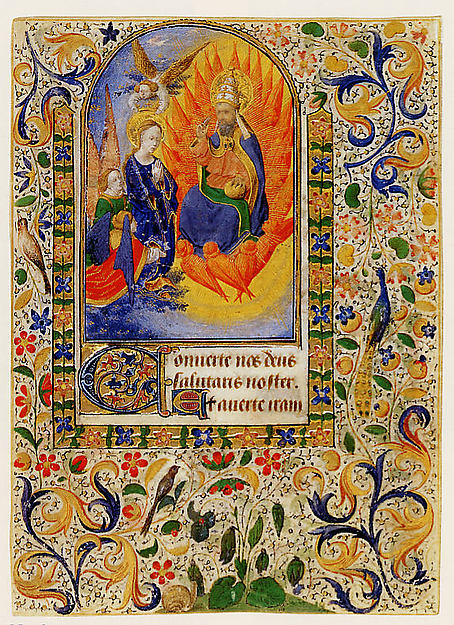
Coronation of the Virgin, Paris, France  (?), Tempera and gold leaf on parchment, France, probably Paris
Coronation of the Virgin, The Met
ca. 1455–60

Continuing this step-by-step progress through Compline (Pt 3), today a little about versicles.  This post also covers their use in the other hours.


OVERVIEW

Versicles are short verses with a response.

At Compline a sign of the cross is made at the ‘Adjutorium nostrum’ verse, and over the heart with the thumb at the ‘Converte nos Deus’.

Alleluias are added to the versicles (where marked) in Eastertide.

More elaborate chant tones are used for Lauds and Vespers, and for feasts at those hours.

What is a versicle?


The versicle is a short statement and response.

In the Diurnal they are usually just marked V: and R:

All of the hours contain versicles, and in the main they are very straightforward to say.

Still, there are a few rubrics that go with them in particular hours, such as Compline, and variants in the chants used them on feasts that are worth noting.

Where the versicles are placed


At Prime to None and Compline, there are versicles after the short reading and/or chapter verse, acting as the equivalent of a responsory to it. Versicles also have other positions and functions in the hours though.

Compline

The first versicle of Compline is said immediately after the short reading:

V. Adjutórium nostrum in nómine Dómini. +
R. Qui fecit cælum et terram.
V. Our help is in the name of the Lord, +
R. Who made heaven and earth.

A second closes off the first section of the hour, 'responding' perhaps to our act of contrition:

V. Convérte nos Deus,+ salutáris noster.
R. Et avérte iram tuam a nobis.
V. Turn us then, O God,+ our saviour: 
R. And let thy anger cease from us.

And there is another one after the chapter verse that comes in the middle section of Compline:

V. Custódi nos, Dómine, ut pupíllam óculi.
R. Sub umbra alárum tuárum prótege nos.
V. Keep us, Lord, as the apple of thine eye.
R. Protect us under the shadow of thy wings.

Prime to None

At both Prime and Compline (aside from those linked to the Marian antiphon), the versicles are the same each day.

At Terce, Sext and None, however, they vary with seasons and feasts, in order to match the chapter verses they follow.

Matins, Lauds and Vespers

At Matins the versicles come immediately after the psalms are said in each Nocturn, while at Lauds and Vespers they come after the hymn and before the New Testament Canticles, and can vary with the day of the week as well as the season or feast.

Versicles are also used at various other points through the Office.

Rubrics for the versicles


When the Office is said in common or in choir, the person leading the Office chants the verse (labelled V.), everyone then joins the response (R.).

In private recitation, just say both the verse and response.

Normally there are no particular gestures or postures associated with versicles.  

The key exception is at Compline, where a sign of the cross is made at the 'Adjutorium nostrum', and with the thumb over the heart at the 'Converte nos Deus'.

Eastertide

The other point worth being aware of is that during Eastertide, alleluias are added to the versicles in the main part of the hour.

If you look at page 263 in the Diurnal (AM 172), for example, you will see  it says (T.P. Alleluia or, in the English version, P. T...).  This means add an Alleluia to the verse (and response) during Paschaltide (Tempus Paschali, ie Easter).

Chant tones for versicles


The Antiphonale Monasticum provides four alternate tones for the versicles (AM 1232-3):

  • a 'simplex tone' (Tonus simplex) for use at Prime to None and Compline, as well as when making a commemoration at Lauds;
  • a common tone (tonus communis) for Lauds and Vespers on normal days;
  • a solemn tone (tonus solemnis), for use on major feasts and Lauds and Vespers; and 
  • a tone for use in the Office of the Dead and during the Triduum (AM 1233).

SUMMARY: Rubrics for the first section of Compline


The versicle 'Converte nos' marks the end of the first section of Compline, and the table below summarises the rubrics for Compline up to this point.

Opening section of Compline

Office component
Page number
Key words
Key points to note
Rubrics
Reading - Short lesson with blessing


MD 256-7
AM 167

[video 1.07]
Jube Domne..
Noctem quietam…
Alternative readings can be used
Stand; in monastery, reader kneels for the blessing
Versicle  
MD 257

[video 1.56]

Adjutorium nostrum…
Make sign of cross
Examination of Conscience or Pater Noster

Confession, absolution
MD 257


MD 258-9 (Unless in a monastery or with a priest leading)


[video 2.17]


Confiteor Deo omnipotenti…

Misereatur nostri…

Indulgentiam…


The Diurnal provides two versions of this section – use the second in private recitation.

Note addition of St Benedict to the Confiteor.

Bow (profound)


Strike breast x3 at mea culpa.

At absolution (Indulgentium), make sign of the cross


Versicle
MD 259


[video 3.49]
Converte nos Deus…
Sign of cross with thumb over heart


Yu can find the next part in this series, on the opening prayers of the Office (and opening of the middle section of Compline), here.

Friday, January 19, 2018

Learn the Office 2.2 - Examen and Confession (Compline step-by-step 2)

Image result for confiteor

When the day’s work is ended, thanksgiving should be offered for what has been granted us or for what we have done rightly therein and confession made of our omissions whether voluntary or involuntary, or of a secret fault, if we chance to have committed any in words or deeds, or in the heart itself; for by prayer we propitiate God for all our misdemeanors.  

The examination of our past actions is a great help toward not falling into like faults again; wherefore the Psalmist says: ‘the things you say in your hearts, be sorry for them upon your beds.’ (Ps 4:5)  Again, at nightfall, we must ask that our rest be sinless and untroubled by dreams. At this hour, also, the ninetieth Psalm should be recited.

Long Rule of St Basil the Great (330-379)


Compline step-by-step part 2 - Examen and confession


This post continues this step-by-step guide to Compline and the components of the Benedictine Office, looking at the Examination of conscience and confession section of Compline.


OVERVIEW

The form of the Confiteor and absolutions used depends on whether or not the Office is being said with or by a priest.

The Confiteor used in the Benedictine Office includes a reference to St Benedict.

The examen


The rubrics in the 1962 Office provide two options - either make a brief examination of conscience, or say an Our Father silently.

The Confiteor and absolutions


The Diurnal then provides two versions of the Confiteor (I confess..).

In a choir of monks

The first version (MD 257, and with an instruction in red that 'The hedbomadary recites the Confiteor') is only used in a choir of monks (or where the Office is lead by a priest). 

The format is the same as in the prayers at the foot of the altar at an EF Mass, with the Confiteor recited first by the 'hebdomadary' (person leading the Office on the day), then by everyone else.

In private recitation or a choir of nuns

Where the Office is said by one person alone, a small group, or by a choir of nuns, the second formula (on page 258) is used.

The text of the Confiteor

It is also worth noting that wording of the Confiteor is slightly different than that used in either the Ordinary or Extraordinary Form Mass as it adds in an invocation to St Benedict.

For those not familiar with the Latin, the video below is not the monastic version, but it says it very slowly so is useful for learning.

Body postures an gestures


In private recitation it is not compulsory to follow the rubrics on standing, sitting, bowing etc - just do what you can.

Still, praying with our bodies helps our mind to focus on what we are doing, so making a profound bow while saying the Confiteor, just as the priest and servers do at Mass, is a good practice to get into the habit of.

You should also make a sign of the cross at the absolution (Indulgentiam...).


And for a version sung on one note:


*NB The videos may not be available in some regions.

Compline - opening section recap


 Opening section of Compline
Office component
Page number
Key words
Video time

MD 256-7
AM
Jube Domne..
Noctem quietam…

1.07
Versicle  
MD 257
Adjutorium nostrum…

1.56
Examination of Conscience

Confession, absolution
MD 257


MD 258-9 (Unless in a monastery or with a priest leading)


Confiteor Deo omnipotenti…

Misereatur nostri…

Indulgentiam…


2.17


3.18

3.32


Versicle
MD 259
Converte nos Deus…

3.49


Thursday, January 18, 2018

Learn the Office 2.1 - The short lesson at Compline (Compline step-by-step 1)


 Compline

…a most beautiful custom has developed in the Church, namely that through each hour of daily psalmody a passage from the Old or New Testament is recited by heart for all to hear, and thus strengthened by the words of the apostles or the prophets, they bend their knees to perseverance in prayer, but also at night, when people cease from the labours of doing good works, they turn willing ears to listen to divine readings.  

St Bede, On Ezra and Nehemiah (Neh 9:3), trans Scott deGregorio, pp 200-201


OVERVIEW

Compline begins with a short lesson.

The texts are laid out in full on MD 256 and AM 167; the chants can be found on AM 1235.

The front section of Compline includes the reading; examination of conscience, confession and absolution; and ends with a short versicle. It is not described in the Rule, but has ancient origins.


The rubrics for the reading at Compline


If you watched the video of Compline in the previous post,  or have looked at this hour in your book, you will know it starts with a short lesson, usually from 1 Peter 2:8-9.

You can find the text for the reading in the Monastic Diurnal at page 256-7, or in the Antiphonale Monasticum on page 167.

The basic format of the reading is more or less the same as for the readings at Matins.

It starts with a request for a blessing for the reader.  This is followed by the blessing.  Then comes the reading, to which is added a short response formula (Tu autem Domine...).  Everyone then responds, 'Deo Gratias'.

In a monastery the reader requests the blessing from the person presiding, who then gives it; but in private recitation the words are all still said.


Jube, domne, benedícere.

Benedictio. Noctem quietam et finem perfectum concedat nobis Dominus omnipotens. Amen.

Lectio ...
V. Grant, Lord, a blessing.

Benediction. May almighty God grant us a peaceful night and a perfect end. Amen.


Reading ...


After the blessing for the reading, everyone (except the reader) sits down.

The standard ending for readings, which is usually not written out in breviaries, is:

V. Tu autem, Dómine, miserére nobis.
R. Deo grátias.
V. But thou, O Lord, have mercy upon us.
R. Thanks be to God.


The chants for the reading


The easiest way to learn the chant tones for this section of Compline is probably to learn it by ear, either by using the video (below), or listening to Compline sung by the monks of Le Barroux.

The chant tones for it are laid out in full in the Antiphonale Monasticum on page 1235 (Tonus Lectionis brevis).


Place in the structure of Compline


As we go through the hours, I would encourage you to read the descriptions of them contained in the Rule of St Benedict (written some time in the period 510-547), and match them up with the Office as you find it in your Diurnal.

the 1962 Office is, of course, the product of around fifteen hundred years of 'organic' (and perhaps sometimes some 'inorganic!) development' of the liturgy, so there are differences.  In most cases though, they are fairly minor.

Of all the hours, though, Compline is actually the one that seems at first glance to have developed the most, with St Benedict's prescriptions now sandwiched between a 'new' front section containing a short reading and confession, and a Marian antiphon and prayer at the end.

In reality though, as the 'added' front section of Compline probably just formalizes and codifies what was always done informally -  a seventh century description of monastic practices in Rome (circa 670) mentions starting the hour with a reading for example.

The table below summarises the content of the first section of Compline, before the elements that St Benedict mentions in chapters 17&18 of the Rule.  It also gives time references to the video, to help you follow it.

 Opening section of Compline
Office component
Page number
Key words
Video time

Reading - Short lesson with blessing
MD 256-7
AM
Jube Domne..
Noctem quietam…

1.07
Versicle  
MD 257
Adjutorium nostrum…

1.56
Examination of Conscience

Confession, absolution
MD 257


MD 258-9 (Unless in a monastery or with a priest leading)


Confiteor Deo omnipotenti…

Misereatur nostri…

Indulgentiam…


2.17


3.18

3.32


Versicle
MD 259
Converte nos Deus…

3.49


Learn the Office 2.0: The individual components of the Office

So far this series has covered some general introductory points on the traditional Benedictine Office.

Why you need to know the rules for the individual components of the Office


In this next section (labelled Learn the Office 2.0-12), I plan to go through each of the individual components that make up the Office.

Each of the components of the Office have specific rules attached to them that generally apply across each of the hours where they are used.

Although the particular texts used changes, the general principles don't.

That includes things like some words that get added on to the end of particular parts of the Office (but not always spelt out in Office books), such as 'Amen', or 'Thanks be to God'.

It can also include rubrics - such as standing or bowing for a particular part of the Office.

So if you know how to say or sing the 'chapter' verse of Prime, you also know how to say it at Lauds, Vespers and the other hours.

How to use these notes


I have listed out all the posts in this section of the series below.

You can either choose to work through them systematically, or just look up the particular element of the Office that you are unsure how to say when you encounter it in the Office.

As Compline is the simplest hour to learn as it is basically the same each day, so I've started with the components of it, and followed the order they appear in that hour (with a few interpolations to cover of other hours) so you can get started straightaway with this hour.

2.1 The short lesson at Compline

2.2 Examination of conscience and confession at Compline

2.3 Versicles

2.4 The opening prayers of the hours - used at all of the day hours (Lauds to Vespers, and in the middle of Compline, each day).

2.5 How the psalms are said Pt 1: The psalms, and psalms without antiphons  (Psalms without antiphons are used at Compline,Lauds and Matins)

2.6 Psalms Pt 2: Psalms and canticles with antiphons (How the psalms and canticles are said at Lauds to Vespers)

2.7 Psalms Pt 3: Singing the psalms and antiphons

2.8 The Office hymns

2.9 The chapter (verse)

2.10 The closing prayers of the Office Pt 1: Structure - the framework used at all of the day hours.

2.11 The closing prayers of the Office Pt 2: Collects

2.12 The closing prayers of the Office Pt 3: Commemorations and memorials

2.13 The Marian antiphon at Compline

2.14 The short responsory at Lauds and Matins


Looking at the individual hours


In the third part of this series, I will go through the structure of the day hours to show you how the various components of the Office are used in each hour, and give you a bit of a flavour of each hour.

And follow the link to go to the next part in this series, on the opening reading at Compline.

Wednesday, January 17, 2018

Learn the Office 1.6: Preparatory prayers


We believe that God is present everywhere and that the eyes of the Lord behold the good and the bad in every place.  

Let us firmly believe this, especially when we take part in the Work of God. Let us, therefore, always be mindful of what the Prophet saith, "Serve ye the Lord with fear" And again, "Sing ye wisely". And, "I will sing praise to Thee in the sight of the angels". 

Therefore, let us consider how it becometh us to behave in the sight of God and His angels, and let us so stand to sing, that our mind may be in harmony with our voice.

Rule of St Benedict, ch 19

Getting started


Before actually saying the hours, it is important to prepare yourself mentally, in line with St Benedict's instructions in his Rule.

Approaching the hours


Traditionally, those saying the Office said preparatory prayers beforehand so as to put themselves in the right frame of mind, remind themselves of what they were doing, and ask for God's help in doing it.

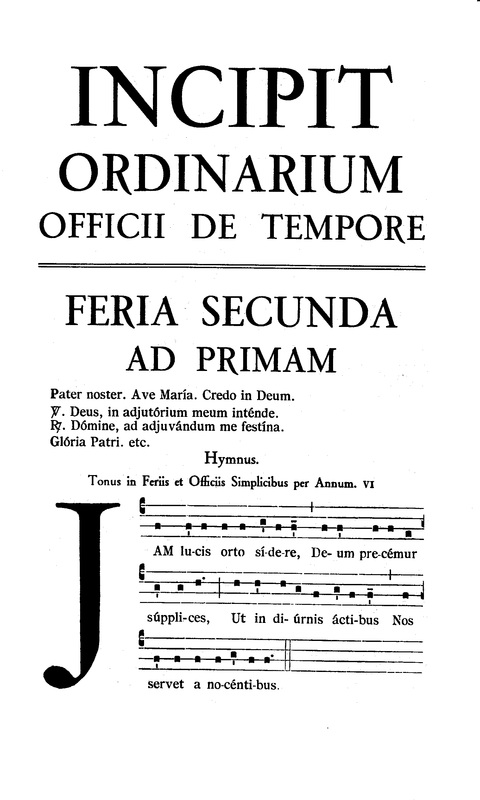
If you look at the first page of the psalter section in the Antiphonale Monasticum, for example, for Monday Prime (Feria Secunda ad Primam) you will see the words 'Pater noster, Ave Maria.  Credo in Deum'.
Image result for incipit ordinarium officii de tempore image
They are code for 'say an Our Father, Hail Mary and the Creed'.

These prayers are no longer compulsory to say before the Office.

All the same, you might want to consider saying the Aperi Domine, the standard prayer that was previously said before the start of the Office each day:

APERI, Dómine, os meum ad benedicéndum nomen sanctum tuum: munda quoque cor meum ab ómnibus vanis, pervérsis et aliénis cogitatiónibus; intelléctum illúmina, afféctum inflámma, ut digne, atténte ac devóte hoc Offícium recitáre váleam, et exaudíri mérear ante conspéctum divínæ Majestátis tuæ. Per Christum Dóminum nostrum. Amen.
Open Thou, O Lord, my mouth to bless Thy holy name; cleanse my heart from vain, evil and wandering thoughts; enlighten my understanding, inflame my will, that so I may worthily, attentively and devoutly recite this Office and deserve to be heard in the presence of Thy Divine Majesty. Through Christ our Lord. Amen. O Lord, in union with that divine intention wherewith Thou whilst here on earth didst Thyself praise God, I offer these Hours to Thee.
Dómine, in unióne illíus divínæ intentiónis, qua ipse in terris laudes Deo persolvísti, has tibi Horas (vel hanc tibi Horam) persólvo.
O Lord, in union with that divine intention wherewith Thou Thyself, while on earth, didst offer praises unto God, I offer these hours (or this hour) unto Thee.


Compline


And to get a sense of what the Office is really about, I recommend watching the video of Compline below, from the monastery of Farnborough, that really conveys, I think, the sense of reverence with which we should approach the liturgy.

If you want to follow it in your book, you can find the texts in the Diurnal on page 256, or in the Antiphonale on 167.

Don't worry if you get lost though, we will go through the hour step by step in future posts.


SUMMARY


Before you start saying the Office each day, make sure you are ready.

Saying the ‘Aperi Domini’ is a good way of preparing to say the Office.


You can find the next part in this series here.

Tuesday, January 16, 2018

Learn the Office 1.5 - What changes and what doesn't in the Office

The last of the preliminaries I want to cover before we get down to the hours themselves and their components, is about the distinction the fixed parts of the Office, and those that change with week, season and/or feast.

In this post I want to provide a bit of an overview of each of these cycles which you can refer back to as we go through the Office in more detail.


OVERVIEW

The Benedictine Office contains several different cycles which affects what you should say in it, encompassing:
  • the eight 'hours' said through each day and night;
  • the cycle of psalms and other prayers that change with the day of the week
  • the annual liturgical cycle, which is based around the week of the liturgical year, including movable feasts whose date depends on the date of Easter each year; and 
  • feasts attached to fixed dates in each month of the calendar year.


The hours 

Image result for divine office image

The eight hours

As noted previously, the Benedictine Office is made up of eight separate sets of prayers called 'hours', although in reality they are mostly much shorter than that to say.

They are called the hours because they mark the turn of them.

In St Benedict's time, the day was divided into twelve even hours of daylight  - so an 'hour' was shorter in winter and longer in summer.

The hours mostly just the Roman name of the hour.  So Prime means first, for the first hour of the day; Terce, means the third hour; Sext the sixth; and None the ninth.

The table below summarises when each hour is ideally said.  Note that while it is good to aim to say those hours that you say at around the correct time, it isn't absolutely essential.  Just make sure you say whichever hours you say in the correct order.

Hour of the Office
Indicative time of day said
Matins (not in Diurnal)
In darkness, very early morning
Lauds
First light/dawn
Prime
Before starting work
Terce
Mid-morning
Sext
Lunchtime/noon
None
Mid-afternoon
Vespers
Sunset/early evening
Compline
Before bed

Note that while professed religious (monks and nuns) are generally obliged to say all of the hours each day, laypeople are simply encouraged to say whatever hours of the Office they can.  Before Vatican II many monasteries encouraged their Oblates to say Prime and Compline; these days many suggest Lauds and Vespers.

The fixed elements of the hours

Each of the hours has some fixed elements.

The extreme case of this is Compline, where all of the texts used are the same each day; only the Marion antiphon and prayer at the end varying with the seasons.

Some fixed elements are common to most or all of the hours - the opening and closing prayers for example.

Many of these fixed elements, though, are particular to the individual hours, and help give each of them a distinctive flavour.

At Prime, Terce, Sext, None and Compline, for example, the hymns are the same each day at that particular hour, and include references to the time of day when the hour is said.

Lauds and Vespers both include New Testament Canticles, the Benedictus and Magnificat respectively.

Matins and Lauds both contain psalms appropriate to the hour that are said every day of the week.


Day of the week


Image result for days of creation medieval


Aside from Compline, all of these hours include some elements that change over the course of the week.

Terce, Sext and None have a threefold form, with different stanzas of Psalm 118 being used at each hour on Sunday and Monday, and then repeats the first nine of the Gradual psalms on Tuesday to Saturday each week.

The remaining hours - Matins, Lauds, Prime and Vespers - each have unique sets of psalms, as well as some other elements, such as hymns for each day of the week for most of the year.

The liturgical week and seasons


The Office is closely linked to the Mass, and this is particularly reflected in the Office as it is said on Sunday.

St Benedict makes it clear in his Rule that the liturgical week starts with Sunday.  And Sundays in the liturgy have specific texts attached to them, appropriate to the changing liturgical seasons.

In the Office as it has evolved over time, the links between the Mass and the Office are made clear by use of the same collect most of the time, and by antiphons at Lauds and Vespers of Sunday that normally refer to the Gospel of the day (in the Extraordinary Form calendar).

Some of the other standard parts of the Office, such as the hymns at Lauds and Vespers, also change to reflect the liturgical season or day.

Feasts fixed by calendar date


Related image


The final cycle that affects the Office is that of feasts fixed to particular calendar dates - feasts or other special days that always occur on a particular date, such as Christmas Day, and feasts of individual saints.

The Monastic Diurnal provides a listing of those in the 1962 General Calendar by month in the front section.  Each monastery, diocese, country or region has its own special feasts that you will need to add to this yourself though.


Using an Ordo


In theory you can use the table of movable feasts that appears in the front of the Monastic Diurnal to work out which season and week of the liturgical year you are in, and so what collect and other texts you need to use.

And you can use the calendar to track what feasts of saints are reflected in the Office.

In practice though, the interactions between movable days and calendar date feasts can get quite complex.

The best approach is therefore to use an 'Ordo' for the Office, that helps keep you keep track of what you should be doing.

Ordos normally tell you about the things that differ, on a particular day, to the standard 'ferial', or everyday Office.

Some monasteries put out their own Ordos for the use of their Oblates.

Alternatively you can use the 'default Ordo', which follows the General Calendar for the Benedictine Order provided on the Saints Will Arise, and just add in any feasts that apply to your particular monastery or location.


FURTHER READING


For more details on the rules around when the hours are properly said, go here.


And you can find the next part of this series, on prayers before saying the Office here.