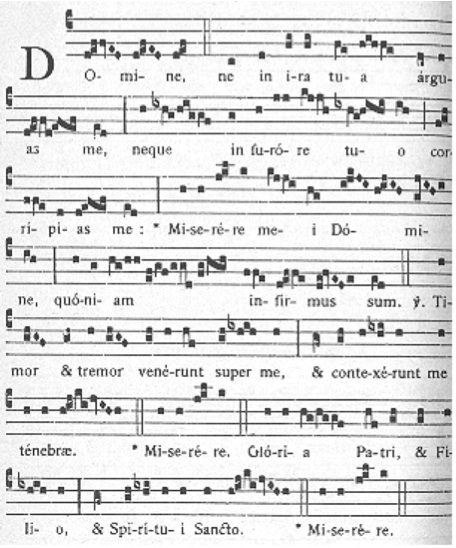
[Matins on weekdays in
winter] …let three lessons be read from the book on the lectern by the brethren
in their turns, and let three responsories be chanted between them. Two of the
responsories shall be said without the Gloria; but after the third lesson let
the reader chant the Gloria. And as soon as he has begun it, let all rise from
their seats in honour and reverence to the Holy Trinity.
Rule of St Benedict, chapter 9
[Matins on weekdays in
summer] Instead of the three lessons, let there be one from the Old Testament
said by heart, and let it be followed by a short responsory.
Rule of St Benedict, chapter 10
[Matins on Sundays] …then
let there be read from the book, as we said before, four lessons with their
responsories. In the fourth responsory only shall the reader chant the Gloria,
and when he begins it let all rise immediately with reverence.
Rule of St Benedict, chapter 11
The rubrics for the elements of Matins
The last element of the rubrics we need to cover is the responsories, as the table below illustrates.
ELEMENTS OF MATINS
|
OPENING SECTION
|
Opening prayer – Domine labia mea aperies
|
Psalm 3
|
Invitatory antiphon and Psalm 94
|
Hymn
|
NOCTURNS
|
| Antiphons |
| Psalms of the day of the week |
| Psalms of Commons and feasts |
| Canticles |
Versicle, Our Father and absolution
|
Blessings for the reader
|
Readings
|
Responsories
|
CONCLUDING SECTION
|
Te Deum (hymn)
|
| Gospel |
Te Decet Laus (hymn)
|
| Concluding Prayers |
What are responsories?
Responsories are chants sung after the readings.
On weekdays during 'summer', they have the same structure as the short responsories of Lauds and Vespers. On Sundays, feasts and in 'winter' they have a slightly different structure, and generally come with much more elaborate chant settings.
The responsories at Matins are typically a mix of texts relating to the particular book of the Bible being read (in the case of the first and second Nocturns), and the season. There are usually special responsories for feasts.
The age of the current repertoire of responsories is disputed: while St Benedict and other sixth century rules talk about responsories, the earliest surviving texts date from the eighth century, so it is unclear whether the same repertoire was in use earlier or not.
Rubrics for the responsories
If you are saying the Office alone, you simply say (or preferably sing!) the whole of the responsory. If the Office is said in choir, a cantor usually starts, with the choir (or a sub-set of it in the case of more complicated responsories) singing the refrain.
Interpreting the breviary
The key issue with responsories is that in a breviary and chant books, they are often not written out in full, so you have to know the structure and/or be able to interpret the cues.
A Matins responsory typically appears in the breviary, for example, looking like this:
| R. Adjutor et susceptor meus es tu Domine: et in verbum tuum speravi:* Declinate a me magni: et scrutabor mandata Dei mei. V. Iniquos odio habui: et legem tuam dilexi. Declinate | V. I hate the unrighteous, but thy law do I love. Depart |
The red initial letter for 'Declinate' is a cue to say all of the words following the asterix (*) in the first line, viz in this case, Declinate a me magni: et scrutabor mandata Dei mei.
In the case of the third (or fourth on Sundays) responsory, containing the half doxology, the breviary pattern normally goes like this:
| R. Adjutor et susceptor meus es tu Domine: et in verbum tuum speravi:* Declinate a me magni: et scrutabor mandata Dei mei. V. Iniquos odio habui: et legem tuam dilexi. Declinate Gloria Patri. Declinate | V. I hate the unrighteous, but thy law do I love. Depart. Glory be. Depart. |
In each case the red letters are a cue for the phrase that should be said, so that this responsory would actually be said as follows:
R. Adjutor et susceptor meus es tu Domine: et in verbum tuum speravi:* Declinate a me magni: et scrutabor mandata Dei mei.
V. Iniquos odio habui: et legem tuam dilexi.
R: Declinate a me magni: et scrutabor mandata Dei mei.
V: Gloria Patri et Filio et Spiritui Sancto
R: Declinate a me magni: et scrutabor mandata Dei mei.
In a chant book, the same chant is generally used for the text following the asterix each time, and so the book simply provides the initial word and note as a cue. In addition, there are fixed tones for the Gloria Patri for each mode, which can be found in the front of the Liber Responsorialis for example, and so these are often not written out in full either.
Variations on the standard pattern
It should be noted that there are a number of variations on this standard pattern that occur during the year. The very first responsory of the year, in Advent, for example (Aspiciens a longe) has an extended form, while in Passiontide the half doxology is omitted. The key is simply to follow the cues in your book!
Finding responsories (and translations for them!)
In a breviary, the responsories usually follow on immediately after the readings.
If you are using Monastic Breviary Matins, you will often find them in a separate section - because the responsories are generally the same for the three or four weeks of a month when a particular book of Scripture is being read, or for a season, they save space by putting them together rather than repeating them each time.
The responsories used in the Benedictine Office typically have a high degree of overlap with the Roman Office, but because the Roman Office uses fewer responsories (on Sundays eight rather than twelve), Divinum Officium (which uses the Roman readings and responsories only) will not provide you with translations of all of the responsories each week. On some but not all occasions, the missing responsories are used on the following weekdays or some other occasion in the Roman office and so can be chased down. This is not always the case though.
In the next post in this series I will look at the various websites and books that you find the responsories in.

No comments:
Post a Comment