Tuesday, April 11, 2017

Matins rubrics for ferias and feasts: A summary


Image result for matins


As we have gone through this series, I've provided you with the rubrics for the various elements of Matins individually.  Now that we have basically covered all of the elements of Matins, I thought it would be helpful to bring all of that material together in summary form.

The two basic forms of Matins


The key points overall are that:
  • Matins always opens the same way, with Domine labia mea aperies.., Psalm 3, Psalm 94 with invitatory and a hymn; and
  • then has Matins either two Nocturns (ordinary days) or three (Sundays and major feasts). 
If Matins has three Nocturns, it always has twelve readings and responsories, and ends with the Te Deum, Gospel and Te decet laus.

If Matins has two Nocturns, it can have either one or three readings, depending on whether it is winter or summer, and the level of day in the liturgical calendar, and ends with a short chapter verse before the concluding prayers.


Sunday Matins
Festal Matins
Weekdays
                                                     Opening prayer – Domine mea aperies
                                                     Psalm 3 (without antiphon)
                                                     Psalm 94 (with responsorial verse)
                                                    Hymn (of day, season or feast)
Nocturn I: Six psalms (of Sunday) with antiphons
Six psalms and antiphons (for the feast or from common)
Six psalms of the day of the week with antiphons
                                                      Versicle, Our Father, absolution
4 readings+responsories
Summer: blessing, short readings, responsory
Winter/minor feasts: 3 readings
Nocturn II: Six psalms (of Sunday) with antiphons
Six psalms with antiphons (from common or of feast)
Six psalms of the day of the week with alleluias as antiphon at beginning and end

Chapter, versicle
                            Versicle, Our Father, absolution                
-
                           4 readings+responsories
-
Nocturn III:                       3 canticles with one antiphon
-
                           Versicle, Our Father, absolution
-
                          4 readings+responsories
-
                         Te Deum (hymn)
 -
                          Gospel
 -
                         Te Decet Laus (hymn)
 -
Collect, Dominus vobisum…Benedicamus Domino, etc
Standard closing prayers

Weekdays

On ordinary weekdays throughout the year, Matins has two Nocturns.

Outside of Advent, Lent and Eastertide (Class IV ferias), the invitatory antiphon, hymn, antiphon and psalms are all of the day of the week.

During the special liturgical seasons, the invitatory antiphon, hymn and sometimes the antiphons (for example the second Nocturn antiphons from Septuageima to Easter; and for Eastertide) are often of the season.

The number of readings depends on whether it is 'summer (after Easter to the end of October) or winter.

As for the other hours, the collect is usually of the (previous) Sunday, except during the more intense liturgical seasons.

Sundays


Sundays always have three Nocturns, with the third Nocturn consisting of canticles.

As for weekdays, outside of the special liturgical seasons, the invitatory antiphon, hymn, psalms and antiphons are for the Sunday (some seasonal variations in the hymn).

The readings, responsories, Gospel and collect are for the particular Sunday of the year.

Feasts


The key changes to Matins on (Class I to III) feasts are that:
  • feasts always have an invitatory antiphon and hymn either specific to the feast, or from the relevant Common;
  • major feasts also have psalms and antiphons (and versicles) of the feast; and
  • there can be either 12, 3 or 1 reading depending on the season and level of the feast. 

How Matins varies depending on the level of the day


The table summarises the key things that change depending on the type and level of the day.

Type of ‘day’
Impact on Matins
Sundays
Three Nocturns, twelve readings and responsories of the Sunday, rest of the season or Sunday
Class I&II feasts
Invitatory antiphon and hymn of the feast (or from the relevant Common); three Nocturns, twelve readings and responsories of the feast, psalms, antiphons etc for feast or from the relevant Common
Class II&III days (Lent and Advent, Ember days etc days)
Ordinary of the season, three readings and responsories of the day
Class II&III vigils (of feasts)
Ordinary of the season, three readings and responsories of the day
Class III feasts in summer (Eastertide to end of October)
Invitatory antiphon & hymn of feast or from the common; reading of the feast
Class III feasts in winter
Invitatory antiphon & hymn of feast or from the common;  3 readings  (1 or 3 of the feast)
Class IV days in winter
Ordinary of the season, three readings
Class IV days in summer
Ordinary of the season, one short reading of the day of the week


Please do let me know if you think I've got anything wrong!

Monday, April 10, 2017

Nocturns 7/ Resources for the responsories


Image result for responsory in monte oliveti


In the previous post, we looked at what responsories are and their rubrics.  Today I want to look at where to find them.

There are basically three issues her as far as I can see:
  • finding the Latin text;
  • finding a translation to use to prepare them, even if you do have a breviary; and
  • finding the chant settings for them.

Finding the responsories


The basic problem is that the Benedictine Office uses more responsories than the Roman, and the ones common to them both are not always used in the same order or on the same day.  That means that sites and resources such as Divinum Officium will only get you so far.  

For weekdays, the issue isn't a big one - although there are occasionally some variations between the Roman and Benedictine Office, the Roman responsories are a reasonable enough substitute on the face of it.  

In terms of Sundays, I am gradually attempting to fill in the gaps for Divinum Officium over at my Lectio Divina blog, and I am experimenting with a separate responsory database to see if it ultimately saves me time.  But assuming that I continue with it, it will take some time before it builds up to a useful level (though if anyone would care to volunteer to help, things could move faster!).

For major feasts, some of the responsories can be found in the Liber Responsorialis.  

But for a complete listing, the only option really is a breviary, and so I will provide a review of the 1963 breviary, and cover off issues around adapting earlier breviaries in due course.

Finding translations of the responsories


If you have a breviary, the next issue may be finding a translation for the text.  Divinum Officium provides a set of translations for those that are common to the Roman Office.  My Lectio Divina blog fill s in some of the gaps, and arranges the responsories in the order specified by the 1963 breviary.  In addition the Benedictine Responsory Blog should gradually include more and more of these.

If you are looking for them yourself, though, it is worth remembering that the Benedictine Office often 'borrows' the missing responsories from other days and feasts, so if you know the Latin key words, a Google search within the Divinum Officium website will often take you to a translation elsewhere on that website.  In addition translations for some responsories which have polyphonic settings can be found on the CDPL website.

Finally, most of the responsories are based on Scripture, but with a few words omitted, or the case changed.  Accordingly, either a google search, or a look at one of the chant databases (viz Cantus or Gregorien) will often point you to the particular source.


Finding the chants


The basic challenge relating to the responsories is that Solesmes, as far as I can tell, never really revived the singing of all of the responsories at Matins, and so has never published a Nocturnale for the Office.  As a result, most monasteries have perforce, resorted to psalm toning them.

Some of the chants can be found in the Liber Responsorialis, a few more in the Processione Monasticum.  But the best source for most of them in book form is the Standhofe Nocturnale Romanum, which has the virtue of having official approval in the form of an imprimaeur.  There are though, some particular to the monastic Office that are missing from all of these sources.

In addition, I have recently been pointed to an excellent website that does appear to fill in many (but I think not all, though I'm still working my way through it) of these gaps, viz Gregofacsimil.  There looks to be lots of wonderful material there, including complete sets of all the texts necessary for Matins on some feasts and Sundays, so do go take a look.

There are also a number of academic databases, most notably the Cantus website, which provides images of manuscripts and transcriptions for some chants that can assist if you are determined to sing all of the chants or to explore this wonderful repertoire.


Saturday, April 8, 2017

Nocturns/6 - About responsories and their rubrics


[Matins on weekdays in winter] …let three lessons be read from the book on the lectern by the brethren in their turns, and let three responsories be chanted between them. Two of the responsories shall be said without the Gloria; but after the third lesson let the reader chant the Gloria. And as soon as he has begun it, let all rise from their seats in honour and reverence to the Holy Trinity.

Rule of St Benedict, chapter 9

[Matins on weekdays in summer] Instead of the three lessons, let there be one from the Old Testament said by heart, and let it be followed by a short responsory.

Rule of St Benedict, chapter 10

[Matins on Sundays] …then let there be read from the book, as we said before, four lessons with their responsories. In the fourth responsory only shall the reader chant the Gloria, and when he begins it let all rise immediately with reverence.

Rule of St Benedict, chapter 11


The rubrics for the elements of Matins


The last element of the rubrics we need to cover is the responsories, as the table below illustrates.

ELEMENTS   OF MATINS
OPENING SECTION
Opening prayer – Domine labia mea aperies
Psalm 3
Invitatory antiphon and Psalm 94
Hymn
NOCTURNS
Antiphons
Psalms of the day of the week
Psalms of Commons and feasts
Canticles
Versicle, Our Father and absolution
Blessings for the reader
Readings
Responsories
CONCLUDING SECTION
Te Deum (hymn)
Gospel
Te Decet Laus (hymn)
Concluding Prayers


What are responsories?


Responsories are chants sung after the readings.

On weekdays during 'summer', they have the same structure as the short responsories of Lauds and Vespers.  On Sundays, feasts and in 'winter' they have a slightly different structure, and generally come with much more elaborate chant settings.

The responsories at Matins are typically a mix of texts relating to the particular book of the Bible being read (in the case of the first and second Nocturns), and the season.  There are usually special responsories for feasts.

The age of the current repertoire of responsories is disputed: while St Benedict and other sixth century rules talk about responsories, the earliest surviving texts date from the eighth century, so it is unclear whether the same repertoire was in use earlier or not.

Rubrics for the responsories


If you are saying the Office alone, you simply say (or preferably sing!) the whole of the responsory.  If the Office is said in choir, a cantor usually starts, with the choir (or a sub-set of it in the case of more complicated responsories) singing the refrain.

Interpreting the breviary

The key issue with responsories is that in a breviary and chant books, they are often not written out in full, so you have to know the structure and/or be able to interpret the cues.

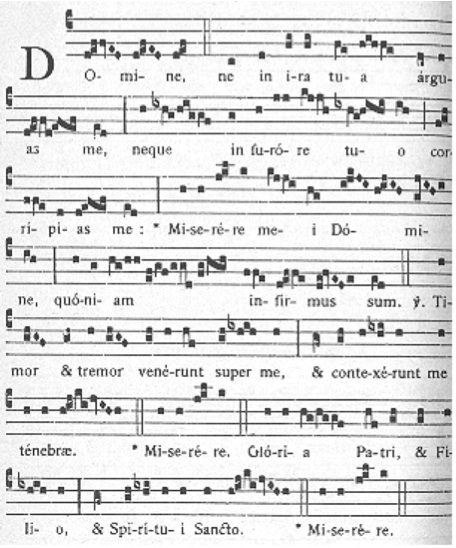
A Matins responsory typically appears in the breviary, for example, looking like this:

R. Adjutor et susceptor meus es tu Domine: et in verbum tuum speravi:* Declinate a me magni: et scrutabor mandata Dei mei.
V. Iniquos odio habui: et legem tuam dilexi.
 Declinate 


R. Thou art my Helper and my Protector, O Lord, and in thy word do I hope.* Depart from me, ye evil doers, for I will keep the commandments of my God.
V. I hate the unrighteous, but thy law do I love.
 Depart

The red initial letter for 'Declinate' is a cue to say all of the words following the asterix (*) in the first line, viz  in this case, Declinate a me magni: et scrutabor mandata Dei mei.

In the case of the third (or fourth on Sundays) responsory, containing the half doxology, the breviary pattern normally goes like this:

R. Adjutor et susceptor meus es tu Domine: et in verbum tuum speravi:* Declinate a me magni: et scrutabor mandata Dei mei.
V. Iniquos odio habui: et legem tuam dilexi.
 Declinate Gloria Patri. Declinate


R. Thou art my Helper and my Protector, O Lord, and in thy word do I hope.* Depart from me, ye evil doers, for I will keep the commandments of my God.
V. I hate the unrighteous, but thy law do I love.
 Depart.  Glory be. Depart.

In each case the red letters are a cue for the phrase that should be said, so that this responsory would actually  be said as follows:

R. Adjutor et susceptor meus es tu Domine: et in verbum tuum speravi:* Declinate a me magni: et scrutabor mandata Dei mei.
V. Iniquos odio habui: et legem tuam dilexi.
R: Declinate a me magni: et scrutabor mandata Dei mei.
V: Gloria Patri et Filio et Spiritui Sancto
R:  Declinate a me magni: et scrutabor mandata Dei mei.

In a chant book, the same chant is generally used for the text following the asterix each time, and so the book simply provides the initial word and note as a cue.  In addition, there are fixed tones for the Gloria Patri for each mode, which can be found in the front of the Liber Responsorialis for example, and so these are often not written out in full either.

Variations on the standard pattern

It should be noted that there are a number of variations on this standard pattern that occur during the year.  The very first responsory of the year, in Advent, for example (Aspiciens a longe) has an extended form, while in Passiontide the half doxology is omitted. The key is simply to follow the cues in your book!

Finding responsories (and translations for them!)


In a breviary, the responsories usually follow on immediately after the readings.

If you are using Monastic Breviary Matins, you will often find them in a separate section - because the responsories are generally the same for the three or four weeks of a month when a particular book of Scripture is being read, or for a season, they save space by putting them together rather than repeating them each time.

The responsories used in the Benedictine Office typically have a high degree of overlap with the Roman Office, but because the Roman Office uses fewer responsories (on Sundays eight rather than twelve), Divinum Officium (which uses the Roman readings and responsories only) will not provide you with translations of all of the responsories each week.  On some but not all occasions, the missing responsories are used on the following weekdays or some other occasion in the Roman office and so can be chased down.  This is not always the case though.

In the next post in this series I will look at the various websites and books that you find the responsories in.


Friday, April 7, 2017

Book review: Liturgical readings


Liturgical Readings The Lessons of the Temporal Cycle and the Principal Feasts of the Sanctoral Cycle according to the Monastic Breviary, Grail Publications, St Meinrad, 1943 (various reprints; I am using one from 1954).

Liturgical readings, still available as a reprint, is one of those books I recommend thinking about buying if you are serious about Matins.

This book wasn't put out for liturgical use - although it has an imprimateur, it specifically says it was for study purposes - but it can readily be used in conjunction with the Office.


What it contains


The first section of the book contains the Patristic readings for the temporal cycle of the year.  For each Sunday and fixed feast, it lists out the (Scriptural) first Nocturn readings, then provides the second and third Nocturn (Patristic) readings.  Through Lent, it provides the weekday Patristic readings, Gospel and collect.

The second half of the book covers most of the first and second class feasts of the sanctoral cycle.

As a bonus, because it dates from before the culling of Octaves, you get a number of extra readings for some feasts (including local feasts of St Meinrad).

The readings are not headed reading 1, reading 2 etc, but the divides the paragraphs to follow the divisions of the Office.

What it doesn't include


The key things missing from a practical point of view are texts for newer feasts added to the calendar or upgraded.  Most of these, however, can be filled in from other sources such as Divinum Officium and the supplement put out by Clear Creek.

It doesn't include the readings for Class III feasts.

And the really unfortunate omission from a practical point of view is the responsories.


Pros and cons


The big advantage of this book as far as a source of translations goes is that it invariably includes readings (or parts thereof) omitted in the Roman Office and so not otherwise available from places like Divinum Officium.  It also follows the traditional cycle of Mass readings (unlike Monastic Breviary Matins, which occasionally diverges from the Catholic cycle).

The translations are generally very good in my view (superior to those on Divinum Officium) and the book is nicely laid out and easy to read (at least in the edition I have).

It is perfect for study use, but for some (new or upgraded) feasts you would need to cross-check to make sure the readings are still current, as there are occasional differences to the 1963 breviary. 

Thursday, April 6, 2017

The Nocturns/5 - rubrics for the conclusion of the nocturns and readings


Related image

When these [the psalms] are finished and the versicle said, let the abbot give a blessing; and then, all being seated in their places, let three lessons be read from the book on the lectern by the brethren in their turns...

Rule of St Benedict chapter 9

FROM Easter to the first of November let the number of the psalms be exactly as given above; but let there be this difference, that the lessons from the book be not read, on account of the shortness of the nights. Instead of the three lessons, let there be one from the Old Testament said by heart, and let it be followed by a short responsory.

Rule of St Benedict chapter 10


Today I want to cover off most of the rest of the rubrics for the Nocturns, leaving just the responsories for a separate post so far as the general rubrics are concerned.

 Just so you can see where we are up to, here is the table with the elements of Matins, with those covered in today's post highlighted.

ELEMENTS   OF MATINS
OPENING SECTION
Opening prayer – Domine labia mea aperies
Psalm 3
Invitatory antiphon and Psalm 94
Hymn
NOCTURNS
Antiphons
Psalms of the day of the week
Psalms of Commons and feasts
Canticles
Versicle, Our Father and absolution
Blessings for the reader
Readings
Responsories
CONCLUDING SECTION
Te Deum (hymn)
Gospel
Te Decet Laus (hymn)
Concluding Prayers

Versicle, Our Father and Absolution


After the last antiphon is said at the end of the first Nocturn each day, and each Nocturn when there are twelve lessons (ie Sundays and major feasts), a versicle, the Our Father (said silently) an absolution is said standing.

The versicles (ie short verse and response) are proper to the day of the week, season or feast.  The one's for each day and the main seasons can be found in most psalters or breviaries.

The Our Father is said exactly as at the day hours outside of Lauds and Vespers.

There are three absolutions normally used on weekdays:  'Exaudi Domine..' for Monday and Thursday; 'Ipsius pietas..' for Tuesday and Friday; and 'A vinculis peccatorum...' for Wednesdays and Fridays.  These three absolution formulas are also used for the first, second and third Nocturn on Sundays and feasts.

There is also a special absolution for the Office of Our Lady on Saturdays.

On Friday in Lent this section looks like this:


V. Scápulis suis obumbrábit tibi.
R. Et sub pennis ejus sperábis.


V. He will overshadow thee with his shoulders.
R. And under his wings thou shalt trust.


Pater noster (then silently: qui es in cælis, sanctificétur nomen tuum: advéniat regnum tuum: fiat volúntas tua, sicut in cælo et in terra. Panem nostrum quotidiánum da nobis hódie: et dimítte nobis débita nostra, sicut et nos dimíttimus debitóribus nostris):
V. Et ne nos indúcas in tentatiónem:
R. Sed líbera nos a malo.
Absolutio. Exáudi, Dómine Jesu Christe, preces servórum tuórum, et miserére nobis: Qui cum Patre et Spíritu Sancto vivis et regnas in sǽcula sæculórum. Amen.


Our Father (then silently:, who art in heaven, Hallowed be thy name. Thy kingdom come. Thy will be done on earth as it is in heaven. Give us this day our daily bread. And forgive us our trespasses, as we forgive those who trespass against us).
V. And lead us not into temptation:
R. But deliver us from evil.
Absolution. O Lord Jesus Christ, graciously hear the prayers of Thy servants, and have mercy upon us, Who livest and reignest with the Father, and the Holy Ghost, ever world without end. Amen. 

The blessing for the readings


After the absolution comes the blessing for the reader.  The pattern for the readings is blessing; reading; responsory.  Accordingly, the number of blessings in each Nocturn depends on how many readings are said (viz 1, 3 or 4).  The table below summarises how many readings to expect.


Type of ‘day’
Number of readings
All Sundays
12 (4 per Nocturn)
Class I&II feasts
12 (4 per Nocturn)
Class II&III days (Lent and Advent, Ember days etc days)
3 (Nocturn I)
Class II&III vigils (of feasts)
3
Class III&IV feasts and days in summer (Eastertide to end of October)
1 (of the day of the week or feast
Class III&IV feasts and days in winter
3 (on feasts 1 or more of the feast)

The blessings for feasts are usually the same as on Sundays, with the possible exception of the blessing for the eleventh reading, which usually reflects the saint or saints being celebrated.

On weekdays, the blessings used depends on the season and types of readings being used.  If you are using a breviary, look for these key words and phrases:
  • for Scriptural readings: ...ad lectiones de Scriptura');
  • Patristic: de homilia..;
  • for Class III feasts in winter: In festis III classis leguntur in hieme...;
  • in summer: In aestate
  •  or for the Office of Our Lady on Saturday.
An example of how they are said each time is set out below:

Jube, domne, benedícere.
Benedictio. Benedictióne perpétua benedícat nos Pater ætérnus. Amen.

Lectio 1...
V. Grant, Lord, a blessing.
Benediction. May the Eternal Father bless us with an eternal blessing. Amen.

Reading 1... 

After the blessing for the first reading, everyone (except the reader) sits down.

The endings for the readings


Each reading is given a standard ending, which is usually not written out in breviaries:

V. Tu autem, Dómine, miserére nobis.
R. Deo grátias.

V. But thou, O Lord, have mercy upon us.
R. Thanks be to God.

Those listening to the readings stay seated except for the Gospel, and for the short extract from the Gospel in the first reading of the Third Nocturn on Sundays and feasts. 


***Where to find the readings on Sundays


One other key point to note.  For much of the year, the readings for all three Nocturns on Sundays are found together, in the section of the breviary covering the texts for the time of year.

Between August and November, however, the readings and responsories for Nocturns I&II are of the week of the month (ie first week of August, second week of August, etc) rather than the Sunday of the liturgical year.  For this reason, you need to look in (at least) two different places during this part of the year to find the texts you need.


Readings on Class III feasts and the Office of Our Lady on Saturday


The final point to note is that the third reading set for the day (feria) can be displaced by on a Class III feast, or on other days such as a Saturday of Our Lady.  In these cases the text of the reading is not omitted altogether; instead the second and third readings are combined into one, with the reading of the day or feast then being added on.


Further reading


How important are readings in the Benedictine Office?
Book Review: Liturgical readings
Lectio Divina Notes Blog - for translations of the daily readings and responsories of the Benedictine Office


Wednesday, April 5, 2017

Nocturns/4 - The readings: how important are they really?


Codex Amiatinus


The books to be read at Matins shall be the inspired Scriptures of the Old and New Testaments, and also the commentaries on them which have been made by well-known and orthodox Catholic Fathers.

Rule of St Benedict chapter 9

I want to turn now to the readings at Matins.

In St Benedict's Office, the readings are treated as far less important than the psalms.

St Benedict decrees, for example, that the lessons be dropped altogether for summer on weekdays, and in relation to Sundays, he notes that if necessary they are to be cut short in order to start Lauds on time.  This probably reflects the fact that monks have a lot of time set aside for lectio divina, as well as hearing readings at meals and in the evening in his timetable.

The content of the readings - temporal cycle


In St Benedict's time, the readings at Matins were probably not fixed (though this is not certain), but rather set by the abbot.  Over time, however, a fixed cycle was established.  The Sunday Gospel cycle and annual Scriptural cycle in the Office (which is essentially the same as that of the Roman Office) can be traced back to the early seventh century, though the 'ordines Romani' concerned may attest to an earlier tradition.  The cycle has really only been modified at the margins since then.  The Patristic readings have their origins in a selection made by Paul the Deacon in the eighth century.

Certainly the readings in the 1963 breviary have not substantially changed, as far as I can see, since at least the time of the (post Council of Trent) Breviary of Pope Paul V (1615), a few new or changed feasts aside.  The basic cycle works like this (feasts aside).  On Sundays:
  • the first Nocturn readings are on a seasonal/monthly Scriptural cycle; 
  • Second Nocturn readings are usually Patristic commentaries on the first nocturn Scriptural readings; and 
  • the third Nocturn readings are generally Patristic commentaries on the Gospel of the (EF) Mass of the day.
On weekdays, the readings are generally from Scripture, filling in (some of the) gaps between the Sundays, save in Lent, when the readings are mostly Patristic commentaries (on the Gospel of the day).

You can find a listing of the Scriptural cycle (Sunday first Nocturns and weekdays) here.

Readings for feasts


On feasts, some or all of the readings are selected to match the type of saint (from the Common) or feast being celebrated.  On third class feasts, usually only the third reading is of the feast, and is on the saint in question's life.  On higher level feasts, the Second Nocturn readings will usually relate specifically to the feast.

Latin or English?


I will come books containing the readings in a post or two, but it is worth noting here that if you are praying the Office devotionally, you can of course, do the readings in English.

For the reasons I have previously set out in relation to the psalms, doing the readings in Latin is preferable, in my view, if at all possible.  One approach you could consider, that I've encountered in some monasteries is to do the readings in Latin in the Office, but then read them in the vernacular at a meal.  Alternatively you could prepare them in advance (or read the English afterwards).

That said, don't let the perfect get in the way of the good - doing them in English devotionally is better then not doing them at all!  In addition, it is, I suppose possible that a case can probably be made for the use of the vernacular for the readings even for liturgical use of the Office - Universae Ecclesiae after all, gives such permission in relation to the Mass.

Set your own cycle?


The other area of possible flexibility, at least in the devotional use of the Office, relates to the cycle of readings.

The Scriptural cycle

First, the readings at Matins do not cover the entire Bible.   The lack of summer weekday readings aside, some books are not read at all, or get only one or two readings (generally for feasts).  The books of the Pentateuch other than Genesis, Chronicles (Parahelion), Acts, and Revelations in particular get short shrift in my view, and even those books that are notionally included in the cycle can be omitted depending on the number of weeks after Epiphany and Pentecost.

In addition, the readings typically select out a few verses from the opening chapters of many books, they don't cover the full chapter or book.

Moreover, some receive, on the face of it, quite a quite disproportionate amount of time (Maccabees for example, compared to the Wisdom books).

That said, there is an underlying logic to the schedule of books read in the first Nocturn (and weekdays) that relates to the liturgical seasons, so I wouldn't lightly discard it.  But it is true that some monasteries have reverted to setting their own readings cycle in recent times, or working from the continuous lectionary used in the Ordinary Form.  And there are a few websites around that will help you with this.

Patristic readings

The second issue relates to the Patristic readings.  Personally, I find I am still getting something out of the Patristic readings even after reading the same texts for several years now and am happy enough to fill these out with other sources as part of my lectio divina program.  But if you did want more variety in the Office itself, it would be easy to rotate at least the third Nocturn readings on Sundays, by using the 'Sunday Sermons of the Great Fathers' volumes, which generally provide several sermons keyed to the Sunday Gospels (in the EF).

Keep in mind though, that these kinds of changes are only permissible if you are praying the Office devotionally - while monasteries have permission under the 1977 guidelines to do this (within specified limits), individuals are not monasteries and so do not hold the required delegation to design their own (liturgical) office.