Thursday, April 13, 2017

Older breviaries - how hard is it to adapt them to 1963?


Yesterday I looked at the 1963 breviary.  As I noted though, finding one can be hard and costly.  Accordingly, another option is to buy an older version, and adapt it to the 1962-3 calendar.

If you are interested in buying an older breviary, though, it helps to have a sense of what you might be buying, so today a little potted history by way of context.

How hard is it to adapt an older breviary?


I have to admit that I haven't done a systematic comparison, but the bottom line to this is that, as far as I can discover is that the core texts and readings have not changed significantly since at least 1615, when the first official Benedictine breviary was approved.  There has, it is true, been some tweaking here and there, particularly where feasts have changed, but the core of the Office can be found in these older books.

The rubrics, however, have been simplified over time, and that does lead to significant discrepancies and gaps.  In essence, the older the book, the less the calendar will follow the 1963 order and the more feasts that will be missing, so the more work you will have to do to align the two.

Calendar reforms


It is worth noting that the key differences between the various books relates to the calendar.  

First, at various points in time, new feasts have been added and others dropped, or their level changed; when this happens the texts for the feasts can also change.

Secondly, the categories for feasts have changed over time.  The table, from the Wikipedia accessed 4.4.17 below summarises the changes for the Roman Mass and Office.  The Benedictine Rite didn't always entirely align with these, but was broadly updated to follow the Roman at various points in time.

Thirdly, the impact of different feasts on the Office has changed over time - commemorations sometimes had readings associated with them, for example, that displaced the text of the day in some cases.
PopeDateRanking
-AntiquityDoublesSimples
-13th centuryDoublesSemidoublesSimples
Pius V1568Doubles, I ClassDoubles, II ClassDoublesSemidoublesSimples
Clement Vlll1602Doubles, I ClassDoubles, II ClassGreater DoublesDoublesSemidoublesSimples
Pius XII1955Doubles, I ClassDoubles, II ClassGreater DoublesDoublesSimplesCommemorations
John XXIII1960I ClassII ClassIII ClassCommemorations
Paul VI1969SolemnitiesFeastsMemorials and Optional MemorialsFerias

The adaptation task then, requires you to be familiar with the 1963 rubrics, so that you know what texts you need for a particular day, and then be prepared to do a bit of hunting to find them!

Making sense of the many old breviaries...


The key challenge in buying an earlier breviary is that if you look on Abebooks or elsewhere, there are often many different options that look similar.

I have to admit that my own knowledge of this topic is pretty sketchy, and I only own or have access to a couple of breviaries myself, so I am largely going to draw on the work (indented quotes below) of an anonymous commentator on the Saints Will Arise blog (cross-posted from an Amazon review) from some years ago, slightly edited and reordered.  I will, though, also add a few things I've gleaned since.

For the Roman Office, Mr DiPippio has provided an extensive description of the various changes that have been made since Trent, but I am not aware of an equivalent set of documentation for the Benedictine Office.  Please do jump in if you know more though.

Note that I am only going to talk about Benedictine breviaries here - there is a whole other history for the Cistercian form of the Benedictine Office.

A potted history of the monastic breviary


1.  Prior to the Council of Trent

Prior to the Council of Trent, each monastery (or Congregation) effectively set its own Office.  There was a substantial common core of hymns, antiphons and responsories from very early on, but manuscripts from various monasteries capture a large number of variants as well.  In the past Solesmes and other experts have largely drawn on these collections to construct their breviaries and chant books, but these days images of many of these manuscripts are now available online, and many of the key chants from them have been transcribed and are available through websites such as the Cantus Database.

2.  After Trent - Breviarium Monasticum ordinis sancti Benedicti (various editions) up to 1915
"Pope Paul V allowed the Benedictines to preserve their proper Rite for the Divine Office in his Bull "Ex injuncto nobis" (1 October 1612) according to the ordinance in the Bull "Quod a nobis" of Pope St. Pius V (9 July 1568) that dispensed certain Dioceses and Religious Orders from the obligation of adhering to the Roman Breviary reformed by order of the Ĺ’cumenical Council of Trent. The Congregation of Sacred Rites promulgated the typical edition of the Monastic Breviary on 24 January 1615"
My comment: A number of versions of the monastic breviary were issued in this period.  First, each Congregation seems to have had its own edition, with the differences mainly being in the feasts included/their level, particular prayers and votive offices.  Some congregations, for example, did not say the Votive Office of St Scholastica.

In addition, the breviary was updated to include new feasts and other calendar changes at various points.

3. 1915 to 1962
 "When Pope St. Pius X commenced the great reform of the Roman Rite by his Bull "Divino afflatu" (1 November 1911), the Abbot-Primate of the Benedictine Order, the Most Rev. Dom Fidelis von Stotzingen, requested the Apostolic See to approve an adaptation of the new reforms for the Monastic Breviary. By authority of Pope Benedict XV, the Congregation of Sacred Rites granted the request on 28 April 1915.
The reforms mentioned above did not affect the substance of the Monastic Office, the heart of which is the Psalter. Now that St. Pius X did away with the old Roman Psalter of immemorial origin, the Monastic Psalter is now the most ancient in the Latin Occident, having been ordained by St. Benedict in his Holy Rule (chapters viii-xviii) in the 6th century. The Latin texts of the Hymns predate the recension of Pope Urban VIII, which made the Hymns of the Roman Breviary conform to Classical metre.
The Monastic Rite had enthusiastically embraced the programme of reform established by St. Pius X for the Roman Rite by giving precedence to the Dominical and Ferial Offices above the Sanctoral Offices. Decades before the reforms of John XXIII, the Benedictines had already eliminated the "Semi-Duplex" rite in the Sanctoral Offices, expunged a great number of Saints' Feasts from the General Calendar of the Order, and had imitated the Ambrosian Rite in reducing all "Duplex" Feasts to commemorations in the Quadragesimal and Passiontide Seasons. The Monastic Rite had anticipated the limitation of the Athanasian Creed "Quicumque" to Trinity Sunday alone (which the Roman Rite did in the simplification of the Rubrics promulgated by the Congregation of Sacred Rites by authority of Pius XII in 23 March 1955) when it conformed to the reforms of St. Pius X." 
My comment: The table below provides the rest of the material summarised on Wikipedia, this time relating to twentieth century calendar changes.

Aside from the calendar and those changes mentioned above aside, the key change made in 1915 seems to relate to Lauds, with the introduction of the Roman 'festal canticles' as an option.

4. 1962-3 
"When the Congregation of Sacred Rites promulgated further reforms for the Roman Rite in the Decree "Novum Rubricarum" (26 July 1960) by authority of John XXIII, the Abbot-Primate of the Benedictine Order, the Most Rev. Dom Benno Gut, followed the example of his above-mentioned predecessor and the same Roman Congregation promulgated a new typical edition of the Monastic Breviary on 15 December 1962...Unlike the Roman Rite, the reforms of John XXIII left Monastic Matins intact."
My comment: Most of the changes made to the 1962 (actually published in 1963) breviary, as far as I can see, relate to the calendar and rubrics, and largely (though not entirely) align them with the 1962 EF Mass and Roman Office.

There were some (in my view highly undesirable) changes made to the psalter though, including changing the divisio points in some psalms, cutting out most of the Saturday ferial canticle at Lauds, and cutting out some verses that have always been included in the Vulgate version of Psalm 13 (but long been regarded as interpolations by some, including St Jerome).  The changes to Matins though were minor.

Wednesday, April 12, 2017

Book review: 1963 Monastic Breviary


Now that we have looked at all of the essential elements of Matins, I thought it would be appropriate to look at the official (1962-3) sources for them, viz the 1963 breviary.

Breviarium Monasticum summorum pontificum cura recognitum per omnibus sub regula militatntibus iussu abbatis primatis editum, 2 vols, Marietti, 1963

This Latin only set of books remains the official breviary for Benedictines, although most monasteries have subsequently constructed their own versions of the Office in accordance with the instructions set out in the 1977 Thesauris and subsequent documents.

Introduced in 1963, it was (in theory at least) used by all monasteries up until around about 1969 (though some did start experimenting earlier).

What it contains

Volume 1 (Tomus Prior) starts at Advent and ends with Saturday Nones in the Octave of Pentecocst (ie the official end of Eastertide); Volume 2 covers the rest of the year, as well as the rubrics for the Office.

For those familiar with the Monastic Diurnal, the structure of the Breviary is very similar, although the order of some sections is not the same.  The key difference is that whereas the Diurnal only includes the texts in each section that relate to the day hours, the breviary also includes Matins.

The two books contain the text only; it does not contain the chants.

Pros and cons

The breviary contains all of the texts you need to say the Office and accordingly is the ideal reference book if you want to say Matins liturgically.

If your Latin is shaky, or a work in progress, you could use it in combination with a bilingual psalter (such as the Clear Creek booklet) and the Liturgical Readings book for example.

If you want to sing some or all of the Office, you will need other books or resources to do that, but the breviary will remain an essential reference document.

The problem, though, is that 1963 monastic breviaries are hard to find and fairly expensive when you do.   Accordingly, the other option is to use an earlier breviary, and adapt it to the 1963 calendar (for example, using the Ordo on Saints Will Arise, or one from the monastery you an oblate of), and I'll say more about this in the next few posts.

1962isms

The other issue around this breviary is that although it remains the official book, still in force, in practice not even the traditional monasteries really follow its rubrics exactly, as far as I can gather, and for very good reasons!  Most of the issues with the 1962-3 calendar and rubrics don't really relate to Matins though, so I'll save my rant on this subject for another time...

Image result for breviarium monasticum


Tuesday, April 11, 2017

Matins rubrics for ferias and feasts: A summary


Image result for matins


As we have gone through this series, I've provided you with the rubrics for the various elements of Matins individually.  Now that we have basically covered all of the elements of Matins, I thought it would be helpful to bring all of that material together in summary form.

The two basic forms of Matins


The key points overall are that:
  • Matins always opens the same way, with Domine labia mea aperies.., Psalm 3, Psalm 94 with invitatory and a hymn; and
  • then has Matins either two Nocturns (ordinary days) or three (Sundays and major feasts). 
If Matins has three Nocturns, it always has twelve readings and responsories, and ends with the Te Deum, Gospel and Te decet laus.

If Matins has two Nocturns, it can have either one or three readings, depending on whether it is winter or summer, and the level of day in the liturgical calendar, and ends with a short chapter verse before the concluding prayers.


Sunday Matins
Festal Matins
Weekdays
                                                     Opening prayer – Domine mea aperies
                                                     Psalm 3 (without antiphon)
                                                     Psalm 94 (with responsorial verse)
                                                    Hymn (of day, season or feast)
Nocturn I: Six psalms (of Sunday) with antiphons
Six psalms and antiphons (for the feast or from common)
Six psalms of the day of the week with antiphons
                                                      Versicle, Our Father, absolution
4 readings+responsories
Summer: blessing, short readings, responsory
Winter/minor feasts: 3 readings
Nocturn II: Six psalms (of Sunday) with antiphons
Six psalms with antiphons (from common or of feast)
Six psalms of the day of the week with alleluias as antiphon at beginning and end

Chapter, versicle
                            Versicle, Our Father, absolution                
-
                           4 readings+responsories
-
Nocturn III:                       3 canticles with one antiphon
-
                           Versicle, Our Father, absolution
-
                          4 readings+responsories
-
                         Te Deum (hymn)
 -
                          Gospel
 -
                         Te Decet Laus (hymn)
 -
Collect, Dominus vobisum…Benedicamus Domino, etc
Standard closing prayers

Weekdays

On ordinary weekdays throughout the year, Matins has two Nocturns.

Outside of Advent, Lent and Eastertide (Class IV ferias), the invitatory antiphon, hymn, antiphon and psalms are all of the day of the week.

During the special liturgical seasons, the invitatory antiphon, hymn and sometimes the antiphons (for example the second Nocturn antiphons from Septuageima to Easter; and for Eastertide) are often of the season.

The number of readings depends on whether it is 'summer (after Easter to the end of October) or winter.

As for the other hours, the collect is usually of the (previous) Sunday, except during the more intense liturgical seasons.

Sundays


Sundays always have three Nocturns, with the third Nocturn consisting of canticles.

As for weekdays, outside of the special liturgical seasons, the invitatory antiphon, hymn, psalms and antiphons are for the Sunday (some seasonal variations in the hymn).

The readings, responsories, Gospel and collect are for the particular Sunday of the year.

Feasts


The key changes to Matins on (Class I to III) feasts are that:
  • feasts always have an invitatory antiphon and hymn either specific to the feast, or from the relevant Common;
  • major feasts also have psalms and antiphons (and versicles) of the feast; and
  • there can be either 12, 3 or 1 reading depending on the season and level of the feast. 

How Matins varies depending on the level of the day


The table summarises the key things that change depending on the type and level of the day.

Type of ‘day’
Impact on Matins
Sundays
Three Nocturns, twelve readings and responsories of the Sunday, rest of the season or Sunday
Class I&II feasts
Invitatory antiphon and hymn of the feast (or from the relevant Common); three Nocturns, twelve readings and responsories of the feast, psalms, antiphons etc for feast or from the relevant Common
Class II&III days (Lent and Advent, Ember days etc days)
Ordinary of the season, three readings and responsories of the day
Class II&III vigils (of feasts)
Ordinary of the season, three readings and responsories of the day
Class III feasts in summer (Eastertide to end of October)
Invitatory antiphon & hymn of feast or from the common; reading of the feast
Class III feasts in winter
Invitatory antiphon & hymn of feast or from the common;  3 readings  (1 or 3 of the feast)
Class IV days in winter
Ordinary of the season, three readings
Class IV days in summer
Ordinary of the season, one short reading of the day of the week


Please do let me know if you think I've got anything wrong!

Monday, April 10, 2017

Nocturns 7/ Resources for the responsories


Image result for responsory in monte oliveti


In the previous post, we looked at what responsories are and their rubrics.  Today I want to look at where to find them.

There are basically three issues her as far as I can see:
  • finding the Latin text;
  • finding a translation to use to prepare them, even if you do have a breviary; and
  • finding the chant settings for them.

Finding the responsories


The basic problem is that the Benedictine Office uses more responsories than the Roman, and the ones common to them both are not always used in the same order or on the same day.  That means that sites and resources such as Divinum Officium will only get you so far.  

For weekdays, the issue isn't a big one - although there are occasionally some variations between the Roman and Benedictine Office, the Roman responsories are a reasonable enough substitute on the face of it.  

In terms of Sundays, I am gradually attempting to fill in the gaps for Divinum Officium over at my Lectio Divina blog, and I am experimenting with a separate responsory database to see if it ultimately saves me time.  But assuming that I continue with it, it will take some time before it builds up to a useful level (though if anyone would care to volunteer to help, things could move faster!).

For major feasts, some of the responsories can be found in the Liber Responsorialis.  

But for a complete listing, the only option really is a breviary, and so I will provide a review of the 1963 breviary, and cover off issues around adapting earlier breviaries in due course.

Finding translations of the responsories


If you have a breviary, the next issue may be finding a translation for the text.  Divinum Officium provides a set of translations for those that are common to the Roman Office.  My Lectio Divina blog fill s in some of the gaps, and arranges the responsories in the order specified by the 1963 breviary.  In addition the Benedictine Responsory Blog should gradually include more and more of these.

If you are looking for them yourself, though, it is worth remembering that the Benedictine Office often 'borrows' the missing responsories from other days and feasts, so if you know the Latin key words, a Google search within the Divinum Officium website will often take you to a translation elsewhere on that website.  In addition translations for some responsories which have polyphonic settings can be found on the CDPL website.

Finally, most of the responsories are based on Scripture, but with a few words omitted, or the case changed.  Accordingly, either a google search, or a look at one of the chant databases (viz Cantus or Gregorien) will often point you to the particular source.


Finding the chants


The basic challenge relating to the responsories is that Solesmes, as far as I can tell, never really revived the singing of all of the responsories at Matins, and so has never published a Nocturnale for the Office.  As a result, most monasteries have perforce, resorted to psalm toning them.

Some of the chants can be found in the Liber Responsorialis, a few more in the Processione Monasticum.  But the best source for most of them in book form is the Standhofe Nocturnale Romanum, which has the virtue of having official approval in the form of an imprimaeur.  There are though, some particular to the monastic Office that are missing from all of these sources.

In addition, I have recently been pointed to an excellent website that does appear to fill in many (but I think not all, though I'm still working my way through it) of these gaps, viz Gregofacsimil.  There looks to be lots of wonderful material there, including complete sets of all the texts necessary for Matins on some feasts and Sundays, so do go take a look.

There are also a number of academic databases, most notably the Cantus website, which provides images of manuscripts and transcriptions for some chants that can assist if you are determined to sing all of the chants or to explore this wonderful repertoire.


Saturday, April 8, 2017

Nocturns/6 - About responsories and their rubrics


[Matins on weekdays in winter] …let three lessons be read from the book on the lectern by the brethren in their turns, and let three responsories be chanted between them. Two of the responsories shall be said without the Gloria; but after the third lesson let the reader chant the Gloria. And as soon as he has begun it, let all rise from their seats in honour and reverence to the Holy Trinity.

Rule of St Benedict, chapter 9

[Matins on weekdays in summer] Instead of the three lessons, let there be one from the Old Testament said by heart, and let it be followed by a short responsory.

Rule of St Benedict, chapter 10

[Matins on Sundays] …then let there be read from the book, as we said before, four lessons with their responsories. In the fourth responsory only shall the reader chant the Gloria, and when he begins it let all rise immediately with reverence.

Rule of St Benedict, chapter 11


The rubrics for the elements of Matins


The last element of the rubrics we need to cover is the responsories, as the table below illustrates.

ELEMENTS   OF MATINS
OPENING SECTION
Opening prayer – Domine labia mea aperies
Psalm 3
Invitatory antiphon and Psalm 94
Hymn
NOCTURNS
Antiphons
Psalms of the day of the week
Psalms of Commons and feasts
Canticles
Versicle, Our Father and absolution
Blessings for the reader
Readings
Responsories
CONCLUDING SECTION
Te Deum (hymn)
Gospel
Te Decet Laus (hymn)
Concluding Prayers


What are responsories?


Responsories are chants sung after the readings.

On weekdays during 'summer', they have the same structure as the short responsories of Lauds and Vespers.  On Sundays, feasts and in 'winter' they have a slightly different structure, and generally come with much more elaborate chant settings.

The responsories at Matins are typically a mix of texts relating to the particular book of the Bible being read (in the case of the first and second Nocturns), and the season.  There are usually special responsories for feasts.

The age of the current repertoire of responsories is disputed: while St Benedict and other sixth century rules talk about responsories, the earliest surviving texts date from the eighth century, so it is unclear whether the same repertoire was in use earlier or not.

Rubrics for the responsories


If you are saying the Office alone, you simply say (or preferably sing!) the whole of the responsory.  If the Office is said in choir, a cantor usually starts, with the choir (or a sub-set of it in the case of more complicated responsories) singing the refrain.

Interpreting the breviary

The key issue with responsories is that in a breviary and chant books, they are often not written out in full, so you have to know the structure and/or be able to interpret the cues.

A Matins responsory typically appears in the breviary, for example, looking like this:

R. Adjutor et susceptor meus es tu Domine: et in verbum tuum speravi:* Declinate a me magni: et scrutabor mandata Dei mei.
V. Iniquos odio habui: et legem tuam dilexi.
 Declinate 


R. Thou art my Helper and my Protector, O Lord, and in thy word do I hope.* Depart from me, ye evil doers, for I will keep the commandments of my God.
V. I hate the unrighteous, but thy law do I love.
 Depart

The red initial letter for 'Declinate' is a cue to say all of the words following the asterix (*) in the first line, viz  in this case, Declinate a me magni: et scrutabor mandata Dei mei.

In the case of the third (or fourth on Sundays) responsory, containing the half doxology, the breviary pattern normally goes like this:

R. Adjutor et susceptor meus es tu Domine: et in verbum tuum speravi:* Declinate a me magni: et scrutabor mandata Dei mei.
V. Iniquos odio habui: et legem tuam dilexi.
 Declinate Gloria Patri. Declinate


R. Thou art my Helper and my Protector, O Lord, and in thy word do I hope.* Depart from me, ye evil doers, for I will keep the commandments of my God.
V. I hate the unrighteous, but thy law do I love.
 Depart.  Glory be. Depart.

In each case the red letters are a cue for the phrase that should be said, so that this responsory would actually  be said as follows:

R. Adjutor et susceptor meus es tu Domine: et in verbum tuum speravi:* Declinate a me magni: et scrutabor mandata Dei mei.
V. Iniquos odio habui: et legem tuam dilexi.
R: Declinate a me magni: et scrutabor mandata Dei mei.
V: Gloria Patri et Filio et Spiritui Sancto
R:  Declinate a me magni: et scrutabor mandata Dei mei.

In a chant book, the same chant is generally used for the text following the asterix each time, and so the book simply provides the initial word and note as a cue.  In addition, there are fixed tones for the Gloria Patri for each mode, which can be found in the front of the Liber Responsorialis for example, and so these are often not written out in full either.

Variations on the standard pattern

It should be noted that there are a number of variations on this standard pattern that occur during the year.  The very first responsory of the year, in Advent, for example (Aspiciens a longe) has an extended form, while in Passiontide the half doxology is omitted. The key is simply to follow the cues in your book!

Finding responsories (and translations for them!)


In a breviary, the responsories usually follow on immediately after the readings.

If you are using Monastic Breviary Matins, you will often find them in a separate section - because the responsories are generally the same for the three or four weeks of a month when a particular book of Scripture is being read, or for a season, they save space by putting them together rather than repeating them each time.

The responsories used in the Benedictine Office typically have a high degree of overlap with the Roman Office, but because the Roman Office uses fewer responsories (on Sundays eight rather than twelve), Divinum Officium (which uses the Roman readings and responsories only) will not provide you with translations of all of the responsories each week.  On some but not all occasions, the missing responsories are used on the following weekdays or some other occasion in the Roman office and so can be chased down.  This is not always the case though.

In the next post in this series I will look at the various websites and books that you find the responsories in.


Friday, April 7, 2017

Book review: Liturgical readings


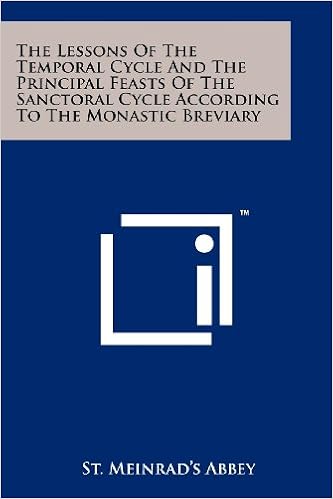
Liturgical Readings The Lessons of the Temporal Cycle and the Principal Feasts of the Sanctoral Cycle according to the Monastic Breviary, Grail Publications, St Meinrad, 1943 (various reprints; I am using one from 1954).

Liturgical readings, still available as a reprint, is one of those books I recommend thinking about buying if you are serious about Matins.

This book wasn't put out for liturgical use - although it has an imprimateur, it specifically says it was for study purposes - but it can readily be used in conjunction with the Office.


What it contains


The first section of the book contains the Patristic readings for the temporal cycle of the year.  For each Sunday and fixed feast, it lists out the (Scriptural) first Nocturn readings, then provides the second and third Nocturn (Patristic) readings.  Through Lent, it provides the weekday Patristic readings, Gospel and collect.

The second half of the book covers most of the first and second class feasts of the sanctoral cycle.

As a bonus, because it dates from before the culling of Octaves, you get a number of extra readings for some feasts (including local feasts of St Meinrad).

The readings are not headed reading 1, reading 2 etc, but the divides the paragraphs to follow the divisions of the Office.

What it doesn't include


The key things missing from a practical point of view are texts for newer feasts added to the calendar or upgraded.  Most of these, however, can be filled in from other sources such as Divinum Officium and the supplement put out by Clear Creek.

It doesn't include the readings for Class III feasts.

And the really unfortunate omission from a practical point of view is the responsories.


Pros and cons


The big advantage of this book as far as a source of translations goes is that it invariably includes readings (or parts thereof) omitted in the Roman Office and so not otherwise available from places like Divinum Officium.  It also follows the traditional cycle of Mass readings (unlike Monastic Breviary Matins, which occasionally diverges from the Catholic cycle).

The translations are generally very good in my view (superior to those on Divinum Officium) and the book is nicely laid out and easy to read (at least in the edition I have).

It is perfect for study use, but for some (new or upgraded) feasts you would need to cross-check to make sure the readings are still current, as there are occasional differences to the 1963 breviary.