Friday, February 9, 2018

Learn the Office 2.10 - The closing prayers of the hours - Pt 1


File:Spanish Chant Manuscript Page 205 (15139258362).jpg


Knowledgeable people understand missae [the dismissal] in two ways: let the missae be done, that is, let absolutions be done; missae can also be called transmissions, akin to that prayer by which the prayers of the people are addressed to God through the ministry of the priest, whence the priest says: Hear, Lord, the voice of your people and so on .

Hildemar, Commentary on the Rule of St Benedict, c850

All of the day hours use more or less the same framework of prayers to conclude the hour.  The key moving parts are the collect, which I will deal with in the next post, and commemorations.

Interpreting the Office books


The words of the closing prayers (except the Collect) do not change except on a few special days in the Office, and are the same for all hours, except for some minor variants at Compline.

For this reason, most Office books do not bother writing them out in full each time they occur.

Accordingly, you either need to learn these by heart or keep a ribbon on the correct page (Monastic Diurnal  page 8 is probably the best one to use, but see the table below for the pages numbers for each hour). 

In addition, most Office books use some shortcuts which make it easy to make mistakes if you are not familiar with the Rules.

(1) The litany

The concluding prayers for most of the hours start with a short litany: 'Kyrie eleison, Christe eleison, Kyrie eleison' (Greek for Lord have mercy, Christ have mercy, Lord have mercy).

Note that these are not repeated as at the Mass, they are just said once each.

The litany is generally sung on one note at Prime (see AM 1243).  For the other hours, the chant tones for the short litany can be found on AM 1236 and 1239 of the Antiphonale Monasticum.

(2) The Our Father

One of the distinctive features of the Benedictine Office is that the Our Father is said at each of the hours, so at least eight times in total each day.

At most of the hours, the first words 'Pater Noster' are said aloud by the person leading the hour (or you if you are praying it alone), and then everyone prays it through silently until the last line, 'sed libera nos a malo', which is said aloud.  Everyone then joins in the Amen.  The chant tones are set out on AM  1239.

At Lauds and Vespers the entire Pater Noster is sung aloud, traditionally by the Superior, in accordance with the instruction in chapter 13 of the Rule.  Everyone else joins in the last line only (ie from Sed libera nos a malo).  The chant tone for this purpose (which is not the same as that used at Mass) can be found on AM 1236.

(3) The Office with priests vs laity

The particular form of the closing prayers varies depending on whether said by clerics or non-clerics.

If you look at the Diurnal in the psalter section, MD 8 (closing prayers of  Prime on Monday) you will see that it instructs you not to use the verse 'Dominus vobiscum' (the Lord be with you) suggesting the standard response 'Et cum spiritu tui' (and with your spirit), as in the Mass, when praying the Office alone, or with non-clerics.

Instead you have to substitute in 'Domine exaudi orationem' and the response 'Et clamor meus ad te veniat' (O Lord hear my prayer, And let my cry come unto Thee).'

Unfortunately, the Diurnal (and most other Office books) provides the clerical option in most places, and it mostly doesn't bother repeating that instruction, it just expects you to know.

Accordingly, it is important to know where you are likely to find it, and train yourself to automatically say the proper verse and response. The table below smmarises the various places the issue arises in the Monastic Diurnal.

Dominus vobiscum vs Domine exaudi orationem meam - Guide to the Diurnal 
HOUR
Full instruction
'Dominus vobiscum vel Domine exaudi'
Dominus vobiscum only
Lauds (2 places)
 na
na
MD 57,75
Prime
MD 8
na
na
Terce, Sext and None
na
na
MD 155
Vespers (2 places)
na
MD 211, 220
na
Compline
na
MD 264
na


(4) Benedicamus Domino/Deo Gratias


The Antiphonale Monasticum provides a large number of chant tones for use with the words Benedicamus Domino/Deo Gratias'(Let us bless the Lord/Thanks be to God), depending on the level of solemnity of the day, the season, and the hour, from AM 1244 onwards.

(5) Fidelium animae...

The final prayer at each hour is a prayer for the repose of the dead, and in some cases, a prayer for absent brethren.  These are generally sung softly on one note, see AM 1242.

Body postures and gestures


The other key thing to keep in mind is the gestures and postures used when saying the prayers.  While these are not compulsory when saying the Office by yourself, the rubrics specify they should be used 'as convenient'.

In a monastery the hebdomadary (person in change of leading the chant for the day) normally says the opening words, everyone else responds.  The abbot or abbess (or Prior/Prioress) sings the Pater Noster out loud at Lauds and Vespers, and gives the blessing at Compline.  When saying it by yourself, of course, you need to say (or sing) it all.

The  closing prayers for Compline are on MD 264 - look there to follow the table below.

                                                                CLOSING PRAYERS
WORDS
GESTURES
NOTES

[v] Kýrie, eléison.
(R) Christe, eléison. Kýrie, eléison.

Pater noster...Et ne nos indúcas in tentatiónem:
R. Sed líbera nos a malo.

Stand (kneel in Advent and Lent)


(Bow)


Superior alone customarily sings the Pater Noster at Lauds  and Vespers; otherwise silent except for opening two words and closing lines.

V. Dominus vobiscum... or Dómine, exáudi oratiónem meam....
Version for celebration with a priest vs when alone.
Oremus:

COLLECT  for the hour
(with appropriate ending)


(Bow)

Prime and Compline always have the same Collect; the collect for all other hours varies (see next post)
V. Dómine, exáudi oratiónem meam.
R. Et clamor meus ad te véniat.

V. Benedicámus Dómino.
R. Deo grátias.
Prime-None  and Compline use simple one;  there are 21 different possible chant tones for Lauds and Vespers depending on season, feast however.

Blessing: Benedícat et custódiat nos omnípotens et miséricors Dóminus,  Pater, et Fílius, et Spíritus Sanctus.
R. Amen.

 (Sign of the cross)
Compline only
[V. Fidélium ánimæ per misericórdiam Dei requiéscant in pace.
R. Amen.]

[] Not specifically mentioned in the rubrics, but customary
 Not said at Compline; can be found at MD 9.
V. Divínum auxílium  máneat semper nobíscum.
R. Et cum frátribus nostris abséntibus. Amen.
 (Sign of the cross)
Lauds, Vespers and Compline (after the Marian antiphon) in public recitation


SUMMARY


In the closing prayers of the Office each phrase of the litany (Kyrie eleison/Christe eleison/Christe eleison, or Lord have mercy/Christ have mercy/Lord have mercy) is said once only.

The formula ‘The Lord be with your spirit’ is only used when led by clerics.  In private recitation by laypeople, use ‘O Lord hear my prayer And let my cry come unto you’ instead.

The basic structure of the closing prayers is:

Litany (Kyrie…)
Pater Noster (Our Father)
Domine exaudi...(O Lord hear my prayer...)
Collect
Domine exaudi... (O Lord hear my prayer...
Benedicamus Domino/Deo Gratias (Let us bless the Lord...)
Fidelium animae... (May the souls...)

The next part of this series covers collects.

Wednesday, February 7, 2018

Learn the Office 2.9 - The chapter (capitulum)

Photo: Cartuxos em oração


After these psalms let a lesson be recited…

Rule of St Benedict, ch 17


Each of the hours of the Benedictine Office normally contains a very short Scriptural reading, typically not more than a sentence, called the capitulum in Latin, or chapter (verse).**

It is important to take note of where the chapter is in each hour, as if you are saying the Office, as opposed to singing it, it is easy to forget to add the words 'Deo Gratias' (Thanks Be to God) to the end of it by way of response, something rarely spelt out in the Office books.

In addition, it is worth noting that the rubrics for the chapter differ slightly from those for the readings at Matins, and the short reading at Compline.

**NB This should not be confused with the Office of chapter, attached to Prime, which I will deal with separately.

Where to find the chapters


The position of the chapter varies depending on the hour.

At Lauds to Vespers the chapter comes immediately after the psalms and their antiphon, so you say the antiphon for the psalms (without a Deo gratias) and then the chapter (with a Deo gratias).

At Compline, the chapter comes immediately after the hymn.

At Matins, the chapter comes after the last antiphon for the psalms in the second Nocturn on weekdays.

At some hours - notably Prime and Compline - the chapter is the same every day.**

The remaining hours have chapters that can vary with the day of the week, season or feast.  Default chapters are provided in the psalter section of Office books such as the Diurnal and Antiphonale; the variants can be found in the sections providing texts for the seasons, individual saints and commons of types of feasts.

**Note: Those using older books such as the Antiphonale Monasticum should be aware that an alternative chapter is provided for Prime (eg AM 6) for use on some occasions and times during the year, however, this was suppressed in the 1962 Office.

The rubrics


The chapter differs from the readings and short readings in that there is no preliminary blessing of the reader, and 'Tu autem Domine...' is not added at the end of it.

When said in common or in choir, everyone stands for the chapter, and it is desirable to do this when saying the Office by yourself as well.

In a monastery, the person in charge of the Office for the day (hebdomadary) says the verse, then everyone responds with the words 'Deo gratias'.  In private recitation, just add the Deo gratias yourself.

In the Monastic Diurnal, the 'Deo gratias' it is written out for Compline, but elsewhere, the Diurnal often just expects you to know to say this this (have a look, for example, at Vespers on Monday, MD 217-8).

The chant tones for the chapter can be found in the Antiphonale Monasticum on pages 1233-4. - the standard tone is on AM 1233; the following page provides variant tones used when the chapter includes a question mark, or when it ends with a question mark (Clausula interrogative).


The Compline chapter


The videos below provide examples using the  Compline chapter for learning purposes (note that some or all of the videos may not be accessible from your location for copyright reasons).


 or


SUMMARY


Each of the hours of the Benedictine Office normally contains a very short Scriptural reading, typically not more than a sentence, called the capitulum in Latin, or chapter (verse).

The position of the chapter depends on the particular hour.

The words 'Deo Gratias' (Thanks Be to God) need to be added to the end of the chapter.


And you can continue on to the next part in this series, on the closing prayers of the Office.

Tuesday, February 6, 2018

Learn the Office 2.8 - The singing the hymn at Compline and the other hours

The Consecration of St Ambrose

At this time it was instituted that, after the manner of the Eastern Church, hymns and psalms should be sung, lest the people should pine away in the tediousness of sorrow; which custom, retained from then till now, is imitated by many, yea, by almost all of Your congregations throughout the rest of the world.

St Augustine on St Ambrose’s introduction of hymns, Confessions Bk 9:7


The hymns of the Benedictine Office are very straightforward rubrics-wise, so most of the notes below relate to using the Antiphonale Monasticum and other resources to sing them.  There are a few things that are worth knowing about them though, so do at least skim this post!

About hymns in the Office


The use of hymns was introduced to the Western Church by St Ambrose of Milan.  A number of St Benedict's monastic contemporaries also used hymns, but the Roman Office didn't add hymns until about four centuries after St Benedict.

St Benedict specifies that the hymns for the 'minor hours' (Compline, Prime, Terce, Sext and None) should be proper to them (ie not change each day).  Accordingly, while the tunes can change with the day of the week (Sundays generally have a different tune for example) season or feast, the texts don't.

In St Benedict's time, the hymns at Lauds and Vespers were probably the same each day, changing only for feasts and perhaps the summer and winter seasons.   The set of Vespers hymns usually used each day from Sunday to Friday, however, were early attributed to St Gregory the Great, and were certainly used widely from the eighth century onwards.

Over time, the repertoire has expanded even greatly, with the composition of hymns for use at Vespers and Lauds on most feasts and seasons.

With a few notable exceptions (such as the Te Deum and Te decet at Matins), the hymns we sing now (with a few exceptions) are not necessarily the one's that were used in St Benedict's time.  In fact the hymns used have changed several times over the centuries, and different ones have been used at different times and places.  St Benedict may well have known an earlier version of the Compline hymn though, given its antiquity.

The Benedictine Office has, however, retained the traditional texts of the hymns throughout its history.  This means that they often differ from the versions used in the Roman Office, which were amended by Pope Urban VIII in the seventeenth century to make them conform with his ideals of classical Latin.  More recent editions of the Roman Breviary have reverted to the original forms of the hymns.

The position of the hymn in the hours and their rubrics


Each hour of the Benedictine Office has at least one hymn, while Matins has three.

St Benedict specifies three different positions for the hymn in the day hours:
  • at Prime to None it comes right at the beginning, following the standard opening prayers, and before the psalms;
  • at Compline it follows immediately after the psalms; and
  • at Lauds and Vespers the hymn comes after the chapter and responsory, and before the New Testament canticle and its antiphon.
In choir or singing the Office with a group, you should stand for the hymn.  You also bow during the last verse (in honour of the reference to the Trinity in the 'doxology).

An amen is always added to the end of the hymn, and you can find the chant tones for this written out on AM 1231.

WHEN
Gestures/postures
Who says it in a monastery/notes
For the hymn
All stand

verses

Verses alternate between sides of the choir
Last verse (doxology)
Bow

Amen

Added to end of all hymns (and sometimes also an alleluia)

Singing the hymns of Prime to None and Compline 


Where hymns are proper to the hour (ie the same each day), they usually have different chant tones for days throughout the week, Sundays, for different levels of feasts, and for special seasons of the year.

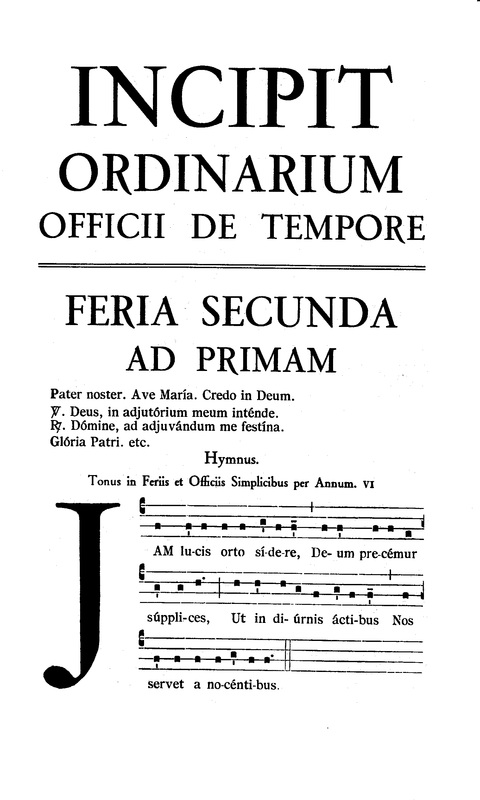
If you look at the first page of the Ordinary in the Antiphonale Monasticum (see image below), for example, you will see it provides the chant tone for the hymn Iam Lucis Orto Sidere for 'feriis et officiis Simplicibus per annum', that is, for use on ordinary days (ferias) throughout the year.

On page 81, an additional tone is provided for use on Sundays.

Note though that AM 2 also provides alternative versions for use on Class III feasts (equivalent to Tonus in festis minoribus per annum); Class II feasts (Tonus in Festis Majoribus); and Class I feasts (Tonus in Solemnitatibus).

A similar variety of tones is provided for the other hours with one fixed hymn, that is:
  • Terce (Nunc Sancte Nobis), on AM 84-5 and 93-94;
  • Sext (Rector Potens), AM 87-8 and 98-9;
  • None (Rerum Deus), AM  90-1 and 98-9; and
  • Compline (Te Lucis ante terminum), AM 170-1-2.
Note that in the case of Compline, because it is said after I Vespers of the Sunday, it counts as part of the Sunday Office, so uses a Sunday psalm tone on both nights.

In addition to these tones, some seasons have set hymn tones, which can be found in the Ordinary of time section.  During Advent, for example, the tone for Compline can be found on AM 183, and for Prime to None on AM 185.

Image result for incipit ordinarium officii de tempore image

You can recordings of many of these hymns in their various tones on youtube.  A particularly useful resource though is the online Liber Hymnarius.  Although it is arranged for the 1970 Liturgy of the Hours, most of the traditional chant tones (Prime aside) can be found on it with a bit of searching.

Singing the hymns of Lauds and Vespers


Lauds and Vespers "during the year'' usually have a hymn specific to the day of the week.  These hymns though, have specific chant tones for summer and winter, both of which can be found in the Antiphonale Monasticum or the Liber Hymnarius.

During the key seasons there are usually special hymns for the hour, noted in the ordinary of time section'of the Antiphonale.

Feasts also generally have their own hymns.  There are also a default set of hymns in the Commons of Saints.  For many feasts the same hymn is for Vespers and Matins, with an another used at Lauds.  There are some feasts with three or even four hymns though.


Further reading/resources


Chant books

The Liber Hymnarius published by Solesmes can be purchased via most monasteries.  If you are singing from the Antiphonale Monasticum, it often only gives one verse set to the chant - the hymnarius often (though not always) sets it out in full.

Understanding the hymns and their context

There are two books that provide translations and notes on the texts of the hymns:

Matthew Britt OSB, Hymns of the Office and Missal, 1922.  Reprints also available.

Joseph Connelly, Hymns of the Roman Liturgy, Newman Press, 1957, reprinted by FSSP.

SUMMARY


Each of the hours of the Office has at least one hymn. 

The hymn for Prime to None and Compline is generally fixed for (proper to) the hour.  The hymns of Lauds and Vespers vary with the day of the week, season, day or feast.

An amen is added to the end of hymns

And for the next part on this series, on the chapter (capitulum), continue on here.

Friday, January 26, 2018

Learn the Office 2.7 - The psalms Pt 3 - singing the psalms and antiphons

O Antiphons

Let those who have been ordered, intone the psalms or the antiphons in their turn after the Abbot. No one, however, should presume to sing or read unless he is able so to perform this office that the hearers may be edified; and let it be done with humility, gravity, and reverence by him whom the Abbot hath ordered.

Rule of St Benedict, ch 47

SINGING THE PSALMS


This post looks at how the to sing the psalms, and in particular, how to decipher the cues given in the Antiphonale Monasticum.

OVERVIEW

The antiphon determines which tone is used to chant the psalm.

There are eight main chant tones, plus a few others that are regularly used.

The Antiphonale Monasticum provides the number of the chant tone as well as the ending (differentiae), and includes a summary for the ending.


The antiphons


Each of the antiphons have their own chant setting, which you can find in the Antiphonale Monasticum,  either in the psalter section of the book, or the sections for the seasons, saints or commons of feasts.

The antiphon normally used for the first psalm of Sunday Vespers, for example, can be seen on page 125 of the Antiphonale, depicted in the image below.


Note that the Antiphonale only provides a short cue for the antiphons before the psalms for Sunday Vespers - but under the 1962 rubrics, the antiphon is sung on full both before and after the psalm.

The psalms themselves are sung to one of a series of fixed tones, numbered 1 to 8, with a couple of extras thrown in.

The 'mode' of the antiphon determines which chant tone should be used for the following psalm.

The chant tones


Normally the key to which psalm tone to use  is the letter and number combination usually written underneath the 'Ant' in the book (as on page 125 for the second psalm of Sunday Vespers, pictured above, which uses Tone 4 g).

But in the case of the first psalm of Sunday Vespers, for example, the book tells you that the psalm tone is 7 c2.

The first number (VII) for Dixit Dominus tells you to use tone 7. 

Once you know the correct psalm tone to use, you can consult pages 1210-1219 of the Antiphonale Monasticum to find the details of that particular chant set out in generic form.

The second letter/number combination tells you which 'differentiae' or ending, to use.  The image below shows the corresponding entry in the Antiphonale.


The four notes used in the word 'Septimus' (seven) are only used for the intonation of the first verse of the psalm (though they are used for every verse of a canticle) - all subsequent verses start on the note used for 'modus...' (re).

The note change marked 'flectitur' is only used when you see the dagger figure in the text of a psalm.

The note changes for 'sic mediatur', however, are always used in the syllables leading up to the * in the middle of each psalm verse.

The pattern of note changes for the second half of the verse varies depending on the 'differentiae', each of which is indicated by a letter (or letter number combination), such as a, c, c2 or d in the case of tone 7.

Most chant books also include some cues on the page with the antiphon for the ending of the verse, so that if you know the start of tone 7 off by heart (and if you sing them regularly over time you will learn them), you don't have to go check the end of the book.  Instead you just look at the arrangement notes that go with 'Euouae', which stands for  'Et in saecula saeculorum Amen' (ie the end of the doxology).

Audio resources and learning the psalm tones


You can find audiofiles of all of the standard chant tones (as well as many other useful audio resources) on the Chantblog. or sung individually on youtube.

Or you can try the video below.

If you are starting from scratch though, I recommend starting with the simplest tones such as Psalm 8.  Sing the psalms using that tone in the Antiphonale, and once you are comfortable with it, add in the next one (2 then 5, then 6, 4 and 7).


Note that there are some minor differences between the psalm tones as set out in the Antiphonale Monasticum and those used in the Roman form of the Office (mainly affecting tones 3 and 6 and the labelling of some of the differentiae).

 Matching the verses to the psalm tones


In theory you could work out which places to change note on for yourself.

In practice, especially at first, it is simplest to use a book with the psalms 'pointed' for you.

There are several books that have been produced at various times for Vespers and Compline, and some of these can be downloaded from CC Watershed (Tomus 9 Psalmiis in notis).  In addition, the Liber Usualis contains a fair number of psalms pointed to tones used in the Benedictine Office.

The simplest solution these days, though, is to use a psalm tone generator to generate your own set of pointed psalms as needed for the particular season, hour or feast.

The image below gives you a feel for the kind of product you can generate.

Another psalm tone generator, offering a range of different formats, can be found on The Academy of Gregorian Chant website (which contains a lot of other very useful resources as well).


How the antiphons and psalms are sung - rubrics

Finally, a note on the rubrics for singing the psalms.

When the Office is sung in choir or in common, the cantor intones the first part of the antiphon, then everyone joins in the rest of it.

The cantor then sings the first half of the first verse of the psalm or canticle, and his or her side of the choir join in with the second half of the verse.

Verses are then alternated between the two sides of the choir.

Everyone stands for the doxology.

When the antiphon is repeated again after the doxology, it is sung by everyone.

And for the next part in this series, continue on to learn about the hymns of the Office.

Thursday, January 25, 2018

Learn the Office 2.6 - The psalms Pt 2 - Psalms and canticles with antiphons.


File:O sapientia.jpg

Antiphons are said at each of the hours, following their institution by Holy Ambrose; this as done because…Blessed Ignatius, the third bishop of Antioch after Blessed Peter, was on a certain mountain and heard choirs of angels singing antiphons.

William Durand, Rationale V


In the last post we looked at psalms said without antiphons; in this one psalms with antiphons; in the next post I will look at singing the psalms and antiphons.


OVERVIEW

Antiphons are short chants used with psalms and canticles.

Under the 1962 rubrics they are always sung in full both before and after a psalm, canticle, or group of psalms.

The ‘default’ antiphons can be found in the psalter section of the Diurnal and Antiphonale, but these can be displaced by those for special seasons or feasts. 

What is an antiphon?


Most of the psalms and canticles in the Office are said with an antiphon, a short set of words that is said or sung before and after a psalm or group of psalms.

Antiphons often serve to focus on a key theme or meaning of either the psalm about to be said, or tell us something important about the season, feast or saint being celebrated.

Antiphons are provided in the psalter section of the Diurnal for each day of the week for use in the period 'throughout the year' (the 'default option').  

The psalter section also provides some - but not all - of the seasonal antiphons.  Antiphons to mark the seasons, feasts and special days though the year can be found in the proper of seasons and proper of saints sections (and sometimes the Common of Saints)..

How antiphons are used


At some hours - basically Prime to None - and during some seasons, such as Eastertide, only one antiphon is used.  In this case it is said before the start of the psalms, and then again after the psalms, that is:

Antiphon
Psalm+doxology
Psalm+doxology
Psalm+doxology
Antiphon

At Vespers for most of the year, however, there is normally one antiphon for each psalm.  In this case the antiphon for the psalm is repeated in full before and after each psalm:


Antiphon 1 +Psalm+Doxology+Antiphon 1
Antiphon 2 +Psalm+Doxology+Antiphon 2
Antiphon 3 +Psalm+Doxology+Antiphon 3
Antiphon 4 +Psalm+Doxology+Antiphon 4

Note: In older versions of the Office, the antiphon was not always said in full before the psalm, so the Antiphonale Monasticum, for example, doesn't always write it out.  In the 1962 rubrics however the antiphon is always said in full before the psalm(s), so you may need to look for it at the end of the psalm.

Lauds uses a mix of both antiphons for a group of psalms, antiphons for individual psalms (and the Old Testament canticle, which is treated exactly like a psalm). 

On normal Sundays, for example, the first three psalms are said under one antiphon, the canticle has its own antiphon, and the three Laudate psalms (Ps 148-150) are said under one antiphon (and with only one doxology, at the end).  On weekdays for most of the year and feasts, however, the first three psalms each have their own antiphon, making five in total.


In addition, at Lauds and Vespers, the New Testament canticle also has its own antiphon.


Where to find the antiphons


The antiphons used on most days of the week throughout the year can be found in the psalter section of the Diurnal and Antiphonale.

If you look at Tuesday Prime, for example, the antiphon normally said throughout the year is 'Deus iudex iustus'.

Accordingly, the middle section of Tuesday Prime (ie after the hymn) goes:

Antiphon: Deus iudex iustus, fortis et longanimis: numquid irascetur per singulos dies?
Psalm: Domine Deus meus...Gloria patri
Psalm: Domine, Dominus noster...Gloria Patri...
Psalm: Confitebor tibi, Domine...Gloria Patri
Antiphon: Deus iudex iustus, fortis et longanimis: numquid irascetur per singulos dies?

Antiphons can change according to seasons, feasts and special days, though, and the easiest way to find the correct set for the season or day is to use an Ordo.

On feasts, there can be as many as three sets of antiphons for the day hours.  The most normal pattern, though is to provide one set of antiphons for Lauds, which are also used at the other hours.  In this case the antiphons are used as follows:

Antiphon 1 of Lauds= Prime, Antiphon 1 of Vespers
Antiphon 2 of Lauds= Terce, Antiphon 2 of Vespers
Antiphon 3 of Lauds= Sext, Antiphon 3 of Vespers
Antiphon 4 of Lauds
Antiphon 5 of Lauds= None, Antiphon 4 of Vespers

And you can find the next part of this series, on singing the psalms, here.

Wednesday, January 24, 2018

Learn the Office 2.5 - How the psalms are said in the Office Pt 1 - Including psalms without antiphons

Georgian Psalter 13-15 c.jpg
King David composing the psalms


Let Compline be limited to the saying of three psalms, said straightforward and without an antiphon.  Rule of St Benedict, ch 17

At Compline let the same psalms be repeated every day: that is, the fourth, the ninetieth, and the hundred and thirty-third.  Rule of St Benedict, ch 18


The Psalms in the Benedictine Office


This post covers some general rubrics around the psalms in the Office, as well as taking a look at psalms said without antiphons at Compline, Lauds and Matins.

The psalms are the core of the Benedictine Office, so it is worth taking a little time to look at how they are properly said. 

OVERVIEW

The layout of the psalms in the psalter differs from that in most Bibles in several ways, including the division of the verses.

In the Office, the doxology (Gloria Patri…) is added to all psalms and canticles unless otherwise noted.

The psalms of Compline, as for Psalm 66 at Lauds, are said without antiphon.

A tone for the psalms without antiphon can be found in the Antiphonale Monasticum on page 1219, however alternate tones are often used at some times of the year.


Reading the psalms in the psalter section of your book(s)


If you look at the psalter section of the Diurnal (or Antiphonale) you will see that the psalms are laid out slightly differently to the way they appear in most Bibles.


Layout of the psalms for liturgical use


The psalter section of the Diurnal is organised so that the psalms appear more or less in their numerical order (a few psalms needed for particular hours excepted).  In the case of Compline though, the psalms span the psalter, so are placed last.

The psalm titles are omitted, as these are not sung.  

In addition, no verse numbers are normally provided.  

It is also worth noting that the division of the verses sometimes differs from the standard divisions in modern Bibles (which date from the seventeenth century).


The asterix marks in the psalter


If you look at the psalms as laid out in the psalter section of the Diurnal or other books you will also see an asterix * in the middle of each verse.

The norm for the Benedictine Office is for it to be sung in choir.  When the Office is sung in choir or in common, the normal practice is to alternate verses between the two sides of the choir or church. 

Rather than pausing between verses, though, it is usual to pause in the middle of the verse, but not have much of a gap between verses.  The asterix marks the place for the pause.  The asterix also helps you know when to change notes if using a chant tone.  

The doxology at the end of the psalms


If you look underneath Psalm 1 at the beginning of the psalter section of the Diurnal, you will see it writes out the Gloria Patri in full at the end of the psalm, and says this is always said at the end of each psalm, part of a psalm (for example the individual stanzas of Psalm 118 said on Sunday and Monday, and psalms that are divided, the second half of which are usually marked with the word 'divisio' ), or canticle unless otherwise indicated.

The key exceptions to the use of the doxology are:
  • after Psalms 148 and 149 at Lauds (the three Laudate psalms are said under one Gloria);
  • after Psalm 115 at Monday Vespers (Psalm 115 is joined to Psalm 116); 
  • the Benedicite Canticle on Sundays; and
  • at certain times of the year, most notably during the Triduum. 
In choir, everyone stands and bows for the words 'Gloria Patri et Filio et Spiritui Sancto'.


The psalms without an antiphon - Lauds and Compline.


There are three different ways of saying the psalms in the Office: 
  • without an antiphon ('in directum'); 
  • responsorially (Psalm 94 at Matins); and 
  • antiphonally (most of the hours). 

I will look at the psalms said antiphonally in the next post, but for now the psalms said without antiphon.

There are three sets of psalms said without antiphon in the Office: Psalm 3 at Matins; Psalm 66 at Lauds; and the psalms of Compline.

Originally psalms said 'in directum' were probably said in full by everyone present.  In most monasteries, though, the verses are alternated between the two sides of the choir and/or church as for the rest of the psalmody.

When sung, the key difference is in the first verse of the psalm, as there is no initial 'intonation' - the singing starts on the note it continues on.

The Antiphonale Monasticum provides only one chant tone for psalms sung without antiphon, on page 1219.  You can hear it used for Psalm 66 at Lauds by following the link here (Lauds, around 3.45).

Many monasteries do use alternate chant tones at Compline for some feasts and times of the year however, and the one on the video of Compline I've previously posted can be found in the Liber Usualis (tone for the Nunc Dimittis on Easter Day in the Roman Office), or in the 2005 Antiphonale Monasticum on page 517 (where the rubrics state that it is used for Christmas and Easter).

Pronouncing the Latin


If you are using the Diurnal, you have the English in front of you to help understand the Latin.  It is the Latin, however, that is approved for liturgical use in the 1962 Office.

If you aren't familiar with Latin pronunciation, the best approach is probably to start by listening to recordings such as the Compline video I've previously posted, and the podcasts of Le Barroux for example.

There are a number of great resources available online to help you thou, including:

And you can find the next part in this series, on psalms with antiphons, here.

Tuesday, January 23, 2018

Learn the Office 2.4 - The 'opening' prayers of the day hours (Compline step-by-step 4)


Image result for deus in adjutorium image

And so for keeping up continual recollection of God, this pious formula is to be ever set before you: O God, make speed to save me: O Lord, make haste to help me, for this verse has not unreasonably been picked out from the whole of Scripture for this purpose. For it embraces all the feelings which can be implanted in human nature, and can be fitly and satisfactorily adapted to every condition, and all assaults...This verse is an impregnable wall for all who are labouring under the attacks of demons, as well as impenetrable coat of mail and a strong shield. St John Cassian, Conferences 10:10 
The more diligent in prayer are wont to subjoin in their prayers the Hallelujah...[which] is excellent which, for the extolling and honouring of God, aims unitedly to bring Him enriched prayer as a choice victim. Tertullian, On prayer, chapter 27

OVERVIEW

A standard set of prayers of prayers are used to open all of the hours from Lauds to Vespers.  At Compline they open the middle section of the hour.

They can be found written out in full on MD1 and consist of the ‘Deus in adjutorium…’, Gloria Patri…’ and Alleluia.

From Septuagesima Sunday to Holy Saturday, the Alleluia at the end of these prayers is omitted, and ‘Laus tibi, Domine’ is said instead.

The Diurnal, Antiphonale and other books do not always spell these out or write these out in full – but they always need to be said, and so are worth memorizing.

Different chant tones are used depending on the hour and level of the day.


The second section of Compline is the section that is described in the Rule, and begins with the opening prayers that are common to all of the day hours.

These prayers start by reminding us of our dependence on God; then affirm our faith in the Triune God who created us; and end with an invocation of praise to him.

(1) Interpreting the Diurnal 


The opening prayers for the day hours are on the first page of the psalter section of the Diurnal - you may wish to keep a ribbon here until you know them off by heart.

In most cases the Diurnal does not write the prayer out in full again.  When it comes to each hour of the Office it either gives you a prompt, but doesn't write out the text needed in full (for example for Monday and Sunday Prime, MD 1, 146); or just expects you to know that these prayers are to be said (for example, Tuesday to Saturday Prime).

The only change in these prayers during the year comes from 'Septuagesima Sunday' (the start of a pre-Lent season in the traditional calendar, up to the end of Lent, when the Alleluia is not said.  Instead the ending becomes: Laus tibi, Dómine, Rex ætérnæ glóriæ (Praise be to thee, O Lord, King of eternal glory).

(2) The rubrics ('do the red')


The opening of the Office is properly said standing.

On the first word (Deus/O God) you should make the sign of the cross.

You should bow for the first half of the doxology (Gloria Patri et Filio et Spiritui Sancto Sancto/Glory be to the Father, and to the Son and to the Holy Ghost).

Stand
V. Deus + (make the sign of the cross) in adjutórium meum inténde.
R. Dómine, ad adjuvándum me festína.
V. (bow) Glória Patri, et Fílio, * et Spirítui Sancto.(stand straight)
R. Sicut erat in princípio, et nunc, et semper, * et in sǽcula sæculórum. Amen.
Alleluia or Laus tibi, Dómine, Rex ætérnæ glóriæ.


(3) The chants


The tone most commonly used for the opening prayers at all hours other than solemn Vespers is set out below, and can also be found in the Antiphonale Monasticum on page 1203.

On the video of Compine we have been using it can be heard around 4.00.


The video below provides a version with the Lent ending.


The chant tone used can, however, change to reflect the greater importance of the hour, or recognise that a feast is being celebrated.  The recording below uses the solemn tone.


And for a particularly grand polyphonic setting of the text:


**NB Videos many not be available in some regions.

And you can find the next part of this series, on saying the psalms in the Office, especially at Compline, here.