Saturday, April 8, 2017

Nocturns/6 - About responsories and their rubrics


[Matins on weekdays in winter] …let three lessons be read from the book on the lectern by the brethren in their turns, and let three responsories be chanted between them. Two of the responsories shall be said without the Gloria; but after the third lesson let the reader chant the Gloria. And as soon as he has begun it, let all rise from their seats in honour and reverence to the Holy Trinity.

Rule of St Benedict, chapter 9

[Matins on weekdays in summer] Instead of the three lessons, let there be one from the Old Testament said by heart, and let it be followed by a short responsory.

Rule of St Benedict, chapter 10

[Matins on Sundays] …then let there be read from the book, as we said before, four lessons with their responsories. In the fourth responsory only shall the reader chant the Gloria, and when he begins it let all rise immediately with reverence.

Rule of St Benedict, chapter 11


The rubrics for the elements of Matins


The last element of the rubrics we need to cover is the responsories, as the table below illustrates.

ELEMENTS   OF MATINS
OPENING SECTION
Opening prayer – Domine labia mea aperies
Psalm 3
Invitatory antiphon and Psalm 94
Hymn
NOCTURNS
Antiphons
Psalms of the day of the week
Psalms of Commons and feasts
Canticles
Versicle, Our Father and absolution
Blessings for the reader
Readings
Responsories
CONCLUDING SECTION
Te Deum (hymn)
Gospel
Te Decet Laus (hymn)
Concluding Prayers


What are responsories?


Responsories are chants sung after the readings.

On weekdays during 'summer', they have the same structure as the short responsories of Lauds and Vespers.  On Sundays, feasts and in 'winter' they have a slightly different structure, and generally come with much more elaborate chant settings.

The responsories at Matins are typically a mix of texts relating to the particular book of the Bible being read (in the case of the first and second Nocturns), and the season.  There are usually special responsories for feasts.

The age of the current repertoire of responsories is disputed: while St Benedict and other sixth century rules talk about responsories, the earliest surviving texts date from the eighth century, so it is unclear whether the same repertoire was in use earlier or not.

Rubrics for the responsories


If you are saying the Office alone, you simply say (or preferably sing!) the whole of the responsory.  If the Office is said in choir, a cantor usually starts, with the choir (or a sub-set of it in the case of more complicated responsories) singing the refrain.

Interpreting the breviary

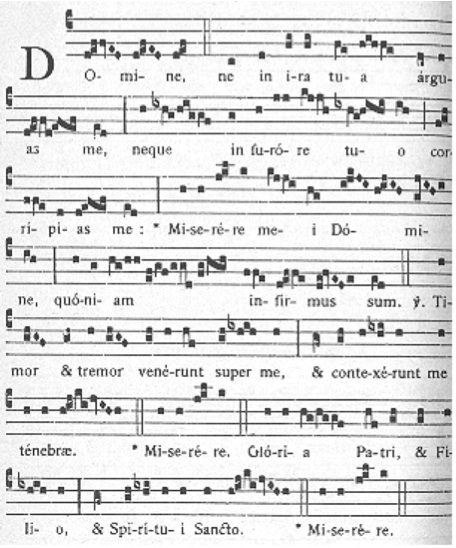
The key issue with responsories is that in a breviary and chant books, they are often not written out in full, so you have to know the structure and/or be able to interpret the cues.

A Matins responsory typically appears in the breviary, for example, looking like this:

R. Adjutor et susceptor meus es tu Domine: et in verbum tuum speravi:* Declinate a me magni: et scrutabor mandata Dei mei.
V. Iniquos odio habui: et legem tuam dilexi.
 Declinate 


R. Thou art my Helper and my Protector, O Lord, and in thy word do I hope.* Depart from me, ye evil doers, for I will keep the commandments of my God.
V. I hate the unrighteous, but thy law do I love.
 Depart

The red initial letter for 'Declinate' is a cue to say all of the words following the asterix (*) in the first line, viz  in this case, Declinate a me magni: et scrutabor mandata Dei mei.

In the case of the third (or fourth on Sundays) responsory, containing the half doxology, the breviary pattern normally goes like this:

R. Adjutor et susceptor meus es tu Domine: et in verbum tuum speravi:* Declinate a me magni: et scrutabor mandata Dei mei.
V. Iniquos odio habui: et legem tuam dilexi.
 Declinate Gloria Patri. Declinate


R. Thou art my Helper and my Protector, O Lord, and in thy word do I hope.* Depart from me, ye evil doers, for I will keep the commandments of my God.
V. I hate the unrighteous, but thy law do I love.
 Depart.  Glory be. Depart.

In each case the red letters are a cue for the phrase that should be said, so that this responsory would actually  be said as follows:

R. Adjutor et susceptor meus es tu Domine: et in verbum tuum speravi:* Declinate a me magni: et scrutabor mandata Dei mei.
V. Iniquos odio habui: et legem tuam dilexi.
R: Declinate a me magni: et scrutabor mandata Dei mei.
V: Gloria Patri et Filio et Spiritui Sancto
R:  Declinate a me magni: et scrutabor mandata Dei mei.

In a chant book, the same chant is generally used for the text following the asterix each time, and so the book simply provides the initial word and note as a cue.  In addition, there are fixed tones for the Gloria Patri for each mode, which can be found in the front of the Liber Responsorialis for example, and so these are often not written out in full either.

Variations on the standard pattern

It should be noted that there are a number of variations on this standard pattern that occur during the year.  The very first responsory of the year, in Advent, for example (Aspiciens a longe) has an extended form, while in Passiontide the half doxology is omitted. The key is simply to follow the cues in your book!

Finding responsories (and translations for them!)


In a breviary, the responsories usually follow on immediately after the readings.

If you are using Monastic Breviary Matins, you will often find them in a separate section - because the responsories are generally the same for the three or four weeks of a month when a particular book of Scripture is being read, or for a season, they save space by putting them together rather than repeating them each time.

The responsories used in the Benedictine Office typically have a high degree of overlap with the Roman Office, but because the Roman Office uses fewer responsories (on Sundays eight rather than twelve), Divinum Officium (which uses the Roman readings and responsories only) will not provide you with translations of all of the responsories each week.  On some but not all occasions, the missing responsories are used on the following weekdays or some other occasion in the Roman office and so can be chased down.  This is not always the case though.

In the next post in this series I will look at the various websites and books that you find the responsories in.

Friday, April 7, 2017

Book review: Liturgical readings


Liturgical Readings The Lessons of the Temporal Cycle and the Principal Feasts of the Sanctoral Cycle according to the Monastic Breviary, Grail Publications, St Meinrad, 1943 (various reprints; I am using one from 1954).

Liturgical readings, still available as a reprint, is one of those books I recommend thinking about buying if you are serious about Matins.

This book wasn't put out for liturgical use - although it has an imprimateur, it specifically says it was for study purposes - but it can readily be used in conjunction with the Office.


What it contains


The first section of the book contains the Patristic readings for the temporal cycle of the year.  For each Sunday and fixed feast, it lists out the (Scriptural) first Nocturn readings, then provides the second and third Nocturn (Patristic) readings.  Through Lent, it provides the weekday Patristic readings, Gospel and collect.

The second half of the book covers most of the first and second class feasts of the sanctoral cycle.

As a bonus, because it dates from before the culling of Octaves, you get a number of extra readings for some feasts (including local feasts of St Meinrad).

The readings are not headed reading 1, reading 2 etc, but the divides the paragraphs to follow the divisions of the Office.

What it doesn't include


The key things missing from a practical point of view are texts for newer feasts added to the calendar or upgraded.  Most of these, however, can be filled in from other sources such as Divinum Officium and the supplement put out by Clear Creek.

It doesn't include the readings for Class III feasts.

And the really unfortunate omission from a practical point of view is the responsories.


Pros and cons


The big advantage of this book as far as a source of translations goes is that it invariably includes readings (or parts thereof) omitted in the Roman Office and so not otherwise available from places like Divinum Officium.  It also follows the traditional cycle of Mass readings (unlike Monastic Breviary Matins, which occasionally diverges from the Catholic cycle).

The translations are generally very good in my view (superior to those on Divinum Officium) and the book is nicely laid out and easy to read (at least in the edition I have).

It is perfect for study use, but for some (new or upgraded) feasts you would need to cross-check to make sure the readings are still current, as there are occasional differences to the 1963 breviary. 

Thursday, April 6, 2017

The Nocturns/5 - rubrics for the conclusion of the nocturns and readings


Related image

When these [the psalms] are finished and the versicle said, let the abbot give a blessing; and then, all being seated in their places, let three lessons be read from the book on the lectern by the brethren in their turns...

Rule of St Benedict chapter 9

FROM Easter to the first of November let the number of the psalms be exactly as given above; but let there be this difference, that the lessons from the book be not read, on account of the shortness of the nights. Instead of the three lessons, let there be one from the Old Testament said by heart, and let it be followed by a short responsory.

Rule of St Benedict chapter 10


Today I want to cover off most of the rest of the rubrics for the Nocturns, leaving just the responsories for a separate post so far as the general rubrics are concerned.

 Just so you can see where we are up to, here is the table with the elements of Matins, with those covered in today's post highlighted.

ELEMENTS   OF MATINS
OPENING SECTION
Opening prayer – Domine labia mea aperies
Psalm 3
Invitatory antiphon and Psalm 94
Hymn
NOCTURNS
Antiphons
Psalms of the day of the week
Psalms of Commons and feasts
Canticles
Versicle, Our Father and absolution
Blessings for the reader
Readings
Responsories
CONCLUDING SECTION
Te Deum (hymn)
Gospel
Te Decet Laus (hymn)
Concluding Prayers

Versicle, Our Father and Absolution


After the last antiphon is said at the end of the first Nocturn each day, and each Nocturn when there are twelve lessons (ie Sundays and major feasts), a versicle, the Our Father (said silently) an absolution is said standing.

The versicles (ie short verse and response) are proper to the day of the week, season or feast.  The one's for each day and the main seasons can be found in most psalters or breviaries.

The Our Father is said exactly as at the day hours outside of Lauds and Vespers.

There are three absolutions normally used on weekdays:  'Exaudi Domine..' for Monday and Thursday; 'Ipsius pietas..' for Tuesday and Friday; and 'A vinculis peccatorum...' for Wednesdays and Fridays.  These three absolution formulas are also used for the first, second and third Nocturn on Sundays and feasts.

There is also a special absolution for the Office of Our Lady on Saturdays.

On Friday in Lent this section looks like this:


V. Scápulis suis obumbrábit tibi.
R. Et sub pennis ejus sperábis.


V. He will overshadow thee with his shoulders.
R. And under his wings thou shalt trust.


Pater noster (then silently: qui es in cælis, sanctificétur nomen tuum: advéniat regnum tuum: fiat volúntas tua, sicut in cælo et in terra. Panem nostrum quotidiánum da nobis hódie: et dimítte nobis débita nostra, sicut et nos dimíttimus debitóribus nostris):
V. Et ne nos indúcas in tentatiónem:
R. Sed líbera nos a malo.
Absolutio. Exáudi, Dómine Jesu Christe, preces servórum tuórum, et miserére nobis: Qui cum Patre et Spíritu Sancto vivis et regnas in sǽcula sæculórum. Amen.


Our Father (then silently:, who art in heaven, Hallowed be thy name. Thy kingdom come. Thy will be done on earth as it is in heaven. Give us this day our daily bread. And forgive us our trespasses, as we forgive those who trespass against us).
V. And lead us not into temptation:
R. But deliver us from evil.
Absolution. O Lord Jesus Christ, graciously hear the prayers of Thy servants, and have mercy upon us, Who livest and reignest with the Father, and the Holy Ghost, ever world without end. Amen. 

The blessing for the readings


After the absolution comes the blessing for the reader.  The pattern for the readings is blessing; reading; responsory.  Accordingly, the number of blessings in each Nocturn depends on how many readings are said (viz 1, 3 or 4).  The table below summarises how many readings to expect.


Type of ‘day’
Number of readings
All Sundays
12 (4 per Nocturn)
Class I&II feasts
12 (4 per Nocturn)
Class II&III days (Lent and Advent, Ember days etc days)
3 (Nocturn I)
Class II&III vigils (of feasts)
3
Class III&IV feasts and days in summer (Eastertide to end of October)
1 (of the day of the week or feast
Class III&IV feasts and days in winter
3 (on feasts 1 or more of the feast)

The blessings for feasts are usually the same as on Sundays, with the possible exception of the blessing for the eleventh reading, which usually reflects the saint or saints being celebrated.

On weekdays, the blessings used depends on the season and types of readings being used.  If you are using a breviary, look for these key words and phrases:
  • for Scriptural readings: ...ad lectiones de Scriptura');
  • Patristic: de homilia..;
  • for Class III feasts in winter: In festis III classis leguntur in hieme...;
  • in summer: In aestate
  •  or for the Office of Our Lady on Saturday.
An example of how they are said each time is set out below:

Jube, domne, benedícere.
Benedictio. Benedictióne perpétua benedícat nos Pater ætérnus. Amen.

Lectio 1...
V. Grant, Lord, a blessing.
Benediction. May the Eternal Father bless us with an eternal blessing. Amen.

Reading 1... 

After the blessing for the first reading, everyone (except the reader) sits down.

The endings for the readings


Each reading is given a standard ending, which is usually not written out in breviaries:

V. Tu autem, Dómine, miserére nobis.
R. Deo grátias.

V. But thou, O Lord, have mercy upon us.
R. Thanks be to God.

Those listening to the readings stay seated except for the Gospel, and for the short extract from the Gospel in the first reading of the Third Nocturn on Sundays and feasts. 


***Where to find the readings on Sundays


One other key point to note.  For much of the year, the readings for all three Nocturns on Sundays are found together, in the section of the breviary covering the texts for the time of year.

Between August and November, however, the readings and responsories for Nocturns I&II are of the week of the month (ie first week of August, second week of August, etc) rather than the Sunday of the liturgical year.  For this reason, you need to look in (at least) two different places during this part of the year to find the texts you need.


Readings on Class III feasts and the Office of Our Lady on Saturday


The final point to note is that the third reading set for the day (feria) can be displaced by on a Class III feast, or on other days such as a Saturday of Our Lady.  In these cases the text of the reading is not omitted altogether; instead the second and third readings are combined into one, with the reading of the day or feast then being added on.


Further reading


How important are readings in the Benedictine Office?
Book Review: Liturgical readings
Lectio Divina Notes Blog - for translations of the daily readings and responsories of the Benedictine Office


Wednesday, April 5, 2017

Nocturns/4 - The readings: how important are they really?


Codex Amiatinus


The books to be read at Matins shall be the inspired Scriptures of the Old and New Testaments, and also the commentaries on them which have been made by well-known and orthodox Catholic Fathers.

Rule of St Benedict chapter 9

I want to turn now to the readings at Matins.

In St Benedict's Office, the readings are treated as far less important than the psalms.

St Benedict decrees, for example, that the lessons be dropped altogether for summer on weekdays, and in relation to Sundays, he notes that if necessary they are to be cut short in order to start Lauds on time.  This probably reflects the fact that monks have a lot of time set aside for lectio divina, as well as hearing readings at meals and in the evening in his timetable.

The content of the readings - temporal cycle


In St Benedict's time, the readings at Matins were probably not fixed (though this is not certain), but rather set by the abbot.  Over time, however, a fixed cycle was established.  The Sunday Gospel cycle and annual Scriptural cycle in the Office (which is essentially the same as that of the Roman Office) can be traced back to the early seventh century, though the 'ordines Romani' concerned may attest to an earlier tradition.  The cycle has really only been modified at the margins since then.  The Patristic readings have their origins in a selection made by Paul the Deacon in the eighth century.

Certainly the readings in the 1963 breviary have not substantially changed, as far as I can see, since at least the time of the (post Council of Trent) Breviary of Pope Paul V (1615), a few new or changed feasts aside.  The basic cycle works like this (feasts aside).  On Sundays:
  • the first Nocturn readings are on a seasonal/monthly Scriptural cycle; 
  • Second Nocturn readings are usually Patristic commentaries on the first nocturn Scriptural readings; and 
  • the third Nocturn readings are generally Patristic commentaries on the Gospel of the (EF) Mass of the day.
On weekdays, the readings are generally from Scripture, filling in (some of the) gaps between the Sundays, save in Lent, when the readings are mostly Patristic commentaries (on the Gospel of the day).

You can find a listing of the Scriptural cycle (Sunday first Nocturns and weekdays) here.

Readings for feasts


On feasts, some or all of the readings are selected to match the type of saint (from the Common) or feast being celebrated.  On third class feasts, usually only the third reading is of the feast, and is on the saint in question's life.  On higher level feasts, the Second Nocturn readings will usually relate specifically to the feast.

Latin or English?


I will come books containing the readings in a post or two, but it is worth noting here that if you are praying the Office devotionally, you can of course, do the readings in English.

For the reasons I have previously set out in relation to the psalms, doing the readings in Latin is preferable, in my view, if at all possible.  One approach you could consider, that I've encountered in some monasteries is to do the readings in Latin in the Office, but then read them in the vernacular at a meal.  Alternatively you could prepare them in advance (or read the English afterwards).

That said, don't let the perfect get in the way of the good - doing them in English devotionally is better then not doing them at all!  In addition, it is, I suppose possible that a case can probably be made for the use of the vernacular for the readings even for liturgical use of the Office - Universae Ecclesiae after all, gives such permission in relation to the Mass.

Set your own cycle?


The other area of possible flexibility, at least in the devotional use of the Office, relates to the cycle of readings.

The Scriptural cycle

First, the readings at Matins do not cover the entire Bible.   The lack of summer weekday readings aside, some books are not read at all, or get only one or two readings (generally for feasts).  The books of the Pentateuch other than Genesis, Chronicles (Parahelion), Acts, and Revelations in particular get short shrift in my view, and even those books that are notionally included in the cycle can be omitted depending on the number of weeks after Epiphany and Pentecost.

In addition, the readings typically select out a few verses from the opening chapters of many books, they don't cover the full chapter or book.

Moreover, some receive, on the face of it, quite a quite disproportionate amount of time (Maccabees for example, compared to the Wisdom books).

That said, there is an underlying logic to the schedule of books read in the first Nocturn (and weekdays) that relates to the liturgical seasons, so I wouldn't lightly discard it.  But it is true that some monasteries have reverted to setting their own readings cycle in recent times, or working from the continuous lectionary used in the Ordinary Form.  And there are a few websites around that will help you with this.

Patristic readings

The second issue relates to the Patristic readings.  Personally, I find I am still getting something out of the Patristic readings even after reading the same texts for several years now and am happy enough to fill these out with other sources as part of my lectio divina program.  But if you did want more variety in the Office itself, it would be easy to rotate at least the third Nocturn readings on Sundays, by using the 'Sunday Sermons of the Great Fathers' volumes, which generally provide several sermons keyed to the Sunday Gospels (in the EF).

Keep in mind though, that these kinds of changes are only permissible if you are praying the Office devotionally - while monasteries have permission under the 1977 guidelines to do this (within specified limits), individuals are not monasteries and so do not hold the required delegation to design their own (liturgical) office.

Tuesday, April 4, 2017

Book reviews - Matins only psalters** (Matins according to the Benedictine Ritual & Stanhofe draft Psalter)


Image result for Holger Peter Sandhofe


As I have previously noted, there are essentially three types of options when it comes to books containing the psalms and main texts for Matins: psalters containing all of the hours; Matins only books (Nocturnale); and breviaries.  I will leave consideration of breviaries and the Monastic Breviary Matins book until we look at the readings for Matins.

There are, though, two other useful sources of the psalms and common prayers that it seems timely to look at now, both of which I think are worth considering acquiring.


(1) Matins According to the Benedictine Ritual with a Supplement Latin-English, Clear Creek 2008.

Image result for matins according to the benedictine ritual

The Clear Creek Matins book was originally intended primarily to help visitors to the monastery to follow Matins there, but is also available through Lulu.

What it contains

The book contains texts for Matins each day in Latin and English, other than the readings, responsories and collects.  It includes the main seasonal antiphons but not all of the variants (such as the Sunday invitatory antiphon during Lent for example).   The supplement actually mainly deals with the other hours, but does include some Matins texts.

The translation of the psalms is (I think) one of the Challoner-Douay-Rheims versions (though not the one that I have).

Pros and cons

This is an especially useful book for beginners as it lays out all the texts (such as Psalm 94) exactly as it is said for most of the year in full.  This layout means the repeated texts appear in each day's pages, reducing the need for page flipping.

Of course, the downside is that this makes it slightly harder to use for feasts and other occasions when some of the texts change.

In addition, unlike the Psautier Monastique, it doesn't contain many of the seasonal texts.  Still, if you are praying Matins devotionally, primarily in order to extend the number of psalms you are saying, the seasonal texts are not essential.

As it is put out by a monastery, though without a formal imprimateur, it can be argued to satisfy the requirement for official approval (in these days when many monasteries have used plastic folders and ad hoc editions for years, it is hard to insist on the letter of the Code when it comes to deciding what constitutes official books in my view!).

A reader has noted though that it only comes in paperback form, so it is unclear how well it will stand up to daily use.

(2) Holger Peter Stanhofe, Psalterium dispositum per hebdomadam pro nocurnis horis secundum regulam SS Patris Nostri Benedicti, 2002.


What it contains

This is a draft of a Benedictine Nocturnale produced by the late Holger Peter Standhofe, who put together the Nocturnale Romanum, and unfortunately never quite completed.  It is Latin only, but includes the standard texts and chants for the psalter section of Matins each day.

It can be freely downloaded here.

Pros and cons

The text is a draft only, and unfortunately there are quite a few errors scattered through it - missing initials and mistakes in the psalter.  Most of them are fairly obvious though, and it is not a big deal to go through and correct them.

Its big advantage over sources is that it provides the chants needed to sing the Ordinary of Matins (ie invitatory antiphons, hymns and antiphons), the only publicly available source I've found for these.

One option would be to do a cut and paste job, and use the chants in conjunction with the Psautier.

Monday, April 3, 2017

Books reviews: Psalters (the Psautier Monastique & Psalterium Monasticum)

Today I want to provide you with some notes on possible books to acquire.  As I noted in the last post in this series, there are basically three categories of books you can use for the psalms of Matins:

  • breviaries, which contain all of the texts for the Office (but not the chants);
  • Matins only books; and 
  • psalters which include the psalms and some of the other key texts.

Why consider buying a psalter?


Today I want to look at two books in the last category.

Both the books discussed below are current officially approved books, complete with imprimateur, so a useful reference point if you want to pray to Office liturgically, 

The big reason for choosing a psalter over a breviary, the other 'officially' approved bok, though, really comes down to price.  A 1963 breviary in particular is hard to find and pretty expensive.  The various psalters by contrast are readily available at a reasonable price, and can be used for all of the hours, not just Matins.

But they have a few other advantages too.

The options


(1) Psalterium cum canticis novi et veteris testamenti iuxta regulam S P N Benedicti & alia schemata liturgiae horarum monastiae cum cantu gregoriano cura et studio monachorum solesmensium, Solesmes, 2012 (reprint of 1980).


Image result for psalterium monasticum


This is one I'm including largely for the sake of completeness, as it uses the neo-Vulgate psalms of 1979 which, as I noted yesterday, I don't recommend.  

That said, this psalter is used in most monasteries who use the Novus Ordo Mass and if you are an oblate of such a monastery, you should probably consider using it, alongside the new Antiphonales put out by Solesmes aligned to the new calendar.

What it contains

This is a Latin only book.

It includes the psalms laid out for each hour, including Matins, with standard daily prayers, and the antiphons with chant tones.  The type face is reasonably sized (though not as large as the Psautier Monastique which I will discuss below).

It also contains pretty much all the texts for the seasons and feasts of saints (ie invitatory, hymns, antiphons and listings of where to find the psalms, and collects).

Another nice feature are the short Scriptural or Patristic quotes that point to the meaning of the psalms.

Pros and cons

This is actually a very nicely laid out book, containing pretty much everything you need for Matins except the readings and responsories.

It is not really usable for the 1963 Office though - the antiphons have been updated to conform with the neo-Vulgate so are not always the same as in the older books, and it contains a number of other quirks, such as an antiphon for Psalm 3 at Matins!


(2) Psautier Latin-Francais du Breviare Monastique En Supplement: L'Ordinaire de l'office au temps de l'Advent du Careme, de la Passio et de Paques...Desclee &Cie, 1938, 2012 reprint  Editions Sainte-Madeleine (at time of writing, 35 Euros + shipping from Abbaye Le Barroux)


Image result for psautier monastique


This is a book I recommend seriously considering acquiring, particularly if you are a french-speaker.

It is the book used on a day to day basis in most of the traditional monasteries for Matins as far as I can work out.  

What it contains

As for the Psalterium, it contains the psalms and prayers for all of he hours including Matins, together with a french translation.

It also contains a short commentary in french on the psalms.

Most of the texts necessary for the seasons (including Office of Our Lady on Saturday) are also included, but not those for the feasts of saints (presumably because these are largely included in the Liber Responsorialis).

Pros and cons

Like the Psalterium, this book contains most of the texts you will need on a daily basis for Matins except for the readings and responsories.  Though heavy, the book is not too large to hold and the type size is nice and large, a big bonus as far as I am concerned.

It doesn't number the psalms of Matins (ie 1 to 6) though, so it is easy to lose track of where in the Nocturn you are up to.  It also omits the commons and texts for saints and that's kind of annoying.

The really major disadvantage of it though, from my point of view, is that it does not contain any of the chants at all.

And while it is nice to have a commentary on the psalms in theory, it very much reflects its early twentieth century date of composition - though perfectly orthodox, it focuses unduly, in my opinion, on the literal rather than spiritual meanings of the psalms so for me at any rate, is not actually that helpful.

Psalter vs Matins only books


The big downside of these two books is that neither is Latin-English, so if you are an English speaker and your Latin isn't great, or you are planning to pray Matins in English, you probably need to look at one of the Matins only resources, which I will cover in the next post.


Sunday, April 2, 2017

Notes and readings for Matins of Palm Sunday


The notes below identify sources for the texts and chants for Matins for Psalm Sunday according to the 1963 rubrics.


Where to find the texts


In a breviary, you need to find the Sunday texts (Dominica ad Matutinum) plus Dominica II  Passionis sue in palmis (aka Dominica Palmarum, Dominica in Palmis).

If you are new to Matins, don't have good Latin, and/or don't have a breviary, the simplest approach is to use the Divinum Officium website.  The main problem with it is the readings and responsories, where Roman texts are provided instead of the Benedictine arrangement.  The readings and responsories for this Sunday, arranged as for the Benedictine Office are set out below, including the missing responsories.

If you are using the Clear Creek booklet for the psalms and other texts, you need to substitute the Invitatory antiphon for Passiontide (Hodie si vocem/When you hear the voice of the Lord) and the hymn (Pange lingua/Sing my tongue), both of which can be found on Divinum Officium.  If you are using the Psautier Monastique, the hymn is on page 587..

You will also need the readings and responsories, and the English version of these can be found below.

**You can find an integrated version of the text and chants for Matins of Psalm Sunday here on the Gregofacsimil site, but note that the Invitatory antiphon and some of the responsory texts differ from those in the 1963 breviary.

Chant tones - antiphons, invitatory, hymn


For the invitatory I use the Psalmus Venite Exultemus per varios tonos cum invitatoriis pro oficiis de tempore et de sanctis, Declee, 1928.  Copies can be obtained secondhand and there is also an 1895 version of this. It can also be found in the Nocturnale Romanum (published in 2002).

The hymn (Pange lingua) can be found in the Liber Hymnarius published by Solesmes.  For the Te Deum and Te Decet Laus, either the Liber Hymnarius or the Liber Responsorialis (which can be downloaded from the CC Watershed library) provides the chants.

The chant tones for the antiphons can be found in the OSB Psalterium (note this is an unofficial draft, and the text of the psalms contains a number of errors - an important resource for the chants though).

Chant tones - responsories


I have listed sources for the responsories below: LR =Liber Responsorialis; NR = Nocturnale Romanum; P= Processionale Monasticum (Solesmes, 1893); G=Gregofacsimil website.

Nocturn I

1.  In die qua invocavi te: LR 339; NR 356
2. Frates mei elongaverunt: NR 356
3. Attende Domine ad me: NR 357
4. Viri impii dixerunt: NR 363

Nocturn II

5. Conclusit vias meas inimicus: NR 357
6. Salvum me fac Deus: NR 359; G 05
7.  Noli esse mihi Domine: NR 359; G 06
8.  Opprobrium factus sum nimis: NR 364

Nocturn III

9. Dominus mecum: NR 360
10. Dixerunt impii apud se: NR 361
11 Circumdederunt me viri mendaces: NR 362; P 52
12. Cum audisset populus:

Readings and responsories - translations


The readings for Matins in the Benedictine Office for Palm Sunday are set out below.

Nocturn I (Jeremiah 2:12-22; 29-32)

Reading 1: Be astonished, O ye heavens, at this, and ye gates thereof, be very desolate, saith the Lord. For my people have done two evils. They have forsaken me, the fountain of living water, and have digged to themselves cisterns, broken cisterns, that can hold no water.  Is Israel a bondman, or a homeborn slave? why then is he become prey? The lions have roared upon him, and have made a noise, they have made his land a wilderness: his cities are burnt down and there is none to dwell in them.

R. In die qua invocavi te Domine, dixisti: Noli timere:* Judicasti causam meam, et liberasti me, Domine Deus meus.
V. In die tribulationis meae clamavi ad te, quia exaudisti me.
R. Judicasti causam meam, et liberasti me, Domine Deus meus.
R. O Lord, in the day that I called upon thee, Thou saidst Fear not.* Thou hast pleaded my cause, and hast redeemed me, O Lord my God.
V. In the day of my trouble I called upon thee, for Thou hast heard me.
R. Thou hast pleaded my cause, and hast redeemed me, O Lord my God.

Reading 2: The children also of Memphis, and of Taphnes have deflowered thee, even to the crown of the head.  Hath not this been done to thee, because thou hast forsaken the Lord thy God at that time, when he led thee by the way? And now what hast thou to do in the way of Egypt, to drink the troubled water? And what hast thou to do with the way of the Assyrians, to drink the water of the river? Thy own wickedness shall reprove thee, and thy apostasy shall rebuke thee. Know thou, and see that it is an evil and a bitter thing for thee, to have left the Lord thy God, and that my fear is not with thee, saith the Lord the God of hosts.

R. Fratres mei elongaverunt se a me: et noti mei,* Quasi alieni recesserunt a me.
V. Dereliquerunt me proximi mei, et qui me noverunt.
R. Quasi alieni recesserunt a me.
R. My brethren stand afar off from me, and they which have known me* Make themselves strange unto me, and leave me.
V. My neighbours forsake me, and mine acquaintance
R. Make themselves strange unto me, and leave me me.

Reading 3: Of old time thou hast broken my yoke, thou hast burst my bands, and thou saidst: I will not serve. For on every high hill, and under every green tree thou didst prostitute thyself.  Yet I planted thee a chosen vineyard, all true seed: how then art thou turned unto me into that which is good for nothing, O strange vineyard? Though thou wash thyself with nitre, and multiply to thyself the herb borith, thou art stained in thy iniquity before me, saith the Lord God.

R. Attende Domine ad me, et audi voces adversariorum meorum:* Numquid redditur pro bono malum, quia foderunt faveam animae meae?
V. Recordare quod steterim in conspectu tuo, ut loquerer pro eis bonum, et averterem indignationem tuam ab eis.
R. Numquid redditur pro bono malum, quia foderunt faveam animae meae?

R. Give heed to me, O Lord, and hearken to the voice of them that contend with me.* Shall evil be recompensed for good? for they have digged a pit for my soul.
V. Remember that I stood before thee to speak good for them, and to turn away thy wrath from them.
R. Shall evil be recompensed for good? for they have digged a pit for my soul.

Reading 4: Why will you contend with me in judgement? you have all forsaken me, saith the Lord. In vain have I struck your children, they have not received correction: your sword hath devoured your prophets, your generation is like a ravaging lion.  See ye the word of the Lord: Am I become a wilderness to Israel, or a lateward springing land? why then have my people said: We are revolted, we will come to thee no more.  Will a virgin forget her ornament, or a bride her stomacher? but my people hath forgotten me days without number.

R. Viri impii dixerunt: Opprimamus virum justum injuste, et deglutiamus eum tamquam infernus vivum: auferamus memoriam illius de terra: et de spoliis ejus sortem mittamus inter nos: ipsi enim homicidae thesaurizaverunt sibi mala.* Insipientes et maligni oderunt sapientiam: et rei facti sunt in cogitationibus suis.
V. Haec cogitaverunt, et erraverunt: et excavavit illos malitia eorum.
R. Insipientes et maligni oderunt sapientiam: et rei facti sunt in cogitationibus suis.
R. Viri impii dixerunt: Opprimamus virum justum injuste, et deglutiamus eum tamquam infernus vivum: auferamus memoriam illius de terra: et de spoliis ejus sortem mittamus inter nos: ipsi enim homicidae thesaurizaverunt sibi mala.* Insipientes et maligni oderunt sapientiam: et rei facti sunt in cogitationibus suis.
R. The ungodly said Let us oppress the righteous man without cause, and swallow him up alive, as the grave let us make his memorial to perish from the earth, and cast lots among us for his spoils and those murderers laid by store for themselves, but of evil.* Fools and haters loathe wisdom, and are guilty in their thoughts.
V. Such things they did imagine, and were deceived, for their own wickedness blinded them.
R. Fools and haters loathe wisdom, and are guilty in their thoughts.
R. The ungodly said Let us oppress the righteous man without cause, and swallow him up alive, as the grave let us make his memorial to perish from the earth, and cast lots among us for his spoils and those murderers laid by store for themselves, but of evil.* Fools and haters loathe wisdom, and are guilty in their thoughts.


Nocturn II (Sermon 62 of St Leo)

Reading 5: Dearly beloved brethren, the jubilant and triumphal day which ushereth in the commemoration of the Lord's Passion is come; even that day for which we have longed so much, and for whose yearly coming the whole world may well look. Shouts of spiritual exultation are ringing, and suffer not that we should be silent. It is indeed hard to preach often on the same Festival, and that always meetly and rightly, but a Priest is not free, when we celebrate so great and mysterious an out-pouring of God's mercy, to leave his faithful people without the service of a discourse. Nay, that his subject-matter is unspeakable should in itself make him eloquent, since where enough can never be said, there must needs ever be somewhat to say.

R. Conclusit vias meas inimicus, insidiator factus est mihi sicut leo in abscondito, replevit et inebriavit me amaritudine: deduxerunt in lacum mortis vitam meam, et posuerunt lapidem contra me.* Vide Domine iniquitates illorum: et judica causam animae meae, defensor vitae meas.
V. Factus sum in derisum omni populo meo, canticum eorum tota die.
R. Vide Domine iniquitates illorum: et judica causam animae meae, defensor vitae meas.
R. The enemy hath enclosed my ways he lay in wait for me as a lion in secret places he hath filled me and made me drunken with bitterness they have cut off my life in the dungeon, and cast a stone upon me.* O Lord, behold all their iniquity, and plead the cause of my soul, Thou That art the Redeemer of my life!
V. I was a derision to all my people, and their song all the day.
R. O Lord, behold all their iniquity, and plead the cause of my soul, Thou That art the Redeemer of my life!

Reading 6: Let man's weakness, then, fall down before the glory of God, and acknowledge herself ever too feeble to unfold all the works of His mercy. We may jade our emotions, break down in our understanding, and fail in our speech it is good for us, that even what we truly feel in presence of the Divine Majesty is but little, (compared to the vastness of the subject.)  For when the Prophet saith Seek the Lord and be strong; seek His face evermore, let no man thence conclude that he will ever have found all that he seeketh, lest he which hath ceased to come near should cease to be near.

R. Salvum me fac Deus, quoniam intraverunt aquae usque ad animam meam: ne avertas faciem tuam a me:
* Quoniam tribulor, exaudi me Domine Deus meus.
V. Intende animeae meae, et libera eam: propter inimicos meos eripe me,
R. Quoniam tribulor, exaudi me Domine Deus meus.
R. Save me, O God, for the waters are come in unto my soul hide not thy face from me;* For I am in trouble. Hear me speedily, O Lord my God.
V. Draw nigh unto my soul, and redeem it deliver me because of mine enemies.
R. For I am in trouble. Hear me speedily, O Lord my God.

Reading 7: But among all the works of God which foil and weary the steadfast gaze of man's wonder, what is there that doth at once so ravish and so exceed the power of our mind's eye as do the sufferings of the Saviour? He it was Who, to loose man from the bands wherewith he had bound himself by the first death-dealing transgression, spared to bring against the rage of the devil the power of the Divine Majesty, and met him with the weakness of our lowly nature. For if our proud and cruel enemy had been able to know the counsel of God's mercy, it had been his task rather to have softened the minds of the Jews into gentleness, than to have inflamed them with unrighteous hatred; and so lost the service of all his slaves, by pursuing for his Debtor One That owed him nothing.

R. Noli esse mihi Domine alienus: parce mihi in die mala: confundantur omnes qui me persequuntur, * Et non confundar ego.
V. Confundantur omnes inimici mei, qui quaerunt animam meam.
R. Et non confundar ego.
R. O Lord, be not Thou far from me spare me in the day of evil let them be confounded that persecute me; * But let not me be confounded.
V. Let all mine enemies which seek after my soul be confounded.
R. But let not me be confounded.

Reading 8: But his own hate dug a pit-fall for him he brought upon the Son of God that death which is become life to all the sons of men. He shed that innocent Blood, Which hath reconciled the world unto God, and become at once the price of our redemption and the cup of our salvation. The Lord hath received that which according to the purpose of His Own good pleasure He hath chosen. He hath let fall on Him the hands of bloody men but while they were bent only on their own sin, they were servants ministering to the Redeemer's work. And such was His tenderness even for His murderers that His prayer to His Father from the Cross, as touching them, was, not that He might be avenged upon them, but that they might be forgiven.

R. Opprobrium factus sum nimis inimicis meis: viderunt me, et moverunt capita sua: * Adjuva me Domine Deus meus.
V. Locuti sunt adversum me lingua dolosa, et sermonibus odii circumdederunt me.
R. Adjuva me Domine Deus meus.
R. Opprobrium factus sum nimis inimicis meis: viderunt me, et moverunt capita sua: * Adjuva me Domine Deus meus.
R. I became a reproach unto mine enemies they looked upon me and shaked their heads. * Help me, O Lord my God!
V. They have spoken against me with a lying tongue they compassed me about also with words of hatred.
R. Help me, O Lord my God!
R. I became a reproach unto mine enemies they looked upon me and shaked their heads. * Help me, O Lord my God!

Nocturn III (St Ambrose)


Reading 9: Beautiful is the type, when the Lord, about to leave the Jews, and to take up His abode in the hearts of the Gentiles, goeth up into the Temple; a figure of His going to the true Temple wherein He is worshipped, not in the deadness of the letter, but in spirit and in truth, even that Temple of God whereof the foundations are laid, not in buildings of stone, but in faith. He leaveth behind Him such as hate Him, and getteth Him to such as will love Him. And therefore cometh He unto the Mount of Olives that He may plant upon the heights of grace those young olive-branches, whose Mother is the Jerusalem which is above.

R. Dominus mecum est tamquam bellator fortis: propterea persecuti sunt me, et intelligere non potuerunt: Domine probas renes et corda:
* Tibi revelavi causam meam.
V. Vidisti Domine iniquitates eorum adversum me: judica judicium meum.
R. Tibi revelavi causam meam.
R. The Lord is with me as a Mighty Terrible One; therefore have they persecuted me, and have not been able to understand. O Lord, Thou triest the reins and the heart* Unto thee have I opened my cause.
V.O Lord, Thou hast seen my wrong that they do me; judge Thou my cause.
R. Unto thee have I opened my cause.

Reading 10: Upon this mountain standeth He, the Heavenly Husbandman, that all they which be planted in the House of the Lord may be able each one to say: "But I am like a fruitful olive-tree in the House of God.And perchance that mountain doth signify Christ Himself. For what other is there that beareth such fruit of olives as He doth, not rich with store of loaded branches, but spiritually fruitful with the fulness of the Gentiles? He also it is on Whom we go up, and unto Whom we go up; He is the Door; He is the Way; He is He Which is opened and Which openeth; He is He upon Whom knocketh whosoever entereth in, and to Whom they that have entered in, do worship.

R. Dixerunt impii apud se, non recte cogitantes: Circumveniamus justum, quoniam contrarius est operibus nostris: promittit se scientiam Dei habere, Filium Dei se nominat, et gloriatur patrem se habere Deum:* Videamus si sermones illius veri sunt: et si est vere Filius Dei, liberet eum de manibus nostris: morte turpissima condemnemus eum.
V. Tamquam nugaces aestimati sumus ab illo, et abstinet se a viis nostris tamquam ab immunditiis: et praefert novissima justorum.
R. Videamus si sermones illius veri sunt: et si est vere Filius Dei, liberet eum de manibus nostris: morte turpissima condemnemus eum.
R. The ungodly said, reasoning with themselves, but not aright; Let us lie in wait for the righteous, because he is clean contrary to our doings he professeth to have the knowledge of God, he calleth himself the Son of God, and boasteth that he hath God to his Father.* Let us see if his words be true; and, if he be indeed the Son of God, let Him deliver him from our hand; let us condemn him with a shameful death.
V. We are esteemed of him as counterfeits, and he abstaineth from our ways as from filthiness, and commendeth the end of the just.
R. Let us see if his words be true; and, if he be indeed the Son of God, let Him deliver him from our hand; let us condemn him with a shameful death.

Reading 11: A figure also was it that the disciples went into a village, and that there they found an ass tied and a colt with her neither could they be loosed, save at the command of the Lord. It was the hand of His Apostles which loosed them. He whose work and life are like theirs will have such grace as was theirs. Be thou also such as they, if thou wouldest loose them that are bound.Now, let us consider who they were, who, being convicted of transgression, were banished from their home in the Garden of Eden into a village, and in this thou wilt see how Life called back again them whom death had cast out.

R. Circumdederunt me viri mendaces: sine causa flagellis ceciderunt me: * Sed tu Domine defensor vindica me.
V. Quoniam tribulatio proxima est, et non est qui adjuvet.
R. Sed tu Domine defensor vindica me.
R. Liars are come round about me, they have fallen upon me with scourges without a cause.* But do Thou, O Lord my Redeemer, avenge me!
V. For trouble is near, and there is none to help.
R. But do Thou, O Lord my Redeemer, avenge me!

Reading 12: For this reason, we read in Matthew that there were tied both an ass and her colt; thus, as man was banished from Eden in a member of either sex, so is it in animals of both sexes that his re-call is figured. The she-ass is a type of our sinful Mother Eve, and the colt of the multitude of the Gentiles; and it was upon the colt that Christ took His seat. And thus it is well written of the colt, Luke xix. 30, that thereon never yet had man sat, for no man before Christ ever called the Gentiles into the Church which statement thou hast in Mark also: Whereon never man sat.

R: Cum audisset populus quia Jesus venit Jerusalem exierunt ei + Plurima autem turba straverunt vestimenta sua in via + alii  ramos de arboribus sternebant et clamabant * Hosanna filio David: benedictus, qui venit in nomine Domini
V: Turbæ autem, quæ præcedebant, et quæ sequebantur, voce magna clamabant,
R Hosanna filio David: benedictus, qui venit in nomine Domini
R: Cum audisset populus quia Jesus venit Jerusalem exierunt ei + Plurima autem turba straverunt vestimenta sua in via + alii  ramos de arboribus sternebant et clamabant * Hosanna filio David: benedictus, qui venit in nomine Domini
R: When the people heard when that Jesus was coming to Jerusalem, they went forth to meet him.
And a very great multitude spread their garments in the way: and others cut boughs from the trees,  and shouted: * Hosanna to the son of David: Blessed is he that cometh in the name of the Lord
V: And the multitudes that went before and that followed, and shouted out in a loud voice.
R: Hosanna to the son of David: Blessed is he that cometh in the name of the Lord
R: When the people heard when that Jesus was coming to Jerusalem, they went forth to meet him.

Gospel (St Matthew 21:1-9):


And when they drew nigh to Jerusalem, and were come to Bethphage, unto mount Olivet, then Jesus sent two disciples,  Saying to them: Go ye into the village that is over against you, and immediately you shall find an ass tied, and a colt with her: loose them and bring them to me. And if any man shall say anything to you, say ye, that the Lord hath need of them: and forthwith he will let them go. Now all this was done that it might be fulfilled which was spoken by the prophet, saying:  Tell ye the daughter of Sion: Behold thy king cometh to thee, meek, and sitting upon an ass, and a colt the foal of her that is used to the yoke. And the disciples going, did as Jesus commanded them.  And they brought the ass and the colt, and laid their garments upon them, and made him sit thereon.  And a very great multitude spread their garments in the way: and others cut boughs from the trees, and strewed them in the way:  And the multitudes that went before and that followed, cried, saying: Hosanna to the son of David: Blessed is he that cometh in the name of the Lord: Hosanna in the highest.