
We believe that God is present everywhere and that the eyes of the Lord behold the good and the bad in every place.
Let us firmly believe this, especially when we take part in the Work of God. Let us, therefore, always be mindful of what the Prophet saith, "Serve ye the Lord with fear" And again, "Sing ye wisely". And, "I will sing praise to Thee in the sight of the angels".
Therefore, let us consider how it becometh us to behave in the sight of God and His angels, and let us so stand to sing, that our mind may be in harmony with our voice.
Let us firmly believe this, especially when we take part in the Work of God. Let us, therefore, always be mindful of what the Prophet saith, "Serve ye the Lord with fear" And again, "Sing ye wisely". And, "I will sing praise to Thee in the sight of the angels".
Therefore, let us consider how it becometh us to behave in the sight of God and His angels, and let us so stand to sing, that our mind may be in harmony with our voice.
Rule of St Benedict, ch 19
Getting started
Before actually saying the hours, it is important to prepare yourself mentally, in line with St Benedict's instructions in his Rule.
Approaching the hours
Traditionally, those saying the Office said preparatory prayers beforehand so as to put themselves in the right frame of mind, remind themselves of what they were doing, and ask for God's help in doing it.
If you look at the first page of the psalter section in the Antiphonale Monasticum, for example, for Monday Prime (Feria Secunda ad Primam) you will see the words 'Pater noster, Ave Maria. Credo in Deum'.
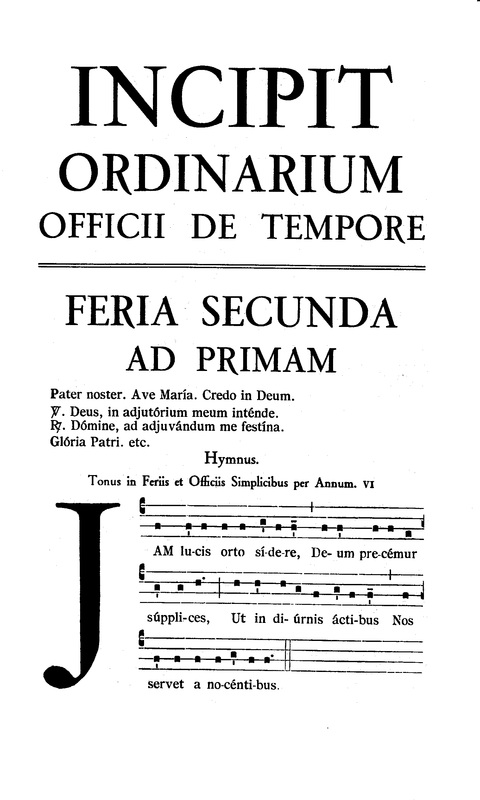
They are code for 'say an Our Father, Hail Mary and the Creed'.
These prayers are no longer compulsory to say before the Office.
All the same, you might want to consider saying the Aperi Domine, the standard prayer that was previously said before the start of the Office each day:
APERI, Dómine, os meum ad benedicéndum nomen sanctum tuum: munda
quoque cor meum ab ómnibus vanis, pervérsis et aliénis cogitatiónibus;
intelléctum illúmina, afféctum inflámma, ut digne, atténte ac devóte hoc
Offícium recitáre váleam, et exaudíri mérear ante conspéctum divínæ
Majestátis tuæ. Per Christum Dóminum nostrum. Amen.
|
Open Thou, O Lord, my mouth to bless Thy holy name; cleanse my heart
from vain, evil and wandering thoughts; enlighten my understanding, inflame
my will, that so I may worthily, attentively and devoutly recite this Office
and deserve to be heard in the presence of Thy Divine Majesty. Through Christ
our Lord. Amen. O Lord, in union with that divine intention wherewith Thou
whilst here on earth didst Thyself praise God, I offer these Hours to Thee.
|
Dómine, in unióne illíus divínæ intentiónis, qua ipse in terris
laudes Deo persolvísti, has tibi Horas (vel hanc tibi Horam) persólvo.
|
O Lord, in union with that divine intention wherewith Thou Thyself,
while on earth, didst offer praises unto God, I offer these hours (or this
hour) unto Thee.
|
Compline
And to get a sense of what the Office is really about, I recommend watching the video of Compline below, from the monastery of Farnborough, that really conveys, I think, the sense of reverence with which we should approach the liturgy.
If you want to follow it in your book, you can find the texts in the Diurnal on page 256, or in the Antiphonale on 167.
Don't worry if you get lost though, we will go through the hour step by step in future posts.
SUMMARY
Before
you start saying the Office each day, make sure you are ready.
Saying
the ‘Aperi Domini’ is a good way of preparing to say the Office.

Thanks! I've been saying the Aperi Domine and it's post-office equivelent before and after ever hour. Is that wrong? Should this only be said before Matins (or whatever your first hour is) and then after Complines (or whatever your last hour is)?
ReplyDeleteSeconding the question above as I’ve also been doing the same. Thanks for all the great resources, God bless.
ReplyDeleteAs it is purely devotional you can use these prayers however you like. If you want to say them before and after each hour that's fine. The last sentence of Aperi Domine has a sentence that talks about the hour or hours, so simply use the singular form, this hour (ie hanc tibi Horam) instead of has 'tibi Horas' persólvo.
ReplyDelete